Control and Neutralization
Chapter 42
Isolation and Limitation of Established Exposure
Barrier target
Isolation means limiting a certain path of exposure between the source and what is being protected. It is not obliged to eliminate the source and does not assume that all properties of the phenomenon are known. To solve a problem, a well-founded model of a specific channel is sufficient, but a general desire to “close the anomaly” is not enough. A physical barrier affects some transferences and may be indifferent to others. Therefore, the insulation record begins with a phrase that can be verified: which path is limited, under what conditions, what observation confirms the result and what remains outside the declared function.
Below is the author's protocol for a case with established exposure. Its engineering logic correlates with the distinction between requirements, performance verification, and system fitness for purpose in NASA manual [5]. Transference to unknown phenomena is a book suggestion and not an industry standard. If the route of exposure has not yet been determined, restriction of access and surveillance within the limits of confirmed capabilities is acceptable; There is no reason to declare an arbitrary shell an insulator of an unknown interaction.
Entry conditions and responsibilities
The study director formulates the function to be protected: prevent contact, reduce certain transfer, or separate the process from the infrastructure. The subject matter expert confirms the applicability of the selected barrier and reviews collateral changes. The metrologist determines how to distinguish successful limitation from loss of sensitivity. The safety coordinator reviews failure actions and has stopping authority. The operator executes only the agreed sequence, and the data custodian records the configuration and transitions. Combination of roles is allowed only where it does not eliminate independent verification of a critical decision.
Before installing the barrier, a map of the source, channels and protected objects is collected. It includes access by people, air, water, mechanical connections, electrical lines and materials carried when relevant. Each path is assigned a status: established, expected, or not evaluated. The conditions without which the barrier does not perform its function are described separately: power supply, tightness, position, condition of fastenings, maintenance. The plan should explain what will happen if each necessary condition is lost and who will notice the loss.
The initial registration is made from a valid position and includes the background, the impact indicator and the state of the meter itself. If you want to limit distribution, you need data on both sides of the functional boundary, obtained without compromising security. You cannot determine the result only within an isolated area where the position of the sensor has changed. The access boundary and the measurement network boundary may differ. They are placed along assessed paths and conditions rather than along a single radius that is the same for sound, material transfer and electrical hazards.
Execute and test the barrier
The preferred design allows for testing of required functions on a known safe representative of the process prior to exposure to the case under study. If such verification is impossible, the restriction is honestly preserved. During installation, the sequence of actions and changes in controlled quantities are recorded. After installation, the physical condition of the barrier, the availability of emergency action and the suitability of the measuring channels are separately checked. Confirmation of one indicator does not replace the entire set: the correct position of the structure does not yet prove sufficient limitation of impact.
Function to be tested | Certificate | Remaining question |
Access restriction | Control of passages and issuance of permits | Other routes of exposure |
Established transfer limit | Comparable measurements along the border | Unverified conditions and channels |
Maintaining the protective function | Power supply and actuator state | Common-cause failure and resource |
Observability of the result | Verified independent channel | Blind Intervals and Ranges |
Two barriers do not necessarily provide two independent protections. Common power supply, support, control or environment can disrupt them simultaneously; this possibility is consistent with the common-cause failure engineering problem [7]. For each reserve, therefore, indicate which specific failure it covers. If a reserve replicates all the dependencies of the primary component, its contribution is limited. Independent monitoring is especially important where barrier failure could simultaneously destroy the signal by which the barrier is being assessed.
If containment involves handling of contaminated materials, separate containment from disposal. WHO processing recommendations require verification of the process under the applicable conditions [39]. A closed container can limit one path of transfer while preserving the hazardous properties of the contents; the treated surface may appear clean without a proven result. The record records what properties are confirmed, what service is required and who accepts the material after transfer. The insulation does not end when the lid or door is closed.
Stopping and residual risk
The reasons for stopping the operation are set before the start: unforeseen increase in impact, change in distribution, violation of the barrier, loss of necessary observation, failure of the protective function, or the procedure going beyond the estimated scenario. The operator makes the intended transition, rather than intuitively selecting stronger protection on the spot. If dismantling makes things worse, stopping means maintaining the barrier and stopping research changes. The decision on further actions is made based on the actual situation with the participation of a specialized specialist.
The working statement lists the limited channel, confirmed conditions, protective system resource and residual uncertainties. It can allow a single action, such as continuing a remote check-in, while still prohibiting other contact. An unvalued path remains unvalued even after a successful check of the neighboring one. Long-term isolation requires an owner of the function, a review schedule for its resource, and rules for transferring responsibility. The absence of someone in charge turns a barrier that works today into an unsecured promise for the future.
Training scenario: The acoustic shield reduces the recorded air signal, but the sensor on the structure retains the vibration. The result of isolation is positive for one path and negative for the other. It would be a mistake to declare the whole case closed or to declare the screen useless. A correct record stores the limit achieved, indicates the remaining mechanical channel, and determines the next valid question. It is precisely this objectivity that allows the scientific model to be applied to management without promising universal protection from the unknown.
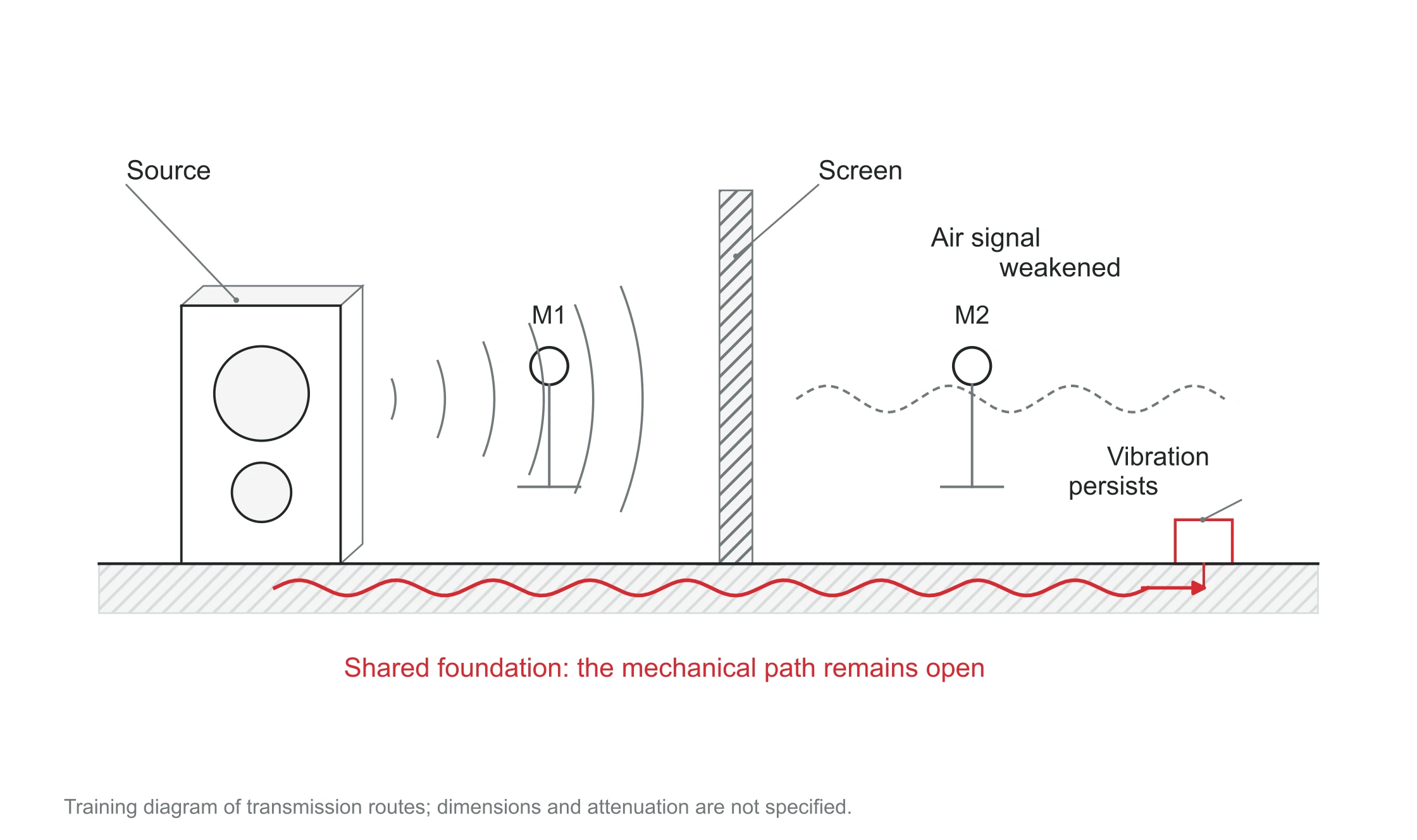
Figure 29. The screen blocks one path, the design preserves the other. A tutorial example of isolation along two transmission paths. The shield reduces the airborne acoustic signal between M1 and M2, but the overall design maintains the mechanical path to the vibration sensor. The result relates to a single channel and does not mean neutralization of the entire case.
Chapter 43
Stabilization and reversible interventions
State instead of impression
Stabilization means keeping significant process variables within a predetermined area while maintaining the necessary protective functions. It is different from the disappearance of a noticeable effect. The system may appear quiet while continuing to accumulate energy, material, or mechanical stress; A safe steady state with a preserved observable signal is also possible. Therefore, the goal is written through measurable parameters, permissible changes and conditions of applicability. The name “anomaly stabilizer” without this information indicates an idea, and not a ready-made control tool.
The proposed author's protocol is applied when at least one controlled connection is established between an action and a state. For an unknown interaction, such a connection may not exist. Then the regime is limited to observation, preservation of already proven protective functions and transfer of the issue to specialized specialists. Engineering judgment considers scenarios, consequences and uncertainty, not just the expected benefit [5]. The absence of a confirmed method of stabilization is an acceptable scientific and organizational conclusion.
Controlled transition record
The manager states the purpose of the intervention and explains what new knowledge or reduction in impact it is expected to produce. The profile specialist sets the permissible control parameter and installation restrictions. The metrologist determines the sensitivity, delay and criteria for channel unreliability. The Safety Coordinator approves termination signs, required protective functions, and control transfer procedures. The operator receives a specific sequence with a ban on independent expansion of the mode. The data custodian records the state before the command, the command itself, the actual execution, and the result.
The record includes the initial configuration, target state, work area and protective limits. The workspace shows where the conclusions of the validated model apply; a protective limit defines a stop or special response condition. They don't have to match. A parameter that has left the area of confident interpretation may require termination of the experiment even before reaching a dangerous state. Limits are selected based on the specific installation, applicable requirements, and measurement uncertainty, rather than on type numbers assigned to all cases of the same class.
Reversibility is considered at two levels. A command can sometimes be canceled, but this does not guarantee restoration of the substance, structure or condition of the body. Before the experiment, describe the observed sign of return and the conditions under which return is prohibited or no longer possible. The cessation plan should not require reintroduction of the hazardous exposure. If the initial configuration was insecure, rolling back to it is not a good outcome just because it is familiar to the operator.
Sequence of permitted experiences
1. Confirm the initial state, the serviceability of critical channels and the readiness of the predetermined safe transition.
2. Make one agreed upon change; log the actual action of the executive system, not just the command sent.
3. Observe pre-selected main and accompanying variables, taking into account delays, without replacing the expectation of the result with additional commands.
4. Compare the result with the prognosis and termination criteria; continue, hold state or stop only within an approved fork.
5. Upon completion, review the protective functions and document any remaining changes, including those not included in the original intent.
The amount of permitted change cannot be selected based on the word “small”. A small command can cross an important regime boundary, and a large change in one safe parameter is sometimes immaterial to the risk. The basis is set by a proven model and engineering tolerance. Before applying to an unknown object, valid system functions are tested on a permitted representative process. Such preparation confirms certain properties of the installation, but does not guarantee the reaction of the unknown material. The distinction between equipment qualification and subject knowledge is retained in conclusion.
The impact of the registration itself should be considered. The measuring platform can change the process under study: experience with an unmanned air monitoring system has shown the dependence of measurements on the flow disturbance by [45] propellers. In a stabilization experiment, this means the need to record the position and mode of the observing device along with the control command. If a change in reading is caused by a signal selection adjustment, the entire result cannot be attributed to source control. The test must distinguish between the process state and the measurement communication state.
Latency and Feedback
If the system responds with a delay, a series of rapid adjustments makes causal inference difficult and can accumulate undesirable effects. The preliminary plan therefore specifies the moment of the next decision on the dynamics of a particular system. An uncertain delayed response is not corrected by increasing the intensity of the stimulus. Automatic control is only permissible for a qualified function with confirmed limitations; the exploratory algorithm for detecting an unknown event should not independently select a new physical intervention.
A stop is declared when there is a divergence from the allowed transition pattern, unexpected propagation, deterioration of the protective function, loss of a critical channel, or failure to complete the intended sequence. Safe mode may require maintaining cooling, ventilation, hold, or power control. Therefore, “stop the experiment” and “turn everything off” are different commands. Their distinction must be technically ensured before work begins. After termination, the condition of the object and the serviceability of the control system are assessed separately: control failure can create the appearance of stabilization.
Verified result status
Training scenario: changing the normal mode of the device reduces the fluctuations of the observed parameter, but increases the temperature of the case. It’s too early to declare success through a single target channel. If the temperature trajectory goes beyond the allowed region, the experiment is stopped in the prescribed manner and the compromise between the functions is recorded. If all agreed indicators are maintained, the result is called stabilization under tested conditions. This does not prove elimination of the source and does not permit the removal of surveillance necessary to maintain the condition.
The transfer of a stabilized object requires a description of the resources, the duration of the confirmed mode, exit signs and the responsible operator. If maintenance depends on the continued operation of the system, the residual risk includes system failure and maintenance. The stability of a past record does not guarantee future stability in a different environment. The next stage is therefore devoted to confirming the result and the boundaries of the solution. Only after such a check can we discuss changing the access mode or completing certain work.
Calculated training transition in a thermal system
Let's consider a safe design example of a known thermal installation: a small qualified heater, thermal mass, temperature sensor and a constant heat removal path. All numbers below are training parameters of the model, and not standards for handling unknown material. The medium temperature is 20 °C, the effective heat capacity C is 200 J/K, the heat transfer coefficient K is 2 W/K. The controlled electrical power P does not exceed 4 W; There is no own unaccounted energy release in this model.
At constant power, the stationary temperature is Tmedium + P/K, and the relaxation time is τ = C/K. Here τ is 100 s. After switching on 4 W from the equilibrium state, the temperature tends to 22 °C according to the calculated exponential. It is this dynamics, with the uncertainties of the parameters and the sensor, that sets the expected transition.
Time after switching on, s | Design temperature, °C | Model condition |
0 | 20.000 | Initial equilibrium |
100 | 21.264 | The transition continues |
200 | 21.729 | Approaching the limit |
300 | 21.900 | Remaining to limit about 0.10 K |
500 | 21.987 | Almost stationary state |
In the plan adopted for this training stand, the work area ends at 23 °C. This is a selected design limit and does not carry over to other installations. Before testing, a metrologist checks the suitability of the sensor, a specialized specialist checks the heat transfer model, and an operator checks the actual power and heat removal conservation. The team is judged on the measured power and temperature trajectory, not just the position of the regulator. Systematic divergence from the model requires stopping the research change before reaching the limit.
Let at moment 300 c the heater be turned off and K is kept unchanged. After the next 100 s the calculation gives about 20.699 °C. This is an observable consequence of the termination of an identified source. If you simultaneously turn off the necessary airflow or another heat sink element, K will change and the previous prediction will no longer apply. Even the absence of a temperature increase in the first seconds will not confirm the correctness of the transition: a large heat capacity delays the visible response.
Another calculation shows the role of insulation. If at the previous 4 W K decreases to 0.2 W/K, the new stationary level will be 40 °C, and the relaxation time will be 1000 s. An initially slow change does not mean stabilization in the allowed region. In this model, the barrier, which reduces heat transfer, increases heating. The installation must have monitoring of the protective function to detect its loss, and termination of the experiment must maintain the intended energy release path.
To confirm control, we first separately evaluate C, K, and the command-power relationship at a conventional permitted facility. A new power sequence is then used that was not used when determining the parameters. Not only the established temperature is checked, but also the transition. If the residuals turn out to be related to the ambient temperature, sensor position, or fan activation, these dependencies are included in the model until the next qualification. It is impossible to compensate for every discrepancy with an arbitrary command and then present such a record as a check of the original law.
The result of this experiment is limited to the known control channel. It shows how the source, transport path, system inertia and stopping criterion are combined in one calculation. An unknown interaction would require its own established relationship between the control parameter and the physical state. While it is not there, it is permissible to control proven accompanying processes, for example, ordinary heating of equipment, without calling it neutralization of the supposed new field.
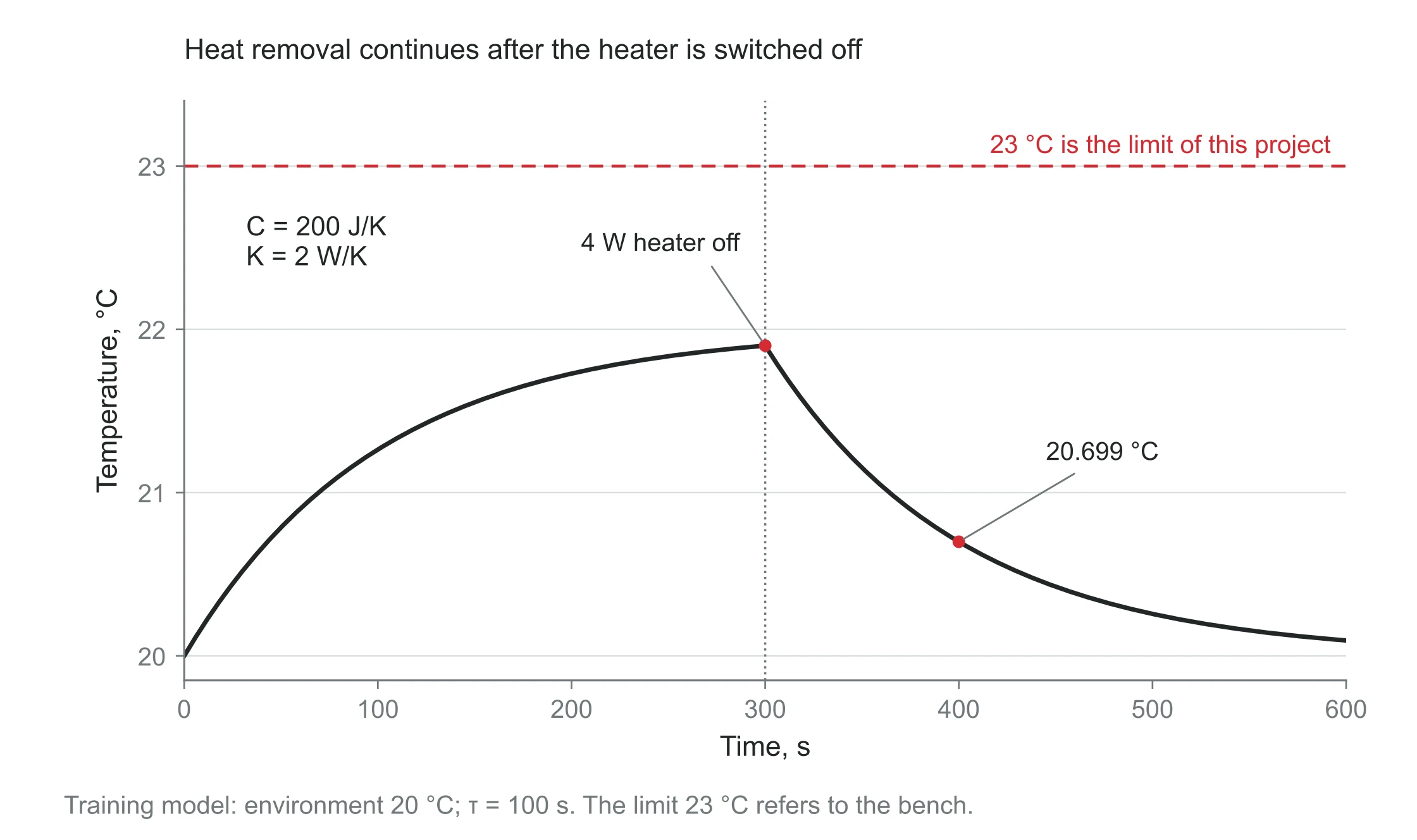
Figure 30. Thermal transition with preserved heat removal. Calculated transition of the training stand at C=200 J/K, K=2 W/K and ambient temperature 20 °C. Power 4 W is turned off at moment 300 s while maintaining heat dissipation. The dotted limit 23 °C only applies to this design example.
Chapter 44
Confirmation of neutralization
Statement to be proven
Neutralization is a conclusion about a specific threat and a specific action, and not an impression from a subsided event. The disappearance of the visible effect is compatible with source elimination, transmission limitation, mode change, departure from the field of observation, and detector failure. Therefore, the confirmation procedure begins before the intervention: it is necessary to formulate what kind of statement is planned to be obtained and what data will distinguish it from alternatives. If success criteria are invented after viewing the result, the completed work remains exploratory and needs new confirmation.
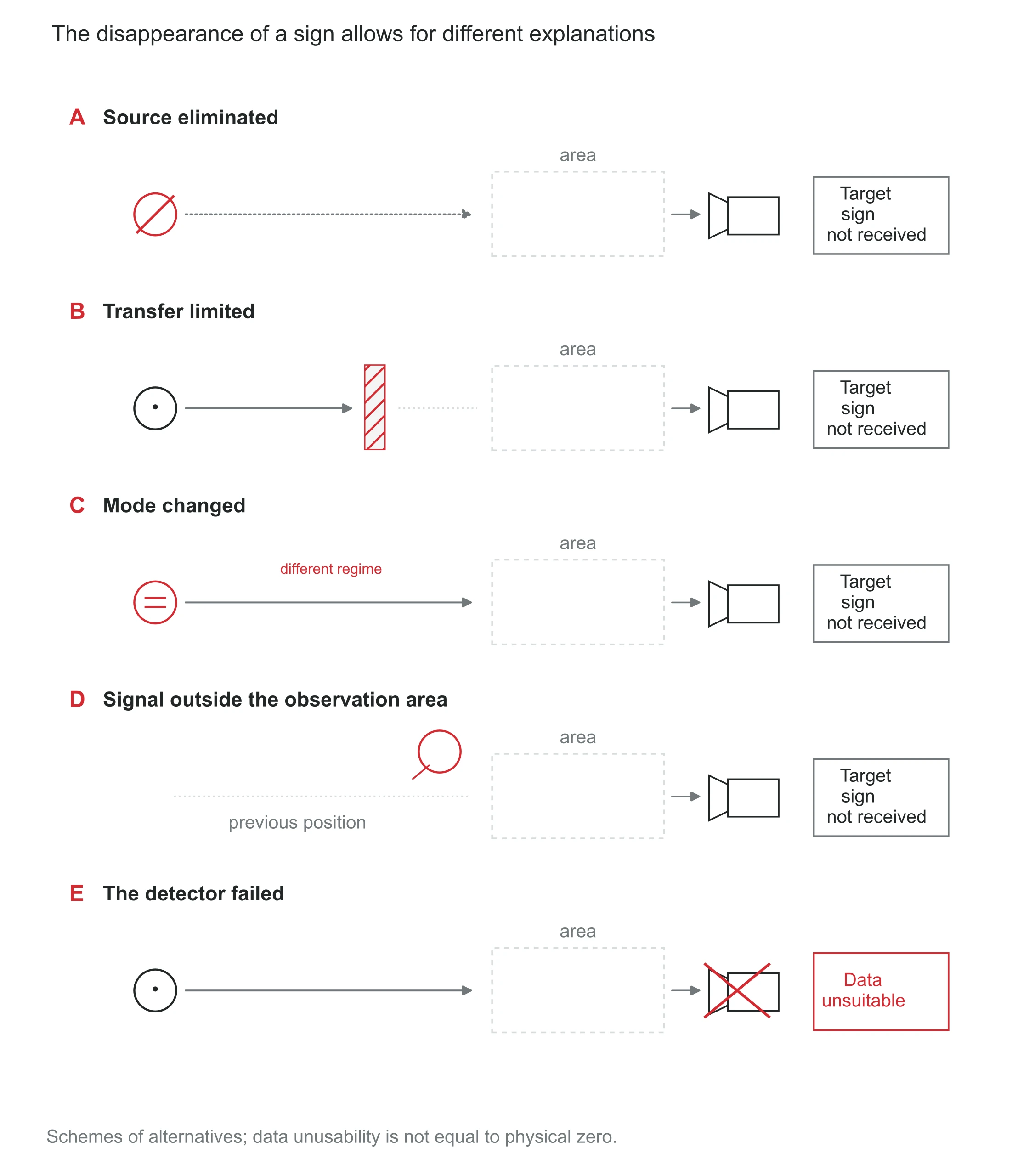
Figure 31. Five explanations for the disappearance of a target feature. Five logical alternatives to the external disappearance of a target feature. Source elimination, transmission limitation, mode change, leaving the observation area and detector failure are highlighted. The latter case means the data is unusable, not the measured physical zero; none of the alternatives is chosen by the circuit itself.
The author's protocol distinguishes between mechanism, measured impact, and decision on further action. A complete theory of the source may be missing, although a certain path is already reliably limited. The opposite situation is also possible: the mechanism is clear, but the data is not enough to remove the restrictions. In radiation regulation, the end of an emergency regime involves a formal decision and transfer of responsibility; after it, monitoring and restrictions [57] may remain. Applying this organizational logic to other classes is a suggested adaptation, not a statement of a universal standard.
Result dossier
The manager sets the statement to be verified and its scope. The subject matter expert determines the indicators of the actual threat and the applicable basis for the decision. The metrologist confirms the suitability of the measurement procedure after the intervention. The Safety Coordinator maintains the restrictions until the agreed conclusion and has the right to terminate the review. The data custodian collects the initial configuration, activity log, results, and deviations from plan. An independent reviewer evaluates whether the claimed status follows from these materials; it should not be limited to signing the already prepared word “success”.
The dossier predetermines the comparison with the initial state, the control background, the observation area and the time horizon. The horizon is selected based on the mechanism, possible delays, cycles and protection resource. There is no universal period of silence. If the mechanism is unknown, observation provides limited evidence about the period tested; Ignorance does not turn any convenient period into a sufficient one. The criteria also indicate conditions under which the data is unreliable and output should be deferred regardless of low readings.
Sensitivity check after intervention
The first step of the analysis is to confirm that the measurement system retains the ability to detect the desired effect. Verify configuration, power, range, optical or other signal path, and available standard evidence of performance. For some GM instruments, saturation can give a false zero, so a drop in readings cannot be automatically taken as the disappearance of the [40] field. Similar reasoning is applied to other channels through their specific failure mechanisms, without asserting that all sensors behave the same way.
The second step is to check comparability. If, after installing the barrier, the device was in a different place or changed sensitivity, a simple difference in numbers does not determine the effect of the intervention. We need a measurement model of a new configuration and data that allows us to reconstruct the comparison. The control channel helps to evaluate the overall background change. Independence of confirmation requires other significant vulnerabilities, and not just a second copy of the previous program. All excluded intervals are stored with the reason for the exclusion; omissions convenient for success are not recognized as neutral.
The third step is to evaluate what kind of result the observational series allows. False alarm testing and detection testing are different characteristics of [3]. The absence of recorded events limits their manifestation only within the limits of sensitivity and scope of observations. A rare, periodic or condition-dependent process may not appear in a short series. Therefore, the outcome includes uncertainty and audit coverage. When data are insufficient, the correct status is lack of confirmation, even if practical measures temporarily keep exposure under control.
Statuses that retain meaning
Status | What's Confirmed | What to save |
Source eliminated | The installed source is missing or has stopped functioning | Checking the remaining paths and consequences |
Channel limited | Transfer of specified impact is reduced to the established criterion under tested conditions | Barrier, its control and maintenance |
Condition stabilized | Parameters are held in the specified area | Required management and resources |
Object isolated | Contacts and transfers are limited by record | Accounting, retention and responsibility |
Effect not observed | The effect was not registered in the specified period | Limits of withdrawal and further observation |
Confirmation is not enough | The result does not yet distinguish between significant versions | Previously justified restrictions |
These statuses can refer to different channels of the same case at the same time. For example, the source of noise is eliminated and the material remains isolated until analysis. A general “safe” label would hide such a difference. To process potentially hazardous material, proof of the process and its effectiveness must relate to specified conditions; the appearance does not replace the validated result [39]. A statement to eliminate one mechanism does not apply to threats that the procedure did not check.
Forking the solution and stopping the check
If the criteria are met, an independent review confirms the restricted status and specific permitted actions. If conflicting data are obtained, first check the measurements and conditions, then clarify the hypotheses; restrictions are not automatically lifted. If the indicator worsens, the test is stopped according to the prescribed plan. If it is impossible to perform the check safely, the available mode is maintained and the absence of evidence is recorded. It is prohibited to create a dangerous situation merely to demonstrate that the protection will work: functional tests must be separately justified and approved.
The conclusion is signed by the persons responsible for the scientific conclusion, safety and further condition of the object within the limits of their roles. It lists residual impacts, dependencies on live systems, untested scenarios and reasons for revision. A new observation, environmental change, or security failure may invalidate the previous resolution without invalidating the old measurements. The result always refers to the described configuration. The transfer of responsibility must include exactly this configuration and the conditions for its preservation.
Training scenario: After intervention, the light disappeared, but the camera lost sensitivity due to the changed optical path. The independent channel continues to record the impact. The first version of the neutralization report is rejected; only a change in observation conditions was confirmed. In the other outcome, both valid channels show a decrease, and the control and subsequent series confirm it under matched conditions. Then let's assume a specific positive status. Scientific rigor is demonstrated by the ability to discern these outcomes before the desired conclusion replaces the test.
Chapter 45
Completion of work and follow-up
Work is completed for a certain reason: the question has received a sufficient answer, further procedure does not bring the necessary information, the available mode has become unacceptable, or the task has been transferred to another competent party. No basis is identical to the statement that all possible dangers have disappeared. Terminating the study, ending the emergency regime, lifting a specific restriction, and allowing a specific use of the site are different solutions. Mixing them up is especially dangerous after a significant event, when the cessation of visible manifestation creates a desire to quickly declare the situation completely normal.
The IAEA requirements for the termination of a nuclear or radiological emergency provide for formal decision, criteria and transfer of responsibility; Monitoring tasks [57] can be saved after completion. For unknown phenomena, the author further proposes an adaptation of the organizational logic, rather than an extension of radiological norms to any anomaly. Real profile requirements retain their own scope. The book describes a way to stay accountable as you move between regimes without creating a fictitious, one-size-fits-all permit document.
Reasons for completion
The manager prepares a proposal that indicates the task completed, the results achieved and the remaining uncertainties. The metrologist describes the area of truly useful observations. Subject matter experts evaluate the impacts that apply to them, and the safety coordinator reviews the consequences of stopping current activities. The Custodian confirms the condition of materials and outstanding transfer obligations. The decision must specify the following mode: maintaining limited access, normal use under certain conditions, transfer to a specialized service, or cessation of research activity.
The foundation cannot be built solely on the absence of a signal. First, it is checked whether the system continued to observe the region of interest, remained usable, and whether the processing had changed. Then they evaluate which manifestations could remain beyond her sensitivity. If the disappearance of an effect is due to a change in conditions, those conditions become part of the output. Acceptable language refers to the tested use, period, and method of control. The promise of safety for any future change extends beyond the final study.
Completion may be partial. For example, a known technical source of interference has been eliminated, but a single rare event remains undetectable. This does not prevent the closure of a specific repair task if the basis for the operational decision is sufficient. At the same time, an indefinable case should not be declared explained for the convenience of a general report. The document lists the issues individually and shows what restrictions remain. Such a recording allows the study to be continued later without restoring artificially lost differences.
Transfer of responsibility
The receiving party receives a description of the status, current restrictions, retry criteria, and available communication channels. The transfer is deemed to have taken place upon confirmation of understanding and not upon submission of the file. Indicate who controls the abandoned equipment, who responds to the message and who has the right to change the mode of use. If there is no owner of these functions, the project should not declare long-term monitoring organized. A maintenance-free chamber in itself is not a follow-up system.
Surveillance assets left behind require their own plan. It defines the feature being tested, the quality of the data, the frequency of performance checks, and how to detect loss of observability. Frequency and duration are selected based on the specific dynamics and task, rather than a universal number of days. If information about the dynamics is insufficient, this limitation is retained and a conservative mode is used, which is actually possible to maintain. The promise of continuous monitoring in the absence of personnel or resources creates a false basis for a decision.
The reopening criterion must be observable. This could be the confirmed return of a certain signal, a change in an essential condition of use, or the failure of a mandatory security channel. The vague phrase "if it gets weird again" does not replace such a criterion, although new messages from people are also accepted and recorded. For them, a path of initial assessment is provided in advance. Rediscovery does not automatically confirm the previous hypothesis: the new episode receives its own test of origin and comparability.
Training scenario
Fictional training scenario: Local temperature variations were observed in a warehouse. The inspection revealed a malfunction of a known technical circuit, which was eliminated and tested in the prescribed modes. The research team completes this task while maintaining operating conditions and re-deviation control. Later, the room is rebuilt, changing the location of equipment and air flows. The previous solution is not automatically transferred to the new configuration. Re-evaluation is required due to changing grounds, even if no one has yet reported unusual sensations.
This example shows why the completion act must be related to the configuration and not just a calendar date. Equally important are dependencies on external systems, availability of service, and allowable changes. When the condition no longer holds, the original conclusion does not disappear retroactively: it simply no longer describes the new situation. A well-written document allows you to notice this transition before a new incident occurs and choose a limited review rather than repeating the entire study without distinguishing tasks.
The message to participants and stakeholders must separate what is established from what is assumed. To a person reporting an unusual experience, it may be explained that a specific external cause has not been verified or that a specific instrumental effect has received a technical explanation. This does not give grounds to declare his story a deliberate deception. At the same time, one cannot promise confirmation of a personal interpretation for the sake of reassurance. Transparent communication preserves the meaning of the outcome and reduces the risk that completion will be understood as a cover-up or as an admission of all original assumptions.
Materials from the closed stage are saved with a description of access, terms and conditions of re-analysis. Samples are transferred or removed from work according to applicable specialized procedures; an unknown state does not become normal just because the project is completed. Personal data is not automatically published along with scientific findings. If an error is subsequently discovered, there is a way to correct the report and notify those whose decisions depended on it. Completion of a stage should not destroy the possibility of responsible revision.
The final result of this stage is a stable correspondence between the known state, the permitted activities and the assigned responsibilities. A scientific question may remain open, but a practical problem may have a fairly limited solution. The opposite situation is also possible: the mechanism is clear, but an acceptable control method has not yet been confirmed. Separate recording of these states makes it possible to complete the work honestly and in an organized manner, without passing off either ignorance as a catastrophe or the cessation of observations as a proven disappearance of the process.
Chapter 46
Expert assessment of conflicting results
A contradiction in results does not always mean that one side observed the truth and the other side was mistaken. The studies may have measured different quantities, used different conditions, or answered different questions. The examination begins with the reconstruction of the exact content of the statements. “Signal detected,” “signal unusual for the model,” and “new mechanism discovered” represent the three stages of inference. Agreement on the first does not require agreement on the third. As long as the steps are not separated, the dispute easily turns into an exchange of general positions instead of checking the data.
The first working document of the examination contains a list of statements and their supports. For each, the starting materials, transformations, uncertainty model and conditions of applicability are indicated. Then the common part is highlighted: what events, numbers or restrictions are recognized by all participants. This part is not determined by the minimum convenient compromise. It must be supported by available grounds. Disagreements are grouped by place of origin: registration, processing, statistical evaluation, mechanism or practical solution.
Competence and independence
The proposed author's protocol appoints the head of the examination, the custodian of the general set of materials and specialists on controversial links. The researcher who created the instrument is useful in explaining its operation, but is not a substitute for an independent reviewer. An external expert, on the other hand, should not make confident conclusions about a configuration that is inaccessible to him. Participants disclose significant professional and financial connections. This allows you to evaluate dependencies without turning membership in an organization or scientific school into automatic proof of rightness or error.
The number of signatures does not replace the quality of the argument. Ten conclusions based on one transformed graph may have a common vulnerability. One independent measurement can change the score if it actually tests the link in question. However, the unusual version does not gain advantage only because of its minority of supporters. All explanations require fit to the data and testable implications. A version that is incompatible with the stated conditions should not be maintained on an equal basis solely for the sake of the external balance of the report.
It is useful to pose a question to each party: What available observation would change its assessment? The answer must be specific enough that a test can be built from it. If an infinite number of exceptions are offered, the explanation loses practical discernibility. It can be left as a program for further theoretical development, but cannot be used as a ready-made mechanism for selecting interventions. The examination has the right to admit that at this stage some formulations do not belong to the same comparison system being verified.
How the discriminative test is chosen
Priority is given to the review that reduces significant disagreement within acceptable risk and available resources. Sometimes this is a new experiment, sometimes a re-analysis of the original data with restored meta-information. There is no point in repeating costly impact if the dispute arose over units or time scale. But endlessly reviewing the old file does not help when both models describe it equally well. Then we need a new channel or a different range of conditions in which the predictions diverge.
Discord node | Testable Question | Possible result |
Original entry | Do the saved versions match? | Localizing data differences |
Processing | Which step changes the output? | Comparison of analysis models |
Mechanism | Where do the forecasts differ? | New Limited Experience |
Practical solution | What consequences remain? | Mode with explicit restrictions |
The history of concerted tests of putative foresight shows the need to consider the entire sequence of studies rather than selecting a single convenient result [14, 15]. A general principle is important for examination: the initial hypothesis, the pattern discovered later and its subsequent tests have different statuses. If the effect changes direction, we need to find out whether the model predicted it in advance. Renaming the opposite result to confirmation without a new constraint does not resolve the contradiction or create a sustainable mechanism.
Experts will agree in advance on the criteria for correct execution of the next check and the method of access to materials. They may differ on the theoretical assessment, but should understand what is considered a valid record and how violations will be accounted for. If agreement cannot be achieved, the conclusion fixes specific incompatible requirements. The procedure does not become independent due to the name of the reviewer: the origin of the data, freedom of analysis and the ability to report an inconvenient result without its subsequent removal from the final text are important.
Training scenario
Fictional training scenario: the first group reports a brief frequency shift, the second in the same area does not detect it. A public dispute initially appears as a direct refutation. Upon comparison, it turns out that the second system only saved average values over longer intervals. The null result of this system does not fully check the short-term prediction of the first. At the same time, the first device shared a common reference channel with local equipment. Both sides have limitations that require a new agreed series.
The discriminating experiment in this scenario preserves the appropriate temporal resolution and introduces an independent support. If the original shift disappears when the overall dependence is eliminated, the technical explanation is strengthened. If persists, the issue is transferred to other influence paths and mechanisms. Before the series is held, the correct conclusion does not announce the winner. It establishes that previous results were not fully comparable and the available data do not allow a choice between the remaining explanations.
A practical solution may be required before a scientific resolution of the dispute. The safety coordinator then evaluates the consequences of acceptable scenarios without passing off the protective measure as proof of the most dangerous theory. For example, a restriction on a certain operation may be justified by lack of observability, even if a new physical mechanism has not been identified. The justification must explicitly state this reason. Otherwise, temporary caution turns into public evidence of a phenomenon that the examination has not actually confirmed.
The final conclusion contains general established provisions, unresolved contradictions, rejected arguments and reasons for rejection. A substantive dissenting opinion is retained with specific reasons, rather than as a vague note of dissent. Separately indicate what new information may change the decision. If the data is insufficient, this is a full-fledged result of the examination. It allows resources to be directed to the right review and prevents the research program from being replaced by disputes over the credibility of individuals.
A good examination does not have to end with a single theory. Its task is to make the contradiction more precise, reduce the number of compatible errors and determine the next justified step. This is where classification, measurement, organization and instrumentation come together. Where existing data do not distinguish between models, a specific technical requirement for a new observation arises. Thus, scientific disagreement becomes a research problem, maintaining the distinction between what has already been established and what remains to be verified.
Part X