Organization of the study
Chapter 37
Research team and distribution of responsibilities
A group becomes a research system at the moment when its participants understand not only their own tasks, but also the boundaries of other people's solutions. Having a strong physicist, doctor, and engineer does not eliminate organizational gaps. One may believe that the other has confirmed security, while the other may believe that the permission given applied only to passive recording. Therefore, the general goal is translated into a description of the current regime, acceptable actions and conditions for its termination. This information should be available before work begins, not restored after an incident.
Engineering manuals consider requirements, verification and validation as related but distinct tasks [5]. In the organization proposed here, they correspond to three questions: what the group intends to establish, whether the installation follows the intended procedure, and whether the result allows the desired conclusion to be drawn. Responsibility for these issues cannot be dissolved in collective certainty. The head of the study brings them together into a single decision, preserving written reasons and comments from specialists. His authority to coordinate the work does not mean the right to cancel a measurement fact or hide an objection.
Functions and right to stop
The safety coordinator reviews deterioration scenarios and has the authority to stop, regardless of the scientific merits of the result. The metrologist is responsible for ensuring that the measurement task is within the capabilities of the equipment and that there are significant data limitations. The operator carries out the approved sequence and reports deviations. The custodian of the data or samples ensures the origin, preservation and transmission of the materials. A subject matter expert evaluates issues that require special competence. In a small group, functions may be combined, but the combination should not eliminate the independent verification of an action on which safety depends.
Solution | Responsible | Mandatory verification |
Start of mode | Head | Objective, Resources and Constraints |
Suitability of measurement | Metrologist | Range, uncertainty, control |
Stop | Safety Coordinator | Agreed safe passage |
Material Integrity | Custodian | Origin and access |
Preparation for the session ends with a brief analysis out loud. The operator reproduces the plan in its own words; the metrologist names signs of unusable data; the coordinator explains which event requires stopping and what exactly follows after the command. Simply repeating the word “stop” is not enough. For one installation, interruption of the power supply reduces the risk; for another, the protective function must be maintained. Therefore, a safe transition is designed in advance for the system. If it is unknown, the controlled intervention regimen is not considered prepared.
A common dependency can destroy a seemingly convincing redundancy: several elements can fail due to a single reason [7]. Organizational analogue occurs when all decisions rely on one person's message or one screen. The group needs to know what information has actually been independently verified and what information has only been repeated by different members. Two agreeing experts reading the same incomplete report do not form two independent lines of observation. Independence refers to the origin of the argument, not the number of positions.
Procedure for permission to work
The input conditions are a registered task, assigned roles, an available hazard profile, functioning required channels, and a prepared completion order. The supervisor checks the availability of resources for the entire session, including restoring a safe state. The coordinator confirms the boundaries of access. The metrologist records the initial configuration. The custodian verifies that the records are actually saved and can be found. After this, the operator receives permission for a specific sequence. Permission does not extend to any activities that appear to be useful during observation.
Any significant change goes through a short, separate decision cycle. Its initiator describes the purpose, expected benefit, new dependencies and method of cancellation. Experts indicate which previous grounds remain valid. The decision can be positive, negative, or delayed until data is received. A deferred decision is a normal operational outcome. It is especially important when the change simultaneously affects sensitivity and danger: an increase in the power of the device cannot be explained solely by the need to obtain a more beautiful recording.
When changing duty, not only the event log is transmitted, but also the actual state of the system. Indicates open issues, workarounds, broken channels, and operations that are prohibited pending review. The receiving operator confirms that they understand the restrictions. If the transfer does not take place, the automatic continuation of the complex mode creates uncertainty of responsibility. For long-term monitoring, the owner of notifications and the acceptable response time for a specific scenario are assigned in advance; There is no universal response time for all unknown processes.
Training scenario
Fictional training scenario: During a limited exploration, the control timeline disappears while the main feed continues to show interesting spikes. The leader offers to finish the remaining episode. The metrologist reports that events can no longer be reliably correlated, and the operator notices an unplanned restart of the control module. The coordinator switches the installation to a predetermined safe mode. The keeper stores the unfinished session without merging it with the previous data. After recovery, the group discusses a new run rather than retroactively declaring the previous one correct.
The result of the group’s work is expressed in a verifiable decision: the session was completed under the stated conditions, terminated for a certain reason, or found unsuitable for some of the conclusions. Stopping is not considered a personal defeat for the operator, and admitting a mistake is not considered a violation of loyalty. At the same time, a friendly atmosphere does not replace accounting discipline: a deviation must have a record, consequences and someone responsible for correction. It is the combination of clear authority and the ability to communicate an inconvenient fact that makes complex research sustainable.
Resource that must survive the session
The resource sheet is built according to the supported functions. For each, record the available balance, how it is determined, the cost of the next action, the need for completion, and the significant uncertainty of the estimate. Energy, free memory, serviceable support, competent personnel and the ability to accept material do not replace each other. Excess storage does not compensate for the absence of an operator, and a spare battery without proven compatibility is not yet an available reserve.
Before authorizing the next block, the manager checks each mandatory line of the G4 form. Sufficiency means that both the block and a valid transition after it are provided. If the completion resource depends on an unknown state, this limitation cannot be hidden by an arbitrary slack percentage. Requires clarification, change of task or rejection of a new block. The replenishment is assessed as an operation: is it possible without losing the necessary function, who performs it, and what characteristics of the replaced unit will have to be confirmed.
Fictional calculation of the training model: the available remaining energy of the recorder is 8 conventional units. The next series requires 4, the intended completion is 3, and the spread of consumption taken into account under the conditions of the exercise is also 2. The amount 9 exceeds the balance. A new series is not permitted; the transition, which requires 3 + 2 = 5 units, is still secured. These numbers describe only the objective of the exercise. Actual flow, uncertainty, and acceptable termination order are determined for a specific configuration, rather than borrowed from an example.
When handing over shifts, they show the state that currently exists, along with open commands and resource constraints. DOE-HDBK-1226-2019 recommends keeping the handover sheet current throughout the shift and checking for completeness before handing it over [63]. In form G4, the recipient repeats in his own words the nearest obligatory action, functions that must be preserved, and prohibitions. The role acceptance notification has its own entry. If there is no receiver, continuation of the long-term mode is not considered ensured just because the equipment is still working.
Five safe training exercises
The proposed program is performed on paper, in a software model, or on a pre-tested safe stand. It tests a joint decision, not a person's resistance to dangerous influences. The organizer sets in advance the configuration, roles, operating instructions, critical errors and how to terminate the exercise itself. Real services do not receive false calls: their role is played by a designated participant. People do not hide in inaccessible places, dangerous sources are not turned on, and technical failure is simulated by a card or a safe test function.
For each training, the introductory, factual sequence, team documents and the evaluator's conclusion in form G6 are saved. The assessment has three meanings: completed without a prompt, completed after a prompt, and not completed. A critical action performed only after prompting does not yet confirm readiness for independent work. The overall average score does not cover this error. A recommendation to regularly review and train emergency plans is available in OSHA for its subject area [64]; The scenarios below are the author's curriculum and not a certificate of professional qualifications.
Exercise 1. Silence on the faulty channel
• Scenario. A zero appears on the screen of the conventional optical stand. The channel card indicates: the last usable packet was before the mode transition; current status is invalid data. A second independent channel maintains response. The organizer transmits the manager’s request to open a previously restricted area.
• Expected actions. The operator separates the reading from the channel state, the metrologist prohibits the conclusion about attenuation based on this record, the coordinator maintains the restriction that depends on it. The custodian notes the interval of unsuitability. The command selects an available standard path test without creating the impact under study again.
• Assessment. A record of the reason for the unreliability, an indication of a suitable residual observation, and a refusal to unjustifiably remove the restriction are required. A critical mistake is to allow access based on zero or hide an inconvenient second channel.
• Readmission. After the analysis, the participant goes through a modified introductory course: a different interface and a blank instead of zero. The evaluator confirms the independent distinction between lack of effect and lack of usable data; the manager separately decides the actual admission to the relevant role.
Exercise 2. Lost common time scale
• Scenario. Two logs contain healthy local sequence numbers and associated messages, but one node's external clock is reset. The organizer proposes to arrange all events according to the displayed time and continue the experiment, which requires a known control delay.
• Expected actions. The keeper retains the original marks and marks a new clock session. The metrologist builds only confirmed connections of order; The command lists pairs with an unknown sequence. Dependent experience does not continue under the previous resolution. Suitable local data is retained for limited analysis.
• Assessment. The report must differentiate between order, duration and causal explanation. The critical mistake is to correct the clock backwards so that the gap disappears, or to declare unmatched events to be simultaneous.
• Readmission. The participant solves a new short chronology without a common time scale, explains each added connection and names the conditions for returning to control. The evaluator does not check the coincidence of the pretty graph, but the origin of all the conclusions.
Exercise 3. Participant unaccounted for
• Scenario. According to the script, one participant does not answer; the last confirmation refers to the previous version of the card. The person himself is in a safe training position known to the organizer. At the same time, an offer comes to film a rare episode. The designated liaison has the contact of the participant playing the external service.
• Expected actions. The team moves to the response map, checks people's records, communicates the facts and uncertainty of the situation, and stops interfering scientific activities. The current map and information about supporting functions are transmitted. The researcher does not organize an impromptu entrance along a route that has lost its foundation.
• Assessment. The actual delivery of the message, the separation of confirmed and inferred, the purpose of updates, and the absence of delay for the sake of registration are checked. Critical errors are a fictitious “all taken into account” mark or independent continuation of a route for which the conditions are no longer confirmed.
• Readmission. After correcting the form and distribution of roles, another case is played out: the connection has been restored, but the position of the participant has not yet been confirmed. Success requires proper status updates rather than automatically declaring the response complete.
Exercise 4. Repetition is more dangerous than uncertainty
• Scenario. A relative movement command of one step is sent to the platform model. Execution confirmation is lost; after restarting, the interface shows the previous frame. The interface prompts the operator to send the command again. There is no physical movement of the actual rig in this exercise.
• Expected actions. The operator blocks automatic continuation in the intended manner, saves the incomplete command, and queries the state of the new session. The command distinguishes between sending, receiving, executing, and observable results. The old frame is marked as archival; the uncertainty of execution is not eliminated by repetition.
• Assessment. The G3 form should contain the command identifier, the recipient's session, the unknown stage and the basis for the next action. A critical error is a repetition of a relative step without clarifying the state or automatic restoration of the previous queue.
• Readmission. The evaluator changes the input to an end state command and verifies that the participant still evaluates the actual conditions, authority, and side effects. Knowing the word "idempotency" is not a substitute for checking the applicability of a particular command.
Exercise 5. Change at resource boundary
• Scenario. The calculation of 8, 4, 3 and 2 conventional units from the resource example is used. At the same time, duty ends. In the model, a separate supporting function must be preserved when recording is completed; turning off the entire system violates the condition of the exercise. The receiving operator is initially unaware of the unacknowledged command.
• Expected actions. A new block is not launched. Perform a secured transition while preserving the specified function, transmitting the real remainder, open commands and the nearest mandatory action. The recipient confirms the restrictions; the transmitter does not remove himself from the role with one sent file.
• Assessment. The calculation of each required line, the absence of offset of different resources, the actual preservation of the function and the confirmed transfer are checked. Critical mistakes - spending the completion reserve for the sake of a series or disabling the necessary protection with a general command.
• Readmission. The team repeats the exercise with a different constraint resource and a replacement component. Admission is possible after independently selecting the scope of verification of the new configuration and agreed upon completion; Numerical answers from the previous exercise are not carried over.
Upon completion of the program, the manager receives a list of confirmed actions and remaining restrictions for each role. The protocol contains the detected error, correction of the instruction or interface, the person responsible and the result of the re-check. The affected task is repeated, and when the interaction of roles changes, the corresponding joint sequence is repeated. A successful exercise does not automatically allow actual experiments: it is one of the evidence for admission in a certain configuration.
Chapter 38
Reconnaissance and Remote Observation
Distance reduces the need for a person to be present near the object, but does not turn observation into an absolutely safe operation. The robot has mass, power, communication and its own influences on the environment. The camera changes its viewing direction, the platform creates vibrations, and the transmitter forms a field. Therefore, remote reconnaissance is designed as a measurement procedure with known limitations. Its first goal is to obtain information that allows you to select the next mode, and not to get as close as possible to the supposed center of the phenomenon.
Passive here is a mode without intentional stimulation of the process under study. This organizational definition does not assert the absence of any disturbance. In a study on pollution measurement from an unmanned platform, the sensor position and the influence of the propellers changed the result depending on the conditions [45]. Therefore, the platform's own influence must be part of the observation model. If the object disappears after the robot approaches, there may be a change in the process itself, as well as a loss of sensitivity or a change in the measurement environment. These options are first saved separately.
Designing the observation position
The input conditions are the established task, the estimated availability of the contact, the known communication path, and a valid way to end the session. The manager chooses which uncertain property needs to be clarified: position, periodicity, spectrum, propagation boundary or signal stability. The metrologist determines the viewing geometry and the necessary control channels. The Safety Coordinator reviews the placement of people and equipment against available information. An arbitrary circle of a fixed radius does not replace this work, since different impacts have different propagation paths and detection limits.
First, a reference observation is established from an already valid position. The normal background, available visibility and the platform's own noise are recorded. It is then checked whether the resulting record matches the expected state of the known object or secure control signal. This test does not prove functionality for any unknown impact, but it does identify some errors before the main series. Blind spots and conditions under which the signal can disappear from the field of view without the physical disappearance of the source are recorded separately.
Monitoring the environment helps estimate how much of the underlying signal may be due to interference; however, common sources of correlation are not eliminated by one shift of the time series [55]. In the author's protocol, therefore, it is not just an additional recording that is important, but a reasonable connection of the channel with a specific interference. A vibration sensor next to the camera answers the question about the movement of the installation. It does not automatically confirm the origin of a distant light object. The assignment of each reference channel is recorded prior to joint interpretation.
Protocol for Limited Reconnaissance
1. The operator confirms the initial state of the platform, the recording of mandatory channels and the possibility of an agreed termination.
2. The metrologist records the reference background and checks the suitability of the observation; the custodian associates the data with the configuration.
3. Position changes are performed only within approved limits, with movement and communication status recorded.
4. After each change, the main signal, control channels and the carrier's own influence are compared.
5. If mandatory control is lost, they move to the specified safe state; the return of equipment does not become the basis for an unprepared person to enter.
Communication is assessed as a separate resource. Loss of telemetry could indicate a link failure, orientation change, or physical malfunction; it is not in itself an indication of unusual exposure. The actions of the platform after a loss of connection must be agreed upon in advance with the operating conditions. Automatic return, standing still, and stopping movement have different consequences, so a universal choice is not possible. If no option is reasonably acceptable, the placement of such a platform in this mode has not yet been prepared.
Restoring the device is also a research operation. Contamination, heat, damage or unknown conditions require a profile assessment prior to routine maintenance. The procedure should not implicitly make the technician the first person to make contact with the object. The data custodian determines which records have already been obtained and which may be lost, but the scientific value of the medium does not change the boundaries of access. If safe retrieval is not possible, the correct outcome may be to abort the attempt and retain the available remote materials.
Training scenario
Fictional training scenario: a camera on a moving platform shows a light mark that appears to move away from the observer. The operator suggests pursuit. A comparison with a fixed camera shows that the movement of the mark is associated with a change in the viewing direction of the first system. The log shows a simultaneous change in exposure mode. Until these dependencies are verified, the statement about the departing object has no independent support. The reconnaissance returns to the reference position, and the next series separately checks the geometry and image settings.
Data from such a scenario does not require that any moving object be considered an artifact. They show the purpose of the stepwise procedure: action, observation and change of the measuring system must remain distinguishable. The final report contains a map of the actual area surveyed, sensitivity conditions, loss of control intervals, and unresolved issues. The wording “nothing found” is only acceptable within these boundaries. They are the ones who determine whether the next regime is justified and what new measurement will bring information that is not yet available.
Reconciling state after disconnection
Returning an image only means that some data stream has appeared. Before continuing, you need to establish what node and session it came from, whether it reflects the current state, and what happened with the commands at the time of the break. STPA specifically addresses control and feedback path errors, including data that is so late that the state model no longer fits the process [62]. The following author procedure reveals this particular risk to the research platform.
Preparation takes place before deployment. Each command receives an identifier, a destination, a control session number, a configuration version, valid conditions, and a specified response to an undefined result. The system must distinguish between new commands and re-delivery of old ones. The ability to maintain this difference after a restart is tested; if the execution log is lost, the absence of an entry is not taken as a lack of action. The change of operator is also noted to ensure that the two control stations do not continue to operate independently.
Command stage | Certificate | Remaining limitation |
Sent | A record of the sending node with an identifier. | Receipt by recipient has not been confirmed. |
Accepted | The addressee's response about receiving a specific command. | The execution and admissibility of the result have not yet been established. |
Executed according to the system message | The execution node logs the completion of the operation. | The message itself may not prove the physical result. |
The result is observed | Suitable evidence of change in controlled state. | Causality, safety and sufficiency of the result are assessed separately. |
1. The operator records the gap and pauses further research sequence in the prescribed manner. The necessary supporting functions operate according to a pre-tested script; loss of telemetry is not replaced by a general shutdown command.
2. The keeper stores the last usable data, list of open commands, local sequence numbers, session IDs, and failure messages. Unknown stages remain unknown.
3. After recovery, the operator confirms the recipient and the current session. Archived packets are accepted into history with their original labels; the moment of redelivery does not make them fresh.
4. The configuration, actuator mode, state of autonomous functions and queue are compared. The previous queue is not automatically renewed. Actions needed to maintain protection are evaluated separately from canceled research steps.
5. For each open command, the last confirmed stage is set. Journal discrepancies are not eliminated by choosing a more convenient version. Whenever possible, obtain new independent evidence of the actual condition without unintended impact.
6. The metrologist checks the suitability of the current channels and the delay limit required specifically for the next task. In the absence of comparable clocks, freshness cannot be proven by differences in screen time alone.
7. The coordinator revises the basis of the position and route according to the current map. The leader authorizes only the agreed upon new sequence; the operator confirms its boundaries and the absence of a competing control station.
Repeat command and restart
The "move one more step" command is non-idempotent: repeating it after the actual execution may cause a second move. If the confirmation is lost, the replay is not a check of the first execution. Defining an end state can sometimes be repeated without changing the end result, but the path to it, re-triggering, and side processes also require evaluation. The word "idempotent" describes the established property of a particular operation under certain conditions, rather than the permission to repeat any command of that kind.
After a restart, the new session is associated with the previous one only with confirmed information. A reset counter, empty queue, or initial splash screen does not prove that the physical installation has returned to its original state. If the configuration is only partially restored, the system receives the corresponding limited status. Resumption is possible after checking the affected functions; if the current pose of the platform cannot be determined, the previous backtracking algorithm does not receive admission on one successful connection.
Fictional example: K7 command accepted, no execution message, then controller starts R2 session. The first packet to arrive is the old session R1 s the image of the previous position. In form G3 they write “reception confirmed; execution unknown; The footage shown is archival.” Relative movement is not repeated. If a subsequent suitable observation confirms the new position, it and the available transition are evaluated first; this does not make the lost part of the journal known. If an observation cannot be obtained, the prescribed residual mode is maintained and the research sequence remains incomplete.
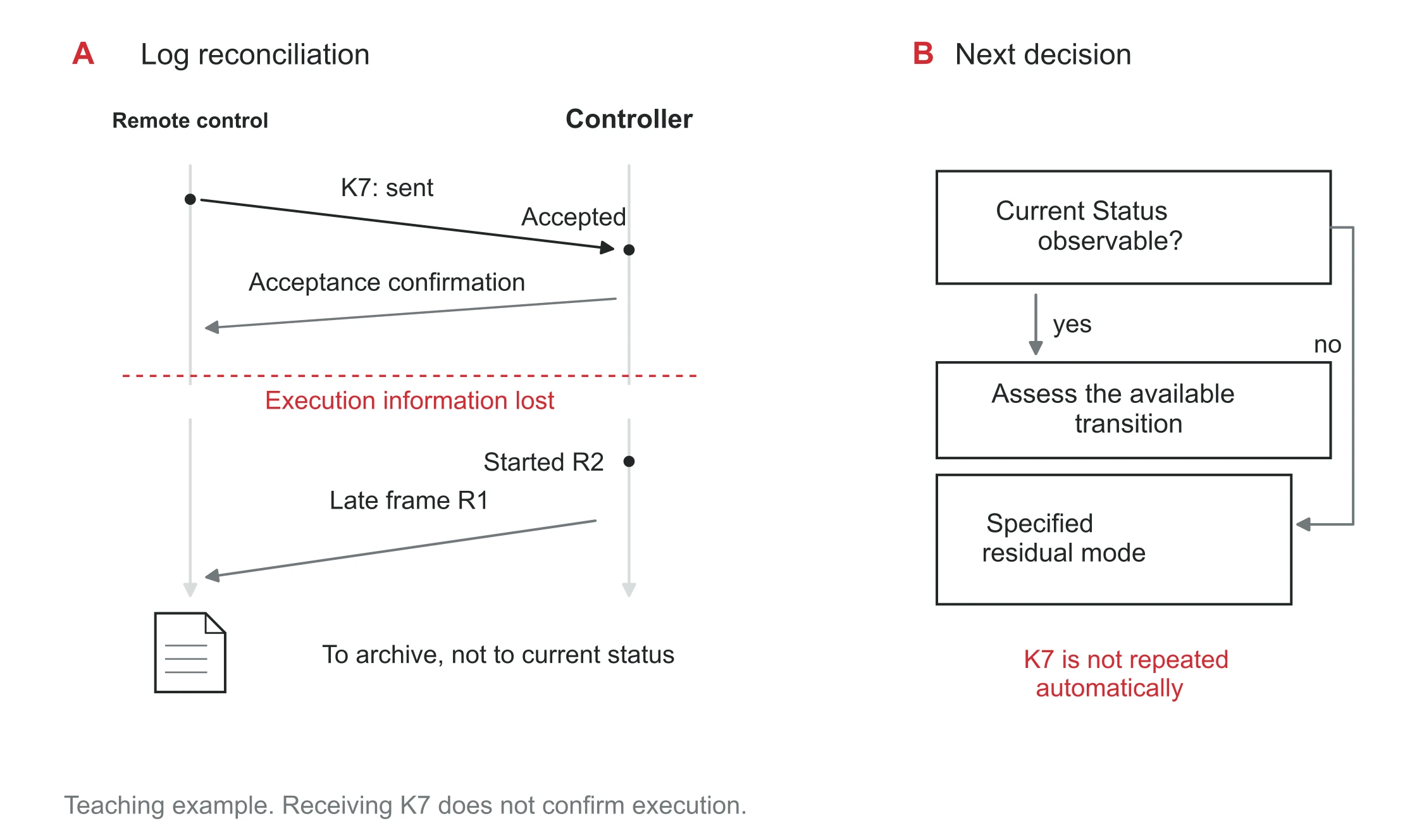
Figure 27. K7 after the connection is broken: accepted does not mean executed. Training analysis of communication restoration. Confirmed reception of K7, its execution and observation of the result are different statements. The session frame R1 after running R2 is saved as an archive frame; receiving it does not allow the relative move to be repeated.
Chapter 39
Controlled Experiment and Independent Replication
A controlled experiment begins with the selection of a difference that should appear under one hypothesis and not under another. An impressive repetition of a previous event is useful, but it can also reproduce a previous mistake. Therefore, a new series must change the basis of the conclusion: eliminate a possible clue, separate the effects, test a different range, or use an independent measurement chain. If only the desire to “look again” is known, the work remains exploratory. This mode is acceptable as long as its results are not presented as confirmation of a predetermined prediction.
Pre-registration captures the question, analysis plan, and decision terms before the outcome is revealed. It allows you to distinguish a prediction from an explanation found after observation, but does not automatically make a bad plan good [4]. Therefore, an open critical review of the design before registration is useful. The metrologist evaluates the sensitivity, the specialized specialist evaluates the reasonableness of the control condition, and the custodian evaluates the ability to restore the entire sequence. The manager then approves the verified version, preserving the history of discussions and the reasons for significant changes.
What is asked before the series begins?
In the author's protocol, the input conditions are a safe tested procedure, operable control channels and a finite list of decisions that are expected to be made. Indicate the main measured quantity, permissible exceptions, how the conditions are distributed, and the stopping rule. If a difference is expected between the two regimes, determine what size it is of scientific or practical significance. Without this, the negative result remains unclear: the experiment may have missed an effect that is really important to the question.
The simplest structure can be written as , where Yₐ and Yᵦ are predetermined indicators for the studied and control modes. The formula does not contain a proof criterion. It requires uncertainty, a model of the dependence of observations, and a justification for why the regimes differ in the particular factor of interest. If lighting, operator, and program version are changed simultaneously, the difference characterizes the package of changes. It does not allow you to select a convenient reason from it after receiving the result.
The control must preserve the essential terms without including the intended operating difference, as far as technically and ethically possible. Sometimes complete alignment cannot be achieved. Then several partial controls can be more meaningful than one formally called control mode. For example, the absence of a signal, operation of the recorder without a source, and a safe known signal are checked separately. The results of these tests answer different questions, so they cannot be combined into one “control passed” mark.
Performing and protecting against unintended cueing
The operator receives a sequence of actions sufficient to work, but, if possible, does not know the expected outcome. The evaluator sees records without condition labels. The custodian discloses compliance only after recording the assessment results. If blinding is not possible, document the available cues and examine the extent to which they could have altered the action or analysis. Writing down a specific constraint is more useful than a general statement of the team's strict objectivity. In a number of tasks, an independent repetition with a different organization makes it possible to reduce what could not be eliminated within the first experiment.
Consistency of design between proponents of competing explanations may reduce future dispute about what exactly was being tested. This approach was used in Transparent Psi Project [14]. Its organizational value does not depend on the desirability of the result obtained. Each party indicates in advance the conditions under which it will change the assessment of the hypothesis, and the essential signs of correct execution. Agreement to a procedure does not necessarily mean agreement with any subsequent interpretation, but it does make the reasons for the discrepancy more verifiable.
Repetition independence has several levels. Running the analysis again on the saved data verifies the calculation. New observations using the same setup test stability under similar conditions. Another team with a different measurement chain reduces some of the common methodological dependencies. Changing the conditions examines the transferability of the effect. These actions complement each other, but are not interchangeable. The report should clearly state what level has been achieved and what components—code, sample, instrument, evaluator training—remain common.
Training scenario
Fictional training scenario: When a new camera mode is activated, the group notices repeated bursts of light. The first series compares the two modes, but always includes the new one after the old one. Therefore, the difference may depend on the order or time of operation. In a confirmatory design, the order is assigned in advance, the transition intervals are kept separately, and the recordings are analyzed blindly. It turns out that the bursts appear mainly after switching, regardless of the name of the mode. The special impact hypothesis weakens, and the study moves to the state of the equipment during the transition.
If during the experiment a required channel is lost, the approved configuration changes, or an unforeseen risk arises, the operator terminates the series according to the agreed procedure. Retained materials may remain useful for exploratory analysis, but do not automatically receive the same supporting status. The decision to restart is made after the cause has been eliminated and a new plan has been registered. An incomplete experiment cannot be “supplemented” with successful observations from another procedure without separate justification.
The final outcome includes an estimate of effect size, uncertainty, compliance with the protocol, and transfer limits. A negative series may exclude a practically significant effect in the tested range, be insufficiently sensitive, or be unusable due to impairments; these outcomes are differentiated. The positive series opens the next question about the mechanism and independence of confirmation. In both cases, experiment fulfills its purpose if it reduces the space of admissible explanations and leaves the subsequent researcher the opportunity to verify this conclusion.
Validation set and frozen analysis version
Before the confirmatory series, a short executable package is compiled: a version of the hypothesis, a list of configuration files, an event rule, a formula for the main indicator, suitability criteria, the number or duration of attempts and a decision table. The data custodian confirms that the validation set was not used when selecting these rules. The performer of the analysis first receives control material with a known expected result; then performs the same calculation on the closed series.
If a software defect is discovered after the series is opened, the fix is documented. The result of the recalculation can be scientifically useful, but the history of viewing the data is preserved. The new version of the algorithm is tested on independent material when the correction may change event detection or feature selection. Fixing a signature typo and changing the threshold have different consequences; they cannot be combined with one status “technical correction”.
For a completed case, the archive contains the original records, transformations, an exception table, calculation parameters and the final formulation. Confirmation is understood within the verified conditions: a change of material, geometry, timing or operator may require the next transfer. This sequence is shown in case 2 and in engineering chapters 50–52.
Chapter 40
Data management and research reporting
The event may be unique, but the path from record to output must remain verifiable. To do this, it is not enough to save the final plot. The origin of the material, the conditions for its production, transformation and solutions that eliminate individual fragments are necessary. The loss of one of these links sometimes limits the output more than the low accuracy of the device. Work with data therefore begins before observation: the group determines in advance what information is needed to restore the meaning of the future recording.
The proposed authoring system separates primary materials, prepared representations and analysis results. The primary record saves what the measuring path actually produced. The prepared representation may contain converted units, corrected formats, or a consistent time scale. The analytical result adds the model and evaluation rules. There is a traceable connection between the levels. Neither cleanup nor correction of a known error should silently replace the original material. Otherwise, a subsequent specialist will not be able to check whether a significant observation was deleted along with the interference.
NIST's digital evidence preservation guidelines focus on provenance, secure storage of checksums, access, and modifications possible before [6] hashing. For a book, this makes an important difference: matching hashes confirms the consistency of the stored digital versions, but not the truth of the event depicted. The archive must protect not only files, but also information about who received them, when and under what circumstances. One technical sign of integrity for the entire chain of evidence is not enough.
Reception and description of materials
The input conditions for reception are a known transmitting participant or a registered source of receipt, a description of the receiving method and an acceptable access mode. The custodian assigns a persistent identifier to the material, verifies readability, and records inconsistencies. If the origin is unknown, the file is not automatically discarded, but is given an appropriate restriction. The operator confirms connection to the session. The metrologist adds the configuration, range, calibration state, and significant environmental conditions. The manager verifies that the information required for the stated task is actually present.
The description of the quantity includes the unit, the direction of reference, the spatial reference and the meaning of the timestamp. The time of packet reception should not be called the event time without explanation. When devices use different scales, the original values and a separate matching rule with its uncertainty are retained. An unknown delay is marked as unknown rather than zero. These simple differences determine whether the sequence of events can be examined. Without them, beautifully combining graphs sometimes creates a causal order that the original records do not contain.
Missing data needs its own label. Missing, channel saturation, planned outage and value below the detection limit have different meanings. Substituting zero in all four cases may create a non-existent vanishing effect. The invalidity mask is stored next to the data, and the reason for the exception is stated before interpreting the result, to the extent possible. If a decision is made later, its timing and reasons remain visible. The completeness of the report includes recognition of what the registration did not provide.
Processing, access and reproducibility
The analyst works with a controlled copy. For each transformation, the input, program version, parameters and the resulting result are saved. It is useful to test a complex chain against a small set of known test data. However, successful computation on such a set confirms only the intended properties. It does not certify a physical model of an unknown process. Rerunning the analysis with a different team checks computational reproducibility; independent observation answers a broader question and requires separate contributions.
Access rights are determined by task. The operator needs a means of recording and monitoring its success, the analyst needs working copies, and the external expert needs the materials necessary to verify the statement. Limiting personal information must be combined with maintaining scientifically relevant context. If a location or identity cannot be revealed, the public version explains what checks are therefore unavailable. It is impossible to assert the complete external verifiability of material that is provided only in the form of illustrations chosen by the author.
If corruption is detected, the custodian stops using the affected version for new outputs, saves the state, and checks for valid copies. Changing the checksum is considered an event that requires analysis, and not as ready evidence of malicious intent. The manager evaluates which published or internal decisions were influenced by the material. The fix is distributed along this chain. It is not limited to replacing a file in a folder if the previous version was already used to select the study mode.
Structure of an evidentiary report
The report is built around verifiable statements. First, the question and the limit of the problem are formulated, then the method and actual execution are described. The results are followed by uncertainty, alternative explanations, and limitations. The author's hypotheses are placed so that they cannot be mistaken for observed events. The reader must understand which entry supports each significant proposition and which step of reasoning connects them. The bibliography helps to find the source of the method, but does not replace the original data of your own research.
Statement | Base | Border |
Change recorded | Source channel and configuration | Range and unusable intervals |
Dependence established | Experience plan and all episodes | Controls and tolerability |
Mechanism proposed | Model and discriminating predictions | Unverified consequences |
Fictional training scenario: The illumination graph shows several seconds of absolute signal disappearance. Upon inspection, it turns out that the export program replaced the lost packets with zeros. The original log allows us to establish the absence of data, but not the behavior of the light during this period. The corrected report removes the claim of darkness, preserves the fact that the connection was lost, and shows the corresponding interval as undefined. Thus, a technical correction changes the scientific conclusion, preventing the gap from being filled with a convenient version of what happened.
Completion of processing means that another trained researcher can trace the basis of the conclusion within the agreed access. This is not a requirement to endlessly store any information without taking into account the rights of people and the purpose of the archive. Deadlines, publication restrictions and transmission procedures are determined in advance and are subject to reasonable revision. The scientific memory of a project consists of more than just successful observations: it includes unsuccessful runs, changes in methods, and recognized limits of knowledge. Without this memory, each new study risks repeating previous mistakes under a different name.
Local sequence and partial order
If the common timeline is lost, the custodian is not obliged to choose a single beautiful chronology. For distributed processes, Lamport defined order through the sequence of events within a process, the sending and receiving of a single message, and the transitive continuation of these connections; not every pair of events is comparable. Logical clocks can accommodate this order, but do not measure the physical duration of [61]. In a research archive, this approach is used to verify the provenance of journals and messages.
The entry ID includes the node, its session, and the local number. Restarting opens a new session; communication through it is established separately. A counter that could reset or repeat itself unnoticed is not sufficient support. For each “before” relationship, the basis is stored: the local sequence or the associated sending and receiving. The transitive output can be reconstructed from these original edges. A cycle in the resulting graph first means a contradiction in bindings, event boundaries, or logs; by itself it does not prove a time loop.
Fully solved tutorial example
All events in the following example are fictitious. Nodes A and B have kept continuous local logs of a single session. Their physical clocks after the crash are not comparable. The suitability of the local order and the correspondence of messages m1, m2, m3 are confirmed separately. The notation A2 means the second event of node A, not the second moment of the overall scale. In the example, X is the light burst, Y is the mechanical response, and Z is the change in benchmark.
Event | Record content | Logical number L |
A1 | Sent m1 to B. | 1 |
A2 | X is registered. | 2 |
A3 | Accepted m2 from B. | 5 |
A4 | Sent m3 to B. | 6 |
A5 | Z registered. | 7 |
B1 | Accepted m1 from A. | 2 |
B2 | Y registered. | 3 |
B3 | Sent m2 to A. | 4 |
B4 | Accepted m3 from A. | 7 |
The first step of the solution is to write down the initial connections. Locally installed A1 → A2 → A3 → A4 → A5 and B1 → B2 → B3 → B4. Messages add A1 → B1, B3 → A3 and A4 → B4. The remaining relations are derived only from the chains of these arrows. For example, the Y entry precedes A3, as well as the Z entry: B2 → B3 → A3 → A4 → A5. This establishes the registration sequence, but does not prove that Y caused Z.
The second step is to name the unresolved pairs. Between X = A2 and Y = B2 there is no directed path in either direction. Their physical order is unknown from these data. There is also no confirmed relationship between A5 and B4. Unknown does not mean simultaneity and does not exclude unrecorded external connection; it characterizes the available evidence.
Checking the solution gives two valid linear layouts: A1, B1, A2, B2, B3, A3, A4, B4, A5 and A1, B1, B2, A2, B3, A3, A4, A5, B4. Both keep all the original links, but change the order of X and Y, as well as A5 and B4. Consequently, the choice of one layout for the convenience of the table does not have the right to become a new fact of the report.
The logical numbers in the last column are calculated from the initial zero: before the local event, the counter is incremented by one; When a message is received, the maximum of the current value and the transmitted number is taken, then one is added. Therefore B1 gets max(0, 1) + 1 = 2, A3 - max(2, 4) + 1 = 5, B4 - max(4, 6) + 1 = 7. A smaller number of A2 compared to B2 does not prove the relationship A2 → B2. Equal numbers A5 and B4 do not prove physical simultaneity.
Summary for the record: the order of entries about Y and Z is established in the accepted journal model; the order of the X and Y entries is not established; physical delays between nodes are not defined. The onset of the physical processes themselves additionally depends on detection delays. These data are not sufficient for an experiment whose tolerance requires a known X-Y interval. Saved local fragments can be used for other tasks with their own justification. The original timestamps remain in the archive; The base graph, the list of incomparable pairs, and the reconstruction version are stored nearby.
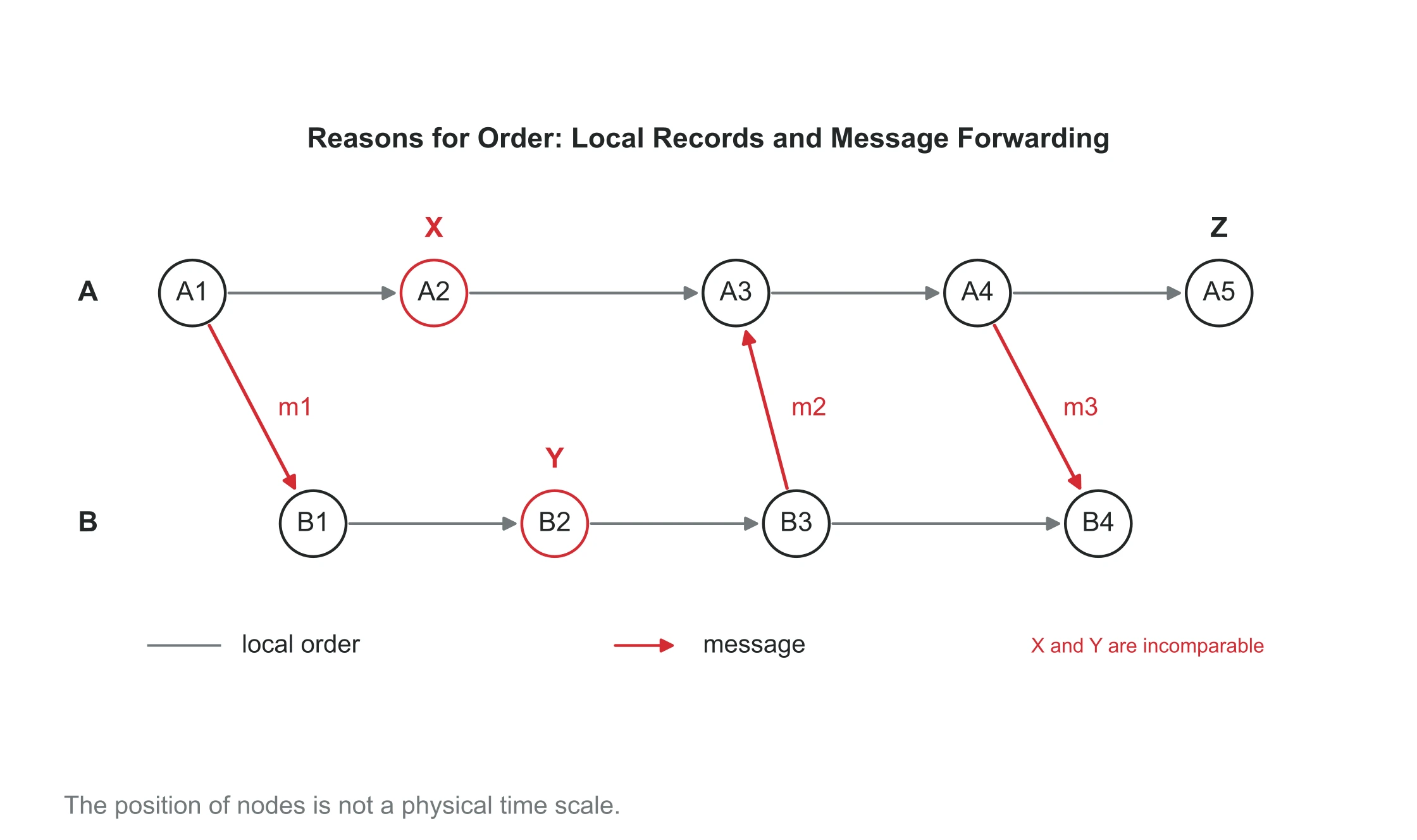
Figure 28. Partial order without a common time scale. Partial order of a solved tutorial example. Gray arrows show the local sequence, scarlet arrows show the sending and receiving of one message. There is no established directional path between X=A2 and Y=B2; the distances in the figure do not define physical intervals.
Chapter 41
Method errors and analysis of failures
The failure of a study is not limited to the lack of the desired effect. An experiment may correctly constrain the hypothesis, produce insufficiently precise results, lose data, or create unintended effects. These outcomes require different actions. The negative result of a sound experiment does not need to be repaired in order to obtain a positive one. On the contrary, a convincing positive result with a broken procedure may require a complete revision. The first decision of the debriefing is to determine what exactly failed: measurement, prediction verification, work organization, or risk management.
The proposed author's protocol is launched after any event that could change the reliability of the conclusions or the safety of further work. The manager limits the use of affected results, the coordinator ensures the intended safe mode, and the custodian preserves the original records and configuration. The operator describes the sequence of actions before the group discussion of the reasons. This procedure is not a search for the culprit. It reduces the likelihood that a plausible explanation proposed first will replace information not yet collected about the actual course of events.
Sequence recovery
The chronology is built from confirmed marks and clearly stated assumptions. It includes the state of equipment, program changes, human actions, external conditions and the moment the problem was detected. It is necessary to distinguish between the time the malfunction occurred and the time when it became noticeable. The delay may explain the apparent direction of causality. If the exact sequence is not available, it cannot be reconstructed according to the convenience of the story. Several acceptable chronology options are retained until distinguishing material becomes available.
The group then develops a short list of causal pathways. Each path should connect a specific change to an observable outcome and offer verification. “Human factors” is too broad if it does not explain what interface, instruction, or dependency made the action possible. The words "unknown energy" have the same problem. A convenient name for a reason is not a substitute for connection. Human responsibility for the decision is considered separately from the failure mechanism; Both questions are important, but one should not cover the other.
Common causes deserve special attention. Coincidence of multiple channels may occur due to a single effect on their power supply, timing, or processing. Environmental control studies show that some correlated interference persists even with techniques designed to test for random coincidence [55]. Therefore, the parsing includes a dependency map. It is necessary to determine which channels may have failed together, and choose a test that actually breaks the intended path, rather than adding another device to the same source.
Checking the detected cause
Reproduction of a similar artifact on a safe stand is useful, but its similarity to a field event is assessed by pre-identified features. One common peak is not sufficient if the duration, spectrum and dependence on conditions differ. A stronger explanation is one that predicts several features of the original record and their change after the cause is eliminated. If it was possible to show only the possibility of an error, the conclusion is limited to the possibility. One cannot turn a convenient demonstration experiment into a proof of the origin of all apparently similar cases.
Analytical solutions are checked just as carefully as hardware solutions. The work of Simmons and colleagues demonstrated that flexible choice of indicators, conditions, and data volume after reviewing the results can generate formally significant false findings [56]. Practical analysis therefore restores all performed analysis options, including unsuccessful ones. If the final hypothesis emerges from such a search, it remains a valuable candidate but is confirmed by a new series. It is impossible to retroactively reassign exploratory data as confirmatory experiment.
Correction of the method is evaluated according to the criterion being tested. The new filter must not only remove known interference, but also remain responsive to important control signals. The updated instruction must be executable by the operator without information inaccessible to it. The new backup channel should reduce the specific dependency. If the change reduces sensitivity, the cost of this reduction is indicated. The disappearance of alarms after rough processing is not independent proof of either the serviceability of the system or the cessation of the studied effect.
Training scenario
Fictional training scenario: three recorders simultaneously show a time shift after a short light episode. The group initially considers the general physical process. Analysis reveals a restart of the computer from which the devices received corrections. On a safe stand, the same order of commands reproduces the jump, but the autonomous control recorder does not show it. This supports the technical explanation of timestamps. But the light episode itself remains a separate observation: the detected clock error does not automatically determine the light source.
In this scenario, the fix has two parts. The organization of the reference time is restructured, and past conclusions are revised taking into account the affected interval. It is only necessary to re-analyze the entire archive when the identified cause could have been active in other sessions. The scope of revision is determined by proven impact rather than by a desire to demonstrate the scope of the work. The custodian records which results are corrected, which remain valid, and which can no longer be confidently interpreted.
Events in which damage was avoided are analyzed separately. The important question here is which barrier worked and how random the successful outcome was. If a fault was discovered by a free specialist who is usually not on shift, such success cannot be considered sustainable protection. If the stop was foreseen and correctly executed, this confirms a certain part of the organizational project. It is useful to distinguish between a functioning barrier and a happy coincidence without assigning the same status to them.
If the cause cannot be determined, the report lists the paths tested, the limits of available materials, and the conditions for safe continuation. Uncertainty is not resolved by voting. The next series should provide the missing discriminative information, and not simply repeat the previous actions for longer. Sometimes it is rational to discontinue a particular technique while keeping the scientific question open. This solution is particularly justified when additional surveillance will not improve identification of the cause but will increase the burden on people or the risk to the facility.
Closing a review means that the corrective actions are completed and verified, the limitations of the results are communicated to everyone who uses them, and the unresolved issues have an owner. The discipline of such work creates a positive research result even after an erroneous alarm. It is known which path should no longer be taken as evidence of a phenomenon, what data should be collected, and where real uncertainty remains. An error becomes part of knowledge only when its mechanism is available for further verification.
Part IX