Perception and information
Chapter 32
Missing Time and Gaps in Memory
A report that "twenty minutes disappeared" may contain several different claims. A person may not remember what happened, judge an interval to have been shorter, discover a gap in a video recording, or find that clocks disagree. These events require different checks. Grouping them prematurely under the name of a temporal anomaly creates a spurious common cause before data are available. The first task is to reconstruct the question precisely: what quantity changed, who noticed it, and what was it compared with? The experience itself deserves to be recorded regardless of whether its proposed explanation can be confirmed.
Physiological conditions may be accompanied by a combination of lucid experience, unusual sensations, and limited control of the body. In a laboratory study by Takeuchi et al, sixteen participants had six episodes of isolated sleep paralysis; polysomnographic data made it possible to associate them with the characteristics of the transition between sleep and wakefulness [46]. This is a narrow experimental support. It does not provide any basis for explaining the report of a long-term absence of memories by any sleepy state, much less considering the disappearance of a section of physical time as proven.
Other work correlated behavioral microsleeps with simultaneous recordings of brain activity, eye movements, and task performance. The observed brief cessations of the response had measurable physiological correspondences [47]. For a research protocol, the way in which data is divided is essential: the participant's report, the observed action and the physiological recording are compared, but do not replace each other. Stillness on video does not establish sleep, no response does not measure memory, and a memory gap does not indicate the amount of clock divergence.
Four independent reconstruction lines
The author's protocol begins after providing assistance to the person and stopping actions that could worsen his condition. The study director determines whether routine recording of circumstances is available without additional burden on the participant. The Safety Coordinator has the right to stop the interview; a specialized specialist resolves health issues within his competence. The operator records the situation, the data custodian takes the original records. The exploratory conversation should not delay needed help or become a test of the person's ability to tolerate a recurrence of the episode.
The first line describes the memory: the last confidently remembered moment, the first subsequent one, the source of the duration estimate and the degree of confidence in each detail. The second reconstructs observed actions from independent records. The third concerns the condition of the participant and the available physiological data obtained with consent. The fourth checks device timelines. For each line, intervals of reliable observation, intervals of uncertainty, and information that appeared later are noted. Alignment of gap boundaries is interesting, but requires checking the common source first, such as turning off power to all recorders.
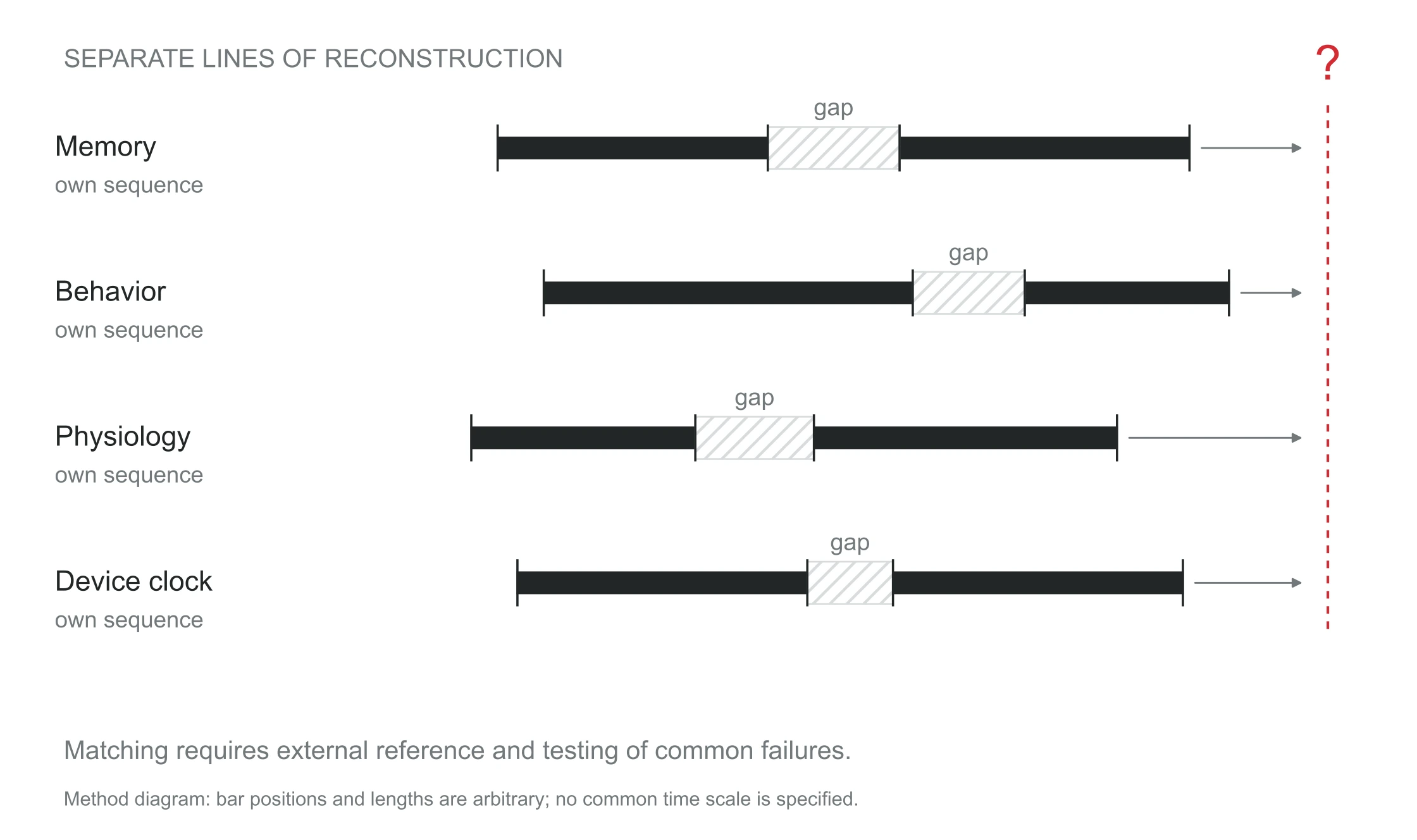
Figure 23. Four lines of reconstruction of one episode. Method diagram. Memory, observed behavior, physiological recording, and device clocks have their own scope. The position and length of the stripes are arbitrary: the drawing does not specify the duration of the spaces and does not establish their simultaneity. The red dotted line marks the issue of external binding and common source of failure, rather than a confirmed link.
1. Write down an initial free description without prompting a suspected reason; preserve the date and circumstances of the story.
2. Accept the originals of available records, figure out ways to create timestamps and identify missing fragments.
3. Create a general chronology with separate tracks for memory, behavior, physiology and instrument time.
4. Pass discrepancies to relevant specialists; complete registration if continuation creates a burden or requires unprepared intervention.
Several eyewitnesses are interviewed in such a way as to preserve the original individual versions. Experimental memory studies show that discussing an event can change participants' subsequent reports [1]. Therefore, in the protocol, not only the content of the message and the number of narrators are important, but also the history of the exchange of information. Repeating someone else's details can be sincere. The investigative intonation gets in the way here: the origin of the information is being investigated, and not the moral assessment of the person. A later clarification is not deleted from the archive, but is added indicating the time and reason for the change.
Educational analysis
Fictional training scenario: An employee reports that after a short rest, he unexpectedly found himself seventeen minutes behind the expected time. The indoor camera also contains a gap. The first assumption connects both facts with one impact. Checking shows that the application displays the creation time of the exported fragment, and not a continuous shooting timeline. The turnstile log and independent lighting recorder continue without skipping. However, they do not capture the employee's internal state, so explaining the video gap does not automatically explain the employee's experience.
The result of such analysis is formulated separately. The gap in the provided video has a technical explanation; the literal loss of time is not confirmed by available instruments; the circumstances of the subjective interval remain insufficiently defined. Additional research is only permissible with a clear question and voluntary participation. It is impossible to suggest that a person disturb his sleep again in order to obtain a more convincing case. If the available materials are insufficient, the final result is a map of limitations, rather than an artificially selected diagnosis or a fantasy version.
The physical time hypothesis requires a positive instrumental result that withstands the tests described in the time section. To study the experience, it is sufficient to correctly pose another question: what conditions accompanied the change in the subjective sequence. These directions can develop in parallel. Separating them preserves the dignity of the evidence and prevents it from carrying an evidentiary burden that it does not have. The outcome of the case analysis should show what has been directly established, what has been reconstructed, and what new material can actually change the conclusion.
Matrix of inconsistent evidence
When stories diverge, first break each piece of evidence into separate statements. For each, the object, action, place, interval and source of knowledge are written down. “I saw the door open” and “I was informed that the door was open” occupy different lines. The witness's confidence persists as a characteristic of the story; it is not a replacement for surveillance coverage testing. Primary versions are recorded before joint discussion, and subsequent changes are associated with the history of obtaining new information.
Approval in a study case | Available material | Scope and limitation | Intermediate output |
Witness A saw a man enter | Primary recording of the story | Time estimated from memory; witness indicates an interval of several minutes, its accuracy has not been independently verified | Evidence of entry is retained; exact moment unknown |
The camera does not show the entrance | Video of the entrance area | There is no recording between the 40th and 55th seconds of the selected fragment | Lack of entry in the pass is not established |
The door sensor gave two pulses | Sensor local sequence | There is no confirmed connection with the common time scale; possible contact bounce | Two counts are set, the number of passes is not defined |
Witness B clarified the time after viewing | Two versions of the story | Latest version depends on video shown | Clarification is not independent confirmation |
The next measurement is selected for a specific gap. If the key issue is the number of passes, check the sensitivity and rules for combining sensor pulses. If order is required relative to an external event, an independent temporal relationship is sought. Repeated questioning after all materials have been shown may help to understand the interpretation, but does not replicate the original independent observation. The contradiction is not resolved by voting on the number of stories.
A conditional history change model must specify which records or states are saved and why. By completely randomly changing all possible traces, no observable difference between versions is determined. With a limited change, the task arises: compare the affected and preserved channels, check their real independence and calculate the discriminative prediction. Such a postulate is noted as conditional; The very fact that the stories do not match does not confirm it.
Chapter 33
A Sensed Presence and Out-of-Body Experiences
The feeling of someone's presence can be definite even when a person does not see a figure or hear a voice. An out-of-body experience, on the contrary, changes the position from which one's own body is perceived. In both cases, the initial subject of registration is the organization of experience: where the observer is felt, what the action is attributed to, what signs allow us to talk about another being. A detailed description aids research more than immediately assigning a name to a putative source. The certainty of an experience and the establishment of its external cause refer to different issues.
Ehrsson's experimental work demonstrated the possibility of changing the experienced position of one's own body through the coordinated manipulation of visual perspective and body signals [48]. This result provides a way to study the components of self-position. It does not measure the separation of consciousness from the organism and does not prove the identity of the laboratory illusion with all spontaneous cases. The practical value of the model lies in the fact that individual conditions of experience become controllable and allow comparison with a control condition.
Robotic studies of sense of presence exploit the incoherence between human movement and returned bodily signals. In work by Bernasconi et al, the procedure was associated with sensorimotor processing characteristics, including in patients with Parkinson's disease; additional data were obtained from a separate clinical sample [49]. Published in 2026, the pooled analysis covered twenty-five experiments conducted by the authors, with a total of 561 [50] participants. This extends the empirical basis of a particular model, while maintaining the need for independent external validation and careful generalization to other situations.
Description without premature diagnosis
The author's procedure of primary description separates three layers. The first is the immediate qualities of experience: direction, distance, movement, duration, bodily location. The second is observable external events, including instrument readings. The third is interpretation: “observed”, “warned”, “managed”. The last layer is not excluded from the recording because it is important for understanding the situation, but is labeled as the participant's conclusion. A clarifying question concerns the basis of this conclusion: what kind of event would be expected if it were true and what would not be expected.
The initial interview is conducted by a trained professional who does not promise to confirm the entity or prove the disease. The data custodian ensures a consistent mode of access: personal experiences cannot be published along with identifying details by default. In case of pronounced distress, the scientific program gives way to assistance along the specialized route. Resumption of the study requires a separate decision, and consent to the conversation does not mean consent to the experimental induction of sensations. This boundary is especially important when the participant is also a member of the expedition and may feel job pressure.
A controlled study is acceptable if there is a specific hypothesis, proven safety of the procedure, and the ability to stop at the request of the participant. The metrologist records real delays, movements and stimulation modes, and not just software commands. The operator carries out the assigned sequence without, if possible, knowing the expected response. The assessor receives reports without condition information. The main indicator is determined in advance: for example, the frequency of a previously described experience, and not an arbitrarily chosen most striking phrase. The result is a relationship between the condition and the indicator within the tested limits.
What does the equipment really measure?
The physiological channel is useful when it answers a specific question about the state of the body. It does not become a sensor of the external subject only because it reacts simultaneously with the experience. In the same way, the camera confirms the change in the image, but not the origin of the sensation, and the robotic stand verifies the sensorimotor model, not the existence of the invisible interlocutor. For each entry, you must specify the subject of the output. If one channel characterizes the movement, the other the participant's report, their agreement confirms a specific relationship between the movement and the report, and not an arbitrary third entity.
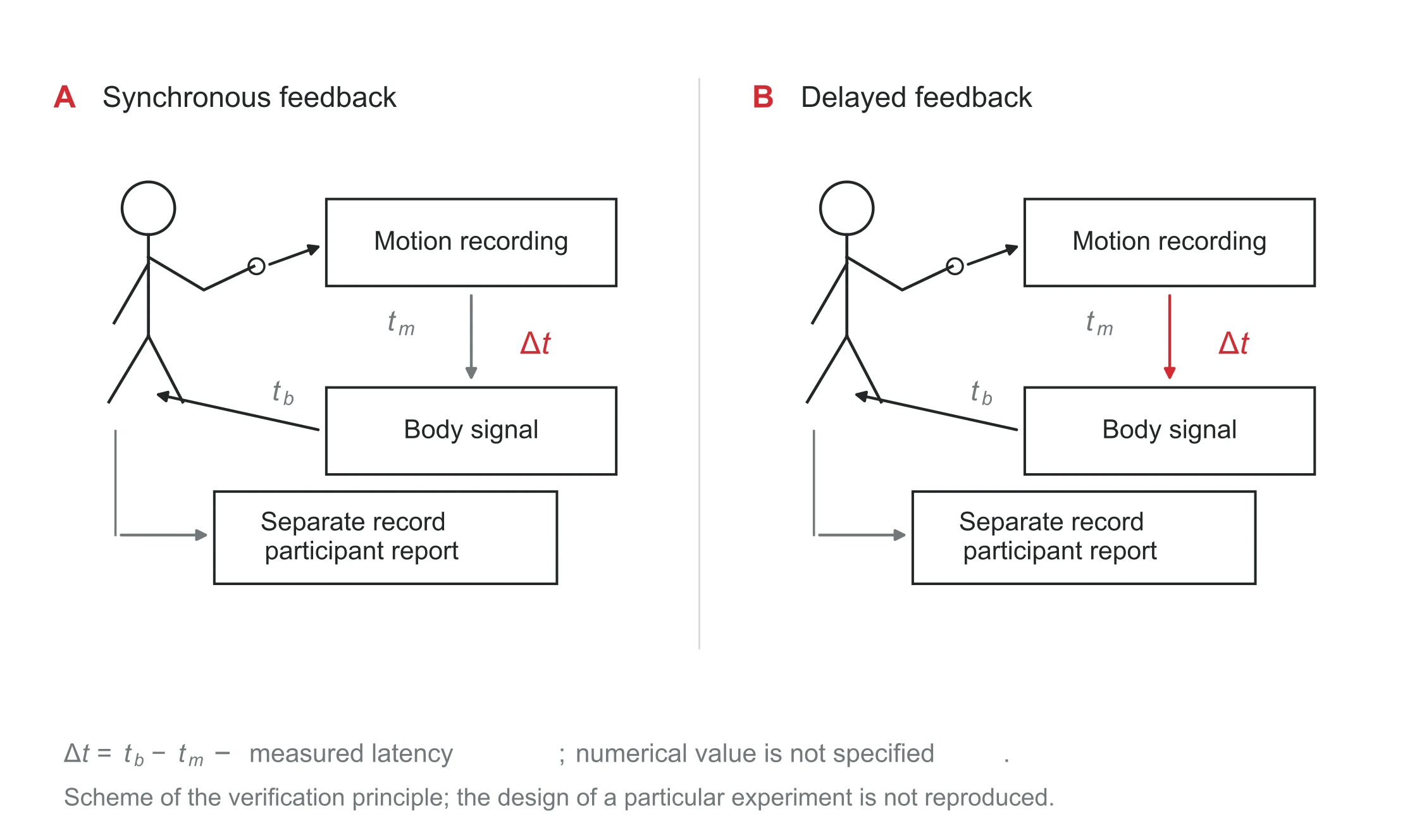
Figure 24. Sensorimotor connectivity and individual participant report. Scheme of the method: coordinated and delayed return of the body signal. Δt is the actual measured delay between movement and return, not the number specified here. The participant's report is registered in a separate channel. The figure illustrates the principle of sensorimotor verification and does not reproduce the construction of a specific experience or the external cause of the experience.
A useful additional check is to separate the presence of the operator, the state of the apparatus and the availability of the result to the observer. However, the “observer effect” cannot be introduced as a ready-made explanation for any difference. First, they describe what changed physically: the sound, the waiting time, the experimenter's movements, the sequence of questions, or the processing of the recording. If a difference remains after control, it requires new experiment. Replacing a specific variable with the word “consciousness” does not reduce uncertainty and does not allow the selection of a device for further research.
Training scenario and output limit
A fictitious training scenario: test participants sense a person approaching behind them when a certain module of the robotic system operates with a delay. An independent recorder confirms the delay, and hidden control sessions weaken the initial connection between the sensation and the name of the mode. It turns out that some of the participants were guided by the characteristic sound of switching. After acoustic equalization, the effect decreases, but persists in some conditions. There are now two testable components: the available cue and the possible influence of sensorimotor mismatch. None of them allow you to diagnose a person based on his story.
The report must preserve both stages, including the initial overestimate. If the final experiment is insufficiently sensitive, the conclusion is limited to uncertainty, rather than a claim that experience is absent. If the association is reproduced, it is described with its conditions, range, and exceptions. Moving to the question of agency requires a different program: an external response, predefined information content, and controls for ordinary channels. This keeps inquiry open to the unusual while distinguishing a description of inner experience from evidence of an independent acting source.
Chapter 34
Unusual Sensations Indoors
The room brings together many influences and expectations. Light, sound, temperature, the location of passages, the operation of equipment and the story of the past of a place are included in one situation, although they do not have to have a common cause. Therefore, a complaint about a “heavy atmosphere” becomes the beginning of several checks. One relates to known hazards, another to the quality of perception, and the third to specific recorded deviations. The change in impression after leaving the room does not in itself determine which of these lines explains the observation.
In Project Haunt, seventy-nine participants were placed in a specially designed room under different combinations of tested electromagnetic fields and infrasound. The authors did not find the expected dependence of the number of unusual sensations on these conditions; the experimenters knew the assigned regimen, so the study was not completely double-blind [51]. In a separate double-blind test of weak complex magnetic fields, the expected presence effect was also not confirmed [52]. These results limit specific explanations without establishing the universal harmlessness of all physical effects.
Initial inspection of the premises
The proposed author's protocol begins with determining the availability of the survey. The safety coordinator assesses what common hazards need to be eliminated before inviting people. A specialized specialist selects devices for specific factors; the absence of a suitable meter is not replaced by a household device with unknown sensitivity. Field Guides for Contaminant Measurement emphasize the importance of calibration, selectivity, and operating conditions for [31] sensors. Therefore, a low reading only makes sense in conjunction with confirmation of the suitability of the entire measuring path for the given issue.
Before turning on additional equipment, the state of the room is recorded: operating installations, door position, lighting, available ventilation information and observation time. This list is not an attempt to collect everything that exists. It describes the variables that can affect the selected measurements or safety. Then a map of observation points is created with stable designations. Rearranging the sensor is registered as a change in conditions, and not a subtle attempt to obtain a more expressive graph. Unoccupied periods are also useful if the equipment can operate without human intervention.
The manager selects the main connection to be verified. For example, pressure messages are assumed to coincide with a specific low-frequency signal. Then, before viewing the joint data, the coincidence time window, the message registration method, and the acoustic event evaluation rule are specified. Expanding the window after failure is acceptable as an exploratory analysis, but the result receives a different status. Otherwise, any sensation can be associated with the nearest fluctuation, and the absence of a predetermined boundary makes the hypothesis practically invulnerable to verification.
Control of the situation and expectations
Comparing two rooms requires more than a “control” sign. If one is darker, colder, and has a humming sound, the difference in reports does not highlight a single cause. Control is built under question: they compare periods of one room, agreed upon safe modes, or rooms with the described differences. When conditions cannot be equalized, this constraint is included in the output. A strong correlation in a complex natural environment may suggest a useful hypothesis, but does not become a controlled experiment due to the large number of visitors.
Research on expectations requires an ethically acceptable design. Neutral instructions reduce the number of imposed images, but do not eliminate prior awareness. It is clarified separately, without turning the question into an examination of correct beliefs. The open story is supplemented with pre-established scales, preserving the possibility of the answer “nothing unusual.” You cannot measure the success of a procedure by the number of bright stories. Quiet sessions, refusal to participate, and cases when an instrument signal appears without a subjective event are no less informative.
Actively changing the environment is the new mode of operation. It requires a limited question, a proven installation, and an independent safety justification; the book does not involve self-made radiation or intense acoustic exposure to people. The operator terminates the procedure if conditions go beyond the agreed limits, loss of control or demand of the participant. If a physical factor can be studied on a safe technical analogue without a person, this path is used first. Avoiding unnecessary exposure both reduces risk and simplifies the measurement task.
Training scenario
Fictional training scenario: In the archive room, visitors regularly feel movement over their shoulder. In the initial recordings, the experience coincides with the hum of a fan. After installing an independent recorder, it is discovered that the messages occur more often after turning to a bright screen, and the hum continues during quiet periods. The evidence suggests different explanations: visual conditions, anticipation, and mechanical cues. None have yet been identified causally. Safe lighting comparison changes the frequency of reporting but maintains differences between participants.
The completed report of such a study describes the discovered relationship and its limits. He does not declare the premises fully explored and does not evaluate the sincerity of previous visitors. For an operational solution, it is specifically stated which known hazards have been verified by competent personnel, which conditions are acceptable and who is responsible for re-examination after changes. The scientific result may turn out to be more modest than the original story, but more useful for action: it becomes clear what to change, what to measure next, and what conclusions the available data do not yet allow.
Chapter 35
Digital anomalies and the limits of automatic analysis
An unusual fragment of a file appears at the last section of a long chain: an event affects the sensor, the signal is converted, transmitted, stored and analyzed. An error in any area can become a convincing picture on the screen. Therefore, a digital anomaly initially means a deviation in the data. To transfer a statement to the outside world, it is necessary to reconstruct the origin of the record. Particular care should be taken when working with a result that exists only after complex processing and disappears when accessing the original signal.
The detection algorithm compares the data to a given model of expected behavior. It can be useful without knowing the reason for the deviation, but that is why a high oddity score does not mean new physics. The NIST AI Risk Management Framework requires assessing quality under the intended use conditions, documenting generalization limitations, and monitoring the system after implementation [53]. For anomaly research, this turns into a specific question: what background was the algorithm tested against and why does this background match the current record.
Two different levels of verification
The first level relates to the algorithm: whether the program reproduces the calculation, whether the input conforms to the specified format, whether model versions and parameters are saved. The second relates to the measurement: whether the signal exists on the original channel, whether it is consistent with independent observations, and whether saturation, gaps and incorrect time scales are excluded. The correctness of the calculation does not confirm the correctness of the measurement. Conversely, a real change in the environment may be missed by a functioning program if its representation of the normal state does not include the desired class of events.
The proposed author's protocol assigns the data custodian to maintaining the original version, the metrologist to check the chain of custody, and the analysis specialist to perform reproducible computational analysis. The manager formulates the purpose of the system: ranking records, issuing a signal to the operator, or supporting a specific decision. These functions cannot be changed unnoticed. An algorithm that is suitable for selecting interesting videos does not automatically have the right to initiate an intervention. A dangerous decision requires self-confirmation and a predetermined procedure for human verification.
The test set includes normal recordings, known artifacts, safely introduced control signals, and conditions other than training. The artificial example must be labeled and separated from the real observation. It tests the ability to recognize a given change rather than the existence of an unknown phenomenon. It is advisable to separate the setup and the final evaluation: after selecting the parameters, the test set is no longer considered unknown to the developer. Repeated improvement of the result on the same materials does not create new independent confirmation.
Number of alarms and meaning of accuracy
Fictional training scenario: ten control events are included in ten thousand fragments of a secure test array. The program finds nine of them and produces an additional hundred false alarms. Sensitivity to inserted events appears to be high, but among 109 messages, only nine relate to test targets. The operator has to view many common fragments. This example shows why overall correct response rates alone are not enough: separate rates of detection, false alarms, and follow-up costs are needed.
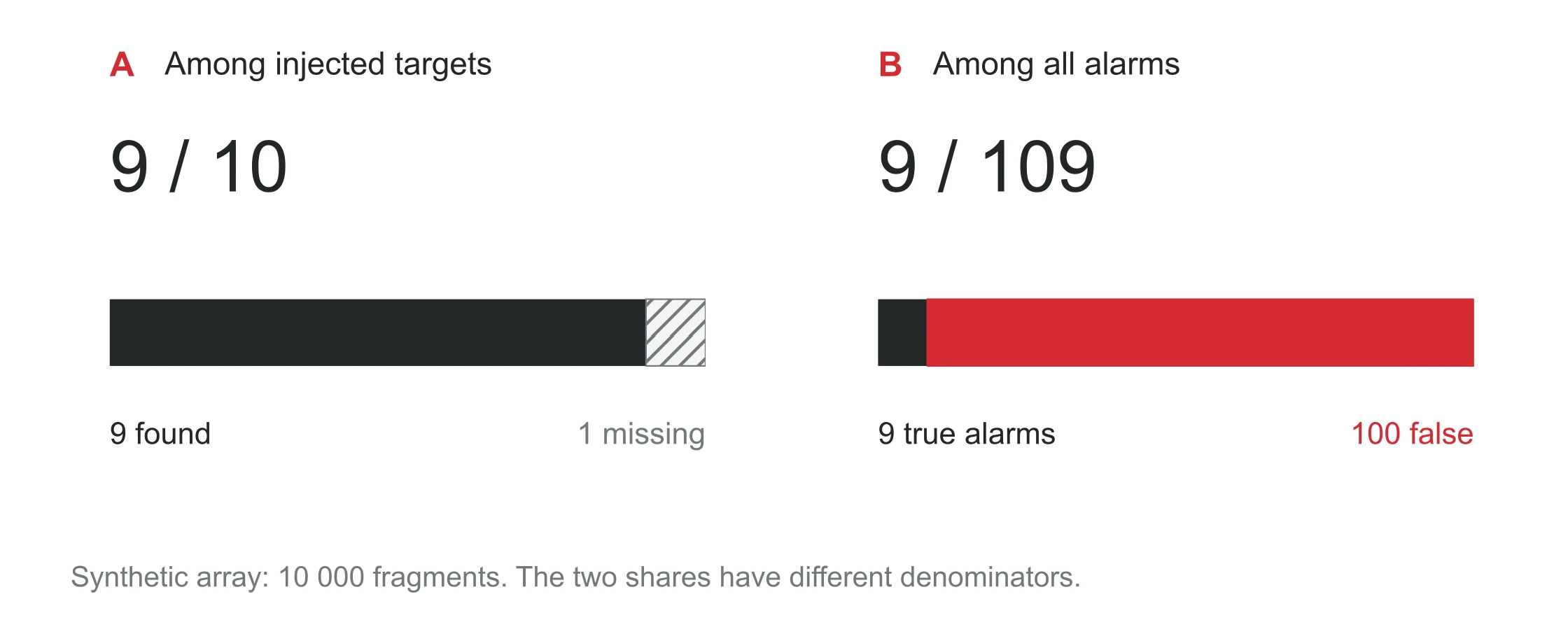
Figure 25. Nine targets among 109 alarms. Synthetic training example. Of the ten entered targets, nine were found, but among the 109 alarms, only nine were targeted. The length of each stripe is normalized to its own denominator. The original array contains 10 000 fragments; the figure does not estimate the prevalence of actual unknown events.
The threshold is chosen in relation to the purpose rather than the attractiveness of the display. For an overview search, one volume of manual checking is acceptable, for continuous duty - another. Given the unknown frequency of true events, the known reliability of each alarm cannot be promised. For a new class that was not in the validated set, the sensitivity may generally remain undefined. The working response of the system in this case becomes a request for verification or refusal of classification, and not a confident signature with the name of an unidentified phenomenon.
Multiple channels and time windows create multiple opportunities to get an unusual number. Statistical methods, including false discovery rate control, rely on certain assumptions; the original Benjamini–Hochberg procedure contains conditions for the corresponding statistics [54]. Simply applying the formula does not correct incorrect background or dependent repetitions of a single signal. The project determines in advance the family of checks and the method for taking into account dependencies. Exploration finds are retained, but new data is requested to establish a pattern.
When automation stops
Signs of loss of suitability include a change in input format, an unknown model version, missing mandatory channels, going beyond the tested range, and a sharp increase in unexplained alarms. These are reasons to stop automatic decision making and keep the registration if it remains secure. The operator marks the moment of switching; a specialist checks the reason on copies. You cannot subtly suppress anxieties with a new filter and then use the silence as evidence that the impact has subsided. Changing the filter changes the observation, not necessarily the environment being examined.
The final analysis should link each alarm to the original record, the treatment version, and the reviewer's decision. Missing milestones, indeterminate cases, and intervals of missing usable data are listed separately. Generative image enhancement is permitted as illustration only with explicit labeling; details created are not returned to evidence. The scientific strength of a digital system is determined by the verifiability of its conclusions. The more complex the processing, the more important it is to maintain the ability to go back from an impressive result to a measured signal.
Chapter 36
Apparent agency and the test of meaningful response.
A sequence of signals begins to look like an address when the observer recognizes it as a response to his own action. However, the answer and the match differ not in emotional persuasiveness, but in the verification conditions. For the AG class, the subject of research is the controlled relationship between input information and the observed output. At the same time, the origin of the control system, the presence of consciousness, intention and possible danger remain separate issues. Even reliably established processing of the message does not yet allow us to attribute human motives to the source or declare it an independent being.
You should start with a passive description. The full stream of available signals, the actions of those present, and recording conditions are recorded, including periods when nothing resembling a response occurred. It is impossible to single out only successful episodes: without the rest, the possibility of a random coincidence is unknown. Then the recognition rule is described. If it changes for each case, the hypothesis is not yet ready for confirmatory experiment. This is a valid exploratory stage, but its results should not be presented as a review of pre-established code.
From a recognizable image to verifiable code
The proposed author's protocol requires the alphabet of output events to be determined in advance. For example, two distinct waveforms are recorded, and all other signals are classified as a separate uncertainty category. Set the valid response window, the rule for handling multiple responses, silence and incomplete recording. The code is fixed until the confirmatory series. This separation of the pre-predicted result and the subsequent interpretation corresponds to the purpose of the pre-registration [4]. Changing the code after viewing is allowed to build a new hypothesis, which is then tested on other material.
The next question concerns entry. What exactly could the supposed source have received: a light stimulus, a digital message, human movement, or ordinary sound? The claim to understand meaning requires tests that distinguish semantic dependence from response to external form. If any loud word is followed by a pulse, the acoustic match is tested, not the understanding of the question. If different formulations should evoke the same response, the set of such formulations and the rules for their evaluation are determined in advance. A positive result first characterizes the observed function.
Admission conditions and distribution of roles
Active communication is only permissible after a separate impact assessment. An attempt to communicate can simultaneously become a physical intervention: turning on the emitter, changing the equipment mode, or approaching a person. The lack of proven agency does not eliminate the usual dangers of these actions. The manager formulates a limited task; The safety coordinator checks the selected channel and termination conditions; a metrologist confirms the distinguishability of output events. If a safe way to provide an input is unknown, the operation remains in the mode of recording and analyzing existing sequences.
In confirmatory testing, it is useful to separate knowledge of the task and evaluation of the result. One participant stores a list of target messages, the other receives anonymized output records. The operator does not prompt the correct answer by the position of the device, intonation or change in delay. The data custodian records the versions of materials and the time they were opened. Protection of records must cover provenance and integrity; the checksum itself does not prove that before its calculation there was no substitution of [6]. Therefore, they check the entire route of information.
Leak control includes available regular communications, information in service files, shared screens, network messages, and human actions. The purpose of such an analysis is to find ways in which the correct answer could have emerged without the stated mechanism. This is not an indictment of the participants. In contrast, pre-agreed review protects the study from subsequent disputes about intent. If a leak is discovered, the corresponding series loses its confirmation status, regardless of whether anyone knowingly used it. After eliminating the cause, new material is needed.
Conditional model and tutorial example
Conditional model: some unknown process is able to choose one of two responses depending on the given task. This assumption yields testable differences between runs with an available task, without a task, and with a control transmission. It does not imply telepathy, benevolence or hostility. If responses depend only on the schedule, the information dependence model is weakened. If the dependence can withstand new tasks, it remains to find out what material or technical path provides it. Verification of function precedes interpretation of the media.
Fictional training scenario: a terminal with no visible network connection produces the correct characters after presenting the cards to the operator. The first observations look like reading hidden information. In the confirmatory series, cards are selected after the initial state of the terminal is fixed, and the operator and evaluator are separated. Success disappears. The test finds that the original order of the cards matches the saved test sequence. This explains this method of obtaining answers. Other entries are not deleted, but require independent analysis instead of transferring the already found reason to them.
If the confirmation is saved, the report reports the exact task, the number of all attempts, evaluation rules, uncertainty and controls performed. You cannot replace this with the formula “the source wanted to respond.” Non-response may be an observation but is not a universal explanation for any negative outcome. A hypothesis that takes both response and silence as confirmation loses its discriminating power. Its further development should offer new restrictions, rather than expand the set of acceptable outcomes without a limit.
Work is stopped if control over the channel is lost, the agreed protocol is violated, or the state of the participants changes. The result is an assessment of information dependence in specific conditions, and not an assignment of personality to the source. Such a discipline retains the possibility of serious study of even unusually organized behavior. It also protects the group from the dangerous mistake of mistaking one's own interpretation of intent as a reliable basis for approaching, interfering with, or trusting an unknown signal.
Information dependence without agent assumption
The addiction being explored may occur without an answer to the question or dialogue. In the conditional model, the physical indicator changes when information is recorded, presented, accessible, or interpreted. These variants have different causal structures. Writing a file changes the way the media works; showing the image changes the light; reading influences a person's actions. Before introducing an additional connection, each of these common circuits and its measurable characteristics are described.
The operating scheme distinguishes between a physical medium P, a predetermined content category S, and operator access A. The category S is established before the experiment according to an independent rule. Confirmation tasks are not used when selecting categories and parameters. The physical characteristics of the material - brightness, duration, file size, arrangement of symbols - are described separately; their approximate equalization does not give the right to declare all physical differences eliminated.
A factorial design allows you to vary multiple conditions and evaluate combinations of them. In a standard two-level design, eight combinations are considered for three factors; the order in the design table is different from the actual random order of trials [59]. Below is the author's training scheme. The indicator values are specified by the formula solely to explain the calculation and do not constitute experimental evidence of information impact.
P | S | A | Target Y |
−1 | −1 | −1 | 8.5 |
+1 | −1 | −1 | 12.5 |
−1 | +1 | −1 | 5.5 |
+1 | +1 | −1 | 9.5 |
−1 | −1 | +1 | 7.5 |
+1 | −1 | +1 | 11.5 |
−1 | +1 | +1 | 10.5 |
+1 | +1 | +1 | 14.5 |
In this construction, the average difference between the levels of S is zero, but it depends on A. For A = +1, the transition of S from −1 to +1 changes Y by +3, and for A = −1, by −3. Therefore, averaging over operator access can hide the interaction of factors. The numbers do not include a measurement noise model; the eight set values cannot assess experimental significance. Testing requires repeated blocks, new materials, and a preselected variation model.
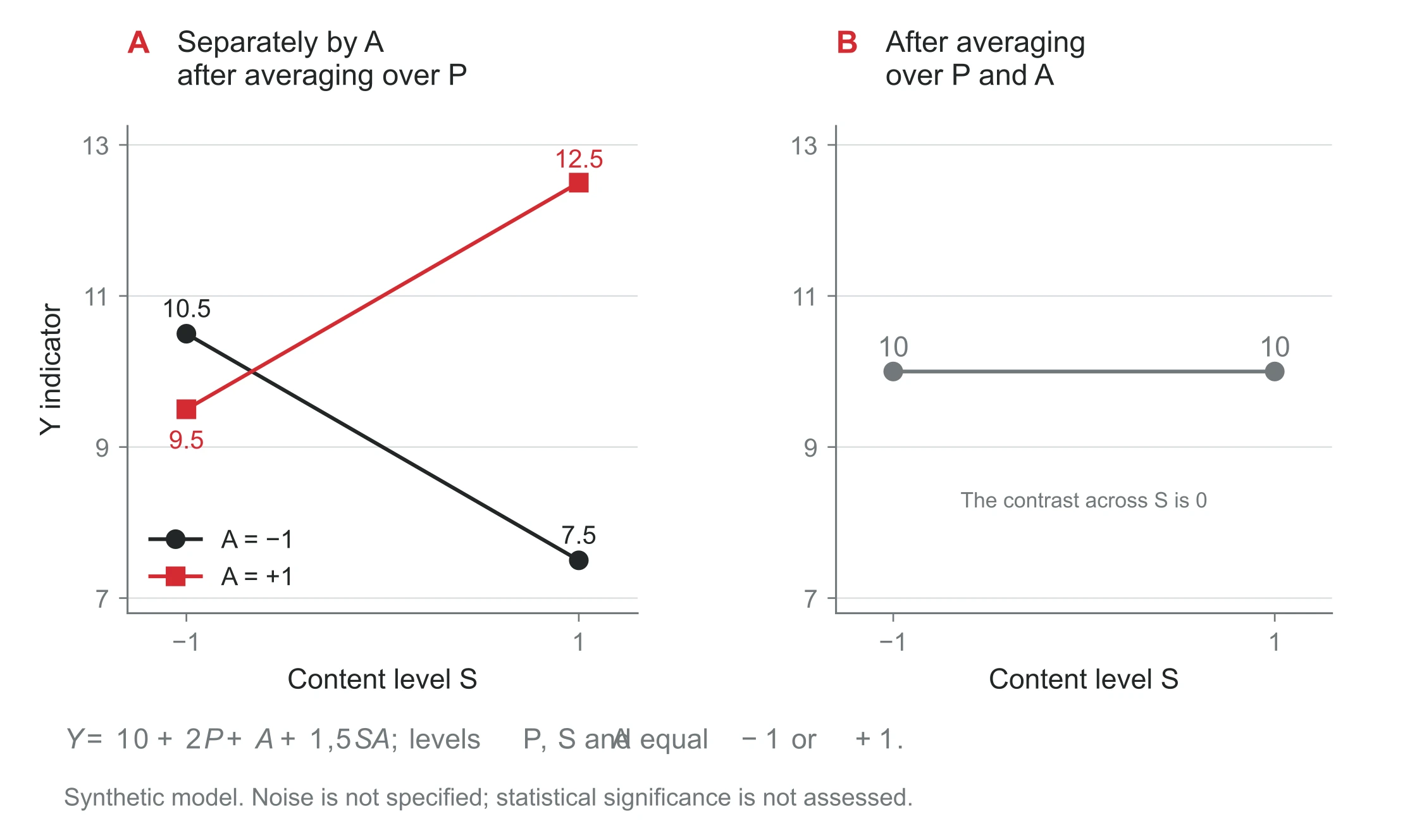
Figure 26. An interaction that disappears on averaging. Synthetic factorial model Y = 10 + 2P + A + 1.5SA. The left panel shows means averaged over P separately for each level of A; the right panel shows means averaged over both P and A. Opposite changes with S cancel. No noise model is specified, so the figure neither establishes experimental significance nor confirms an informational mechanism.
If A = +1 means access to content, the dependency in this branch admits the usual behavioral explanation: the operator acts differently according to the condition. This version by itself does not explain the entire table: it is separately necessary to explain the contrast S for A = −1, that is, without access. It is tested by the registration of actions, the transfer of execution to an independent operator, and the configuration in which the content is revealed after the completion of physical actions. Recording the analysis and distributing tasks should exclude changing the category based on the result already seen. Each of these checks concerns a specific path of influence; their results are stored separately.
Conditional law of connection and transfer to new tasks
The author's hypothesis of an additional connection can introduce the term βS into the measurement model, but must determine who assigns S and by what rule. The word “meaning” without such a rule leaves the parameter non-operational. If two prequalified evaluators disagree, the protocol should provide a separate uncertainty category or an independent resolution rule before reviewing the physical result. It is not possible to exclude inconvenient tasks after measurement within the framework of the initial confirmatory series.
The check consists of three transfers. First, the wording within a predefined category is changed; then new physical media are used; the content is then revealed to the other participant while the procedure is saved. For each transfer, the forecast of its own model and conventional alternatives is calculated. If the effect follows a specific display program rather than a predefined category, the study returns to the display device. If the dependence persists, the result is formulated in terms of the found conditions, size and uncertainty, without attributing consciousness or intention to the source.
Case 5 shows filling out a plan for information dependence and testing it on new jobs. Such designs provide a language for examining conditioned effects. They do not establish the existence of a separate natural mechanism that responds to content.
Part VIII