Physical processes in the environment
Chapter 22
Electromagnetic deviations
Quantity before name
The message about a “strong field” does not yet specify the subject of measurement. Electric field, magnetic induction, radio frequency radiation and voltage on a conductor are described by different quantities. They differ in spatial structure, time course and methods of registration. Therefore, a case is assigned an EM class by the observed deviation of a specific channel, and not by the feeling of the researcher or the inscription on a universal indicator. The primary record should make it possible to restore what exactly the sensor converted, in what units the result is expressed, and what processes remained beyond the limits of its sensitivity.
An established example of a common anomaly is provided by geophysics: the global grid EMAG2v3 combines magnetic measurements of different origins. This product shows large-scale structure of the field, but does not replace the survey of a single room or small area [30]. The word "anomaly" here means a deviation from the selected background representation. If you compare a local measurement with a map of a different height and resolution, a difference may already arise in the comparison procedure. The absence of a detail on the general map does not make the found detail a violation of physical laws.
Measurement model and observation network
The author's proposed protocol begins with three questions: does the value change over time, does it depend on position, and does the result follow the instrument. To answer, the coordinates and orientation of the sensor, its band, averaging mode, temperature, power state and nearby operating devices are recorded. The scalar reading and vector components do not mix. Rotating the sensor can change one component while the field remains unchanged; such a change cannot automatically be described as the appearance or disappearance of a source.
An observational network is built around a testable difference. One channel remains at the reference location, the second passes through predetermined available positions, and the third, if necessary, uses a different conversion principle. Simultaneous recordings help separate changes in time from changes in position. Rearranging devices is permissible only after evaluating the operation itself and is accompanied by a note about the new position. The metrologist determines in advance how much the difference should exceed the uncertainty of comparison. The measurement model includes significant influencing quantities and dependencies, and not just the nominal accuracy of the [2] sensor.
Records are saved before filtering. Along with the amplitude graph, a time scale, frequency representation, and overload indications are needed. The narrow peak may correspond to the real source, the instrument's internal oscillator, or frequency conversion during processing. The discriminating test consists of comparing an independent channel and documented equipment modes, and not in sequentially including more and more powerful influences. If disconnecting a device is permitted by its normal procedure and does not affect protective functions, record the expected change and associated environmental changes in advance.
Forks of explanation
If the deviation moves with the sensor, its own materials, power supply and processing must be checked. If it remains in place but follows the equipment schedule, a man-made connection is investigated. If the spatial profile is maintained under different devices and modes, a model of the external source is formed. These branches can be combined: the real background can interact with the device error. Multiple source distributions can fit a single magnetic map; geological and structural information helps limit such non-uniqueness [22].
Training scenario: near a closed door, the magnetometer regularly shows a jump, and the camera simultaneously loses frames. The first explanation combines events into one unusual field. However, the building log detects the actuator's operation; The standalone camera stores the image, whereas the previous camera and recorder shared power. This fictitious example does not prove the specific cause of a real case. It makes the necessary distinction between physical disturbance, hardware susceptibility and general infrastructure failure.
Tolerance and result
The study director approves the question and available positions. The metrologist is responsible for the suitability of ranges; a specialized specialist assesses the electrical installation and the compatibility of the equipment with the environment; The safety coordinator determines the termination conditions. The meter itself must be suitable for the conditions of use: the presence of a measuring function does not confirm the permissibility of the device in a hazardous atmosphere [31]. People with medical devices are not used as field indicators. The person's tolerance and the suitability of his technique are considered separately from the interest in observation.
It is useful in the operational record to separately show the reliability of the scientific conclusion and the admissibility of the next action. The mechanism may remain unclear, although the established profile already allows one to reasonably limit a specific contact. The opposite situation is also possible: the source is well understood, but the existing equipment is unsuitable for safe work near it. These two assessments cannot be reduced to one mark. The metrologist reports that he is able to confirm the channel, and the safety coordinator reports what action remains acceptable given this quality of information.
Operation is stopped when the channel leaves the confirmed range, the permitted access boundary is violated, the protective function is lost, or the setting is changed outside the considered scenario. Stopping the study does not mean randomly de-energizing the object. The outcome is formulated as an established field profile, an instrument effect, an explained anthropogenic source, or a remaining deviation with the listed uncertainties. The hypothesis of a new interaction will require an additional prediction: what quantity will change, in what comparison, and why known models do not assume this. One unusual card is not enough for such a transition.
Chapter 23
Unusual Luminous Objects
Glowing area and material object
The light spot on the recording is not identical to a separate body. The camera records the distribution of radiation after passing through the medium, optics and electronic processing. The visible boundary may belong to the source, an illuminated surface, scattering in the air, or a saturated area of the matrix. The study begins by separating these possibilities. The word “object” is acceptable as a convenient designation for the image area being monitored while its material independence is still being verified. Size, speed, and distance cannot be inferred from angular dimension without additional geometric data.
Instrumental studies of rare luminescences exist. Cen, Yuan and Xue recorded an episode interpreted as ball lightning after a cloud-to-ground discharge; observation by two slitless spectrographs contained signatures of soil elements [32]. This is a narrow result of one event. In the Abrahamson and Dinniss model, the energy source is the oxidation of nanoparticle networks. Their laboratory experiments revealed chain aggregates, but the luminous ball in the described experiments did not turn out [33]. Supporting part of a mechanism and reproducing the entire phenomenon are different levels of evidence.
Another scale is represented by the observation of the ASIM instrument - the atmosphere-space interaction monitor on the International Space Station: a thunderstorm gamma-ray flash was compared with ultraviolet elve-type glow in the lower ionosphere and other registration channels [34]. This result does not mean a common origin for all luminous events. For a close spherical glow and a high-altitude brief event, different geometric models and instrument ranges are needed. The external similarity of color images does not unite processes separated by the conditions of occurrence and the method of signal transmission.
Registration that preserves differences
The author's observation scheme includes a general view of the scene, a channel with a known angular scale and, when justified by the question, spectral registration. The positions of the platforms, the direction of the optical axes and time stamps are checked independently of the event itself. Before observation, safe control scenes are recorded to establish saturation, highlights, and automatic exposure features. Settings that can change automatically are saved along with the frames. If it is impossible to obtain the original camera data, this limitation is included in the case record.
For geometry, spaced viewpoints with overlapping fields of view are especially useful. However, two images do not guarantee triangulation: it is necessary to prove that they are matching the same detail and the same time interval. With a rapidly changing glow, different observers can see different parts of the distributed source. In the journal, therefore, the coordinate of the bright maximum is separated from the boundary of the region and from the supposed center of the material body. The geometry mismatch is preserved without being corrected by selecting a convenient trajectory.
The spectrum is checked for background, sensitivity, saturation and relationship with the image. The presence of a line helps discuss the emitting component, but does not automatically determine the overall composition and energy source. The absence of a line only makes sense within the limits of the recorded bandwidth and sensitivity. The time sequence of the spectra sometimes distinguishes between cooling, compositional change, and movement relative to the background; if the timing accuracy is insufficient, these versions remain compatible. The spectrum obtained after the disappearance of the glow from the supposed trace is formalized as a separate measurement with its own chain of origin.
Competing explanations and security
For each version, a distinctive feature is specified. The reflection must be consistent with the position of the possible source and surface. Instrument flare is associated with the optical system and its orientation. Atmospheric refraction allows for displaced and multiple images of real objects, but a specific mirage requires checking the geometry and air conditions [16]. The self-emitting process must explain not only the visibility, but also the duration, spectrum, and change in brightness. The absence of a ready explanation leaves the case open; it does not select the most unusual version for the researcher.
The default mode for an unpredictable light event is accessible passive observation rather than zooming in for the best shot. A thunderstorm, an unknown electrical installation or suspicion of ionizing radiation are considered by specialized specialists as independent grounds for restricting work. The spectrograph does not serve as a protective device. The operator stops guidance or movement if the task requires moving beyond the agreed position, and the safety coordinator stops the study if observation conditions are violated. This protocol does not propose to initiate a discharge to test for similarity with a rare phenomenon.
Conditional model and result limit
If autonomous glow is confirmed, but known versions do not explain its duration, a conditional model of a hidden energy storage device is acceptable. The model should specify the state variable, the path of energy entry or release, and the observed consequence of depletion. The researcher compares the calculated brightness progression with the new series, maintaining the alternative of external power supply. A model is considered useful when it distinguishes possible outcomes in advance. The name “ball lightning” in itself does not specify either the design of the source or the method of its safe suppression.
The conclusion shares the reliably recorded glow, the reconstructed geometry, and the hypothesis of the mechanism. It lists saturation intervals, lost frames, available spectral region, and reasons for eliminating alternatives. Unsuccessful reproduction is recorded with the same attention as a successful match of features. As a result, even a non-repeated episode can produce a meaningful scientific result: limit the distance, rule out a specific optical artifact, or formulate a test that the next observational setup can actually perform.
Worked model of a finite energy reservoir
Let us expand the conditional hypothesis of the accumulator into a verifiable calculation. Let there be no external power after moment t = 0, the entire model loss of reserve E turns into radiation and its power is equal to E/τ. Let us also assume that a constant fraction b of the total power comes out in the selected spectral band. These are three independent assumptions. They must be checked for dynamics and spectrum; neither follows simply from the fact that the camera shows a glowing ball.
In the full tutorial example, E₀ = 12 J, τ = 4 s and b = 0.20. Then the initial total radiated power is 3 W, and the power in the observed band is 0.60 W. The table shows a calculation, not a record of a natural event. These values are available for comparison only after establishing the radiation geometry and radiometric calibration. The signal from one receiver at an unknown distance does not yet determine the power of the entire object.
Time, s | Remaining stock, J | Band power, W |
0 | 12.000 | 0.6000 |
4 | 4.415 | 0.2207 |
8 | 1.624 | 0.0812 |
12 | 0.597 | 0.0299 |
The total power integral from zero to infinity is 12 J, and the in-band energy integral is 2.4 J. These two consequences must be consistent with one set of parameters. If τ is estimated from the first four seconds, the remaining section checks the decay shape. A separate series of spectra checks the consistency of b. Changing the color or opacity of a path can disrupt the band prediction while preserving the original energy law; therefore, the light curve cannot be considered outside of the propagation model.
The competing version adds constant power supply 3 W. With the same initial margin and τ = 4 s, the margin remains equal to 12 J, and the in-band power is 0.60 W. If the power then stops, a calculated decline will begin. Such switching can be observed during a natural change in an installed conventional source or at a qualified safe stand. Experiments with discharges or arbitrary influence on an unknown glow do not follow from these equations.
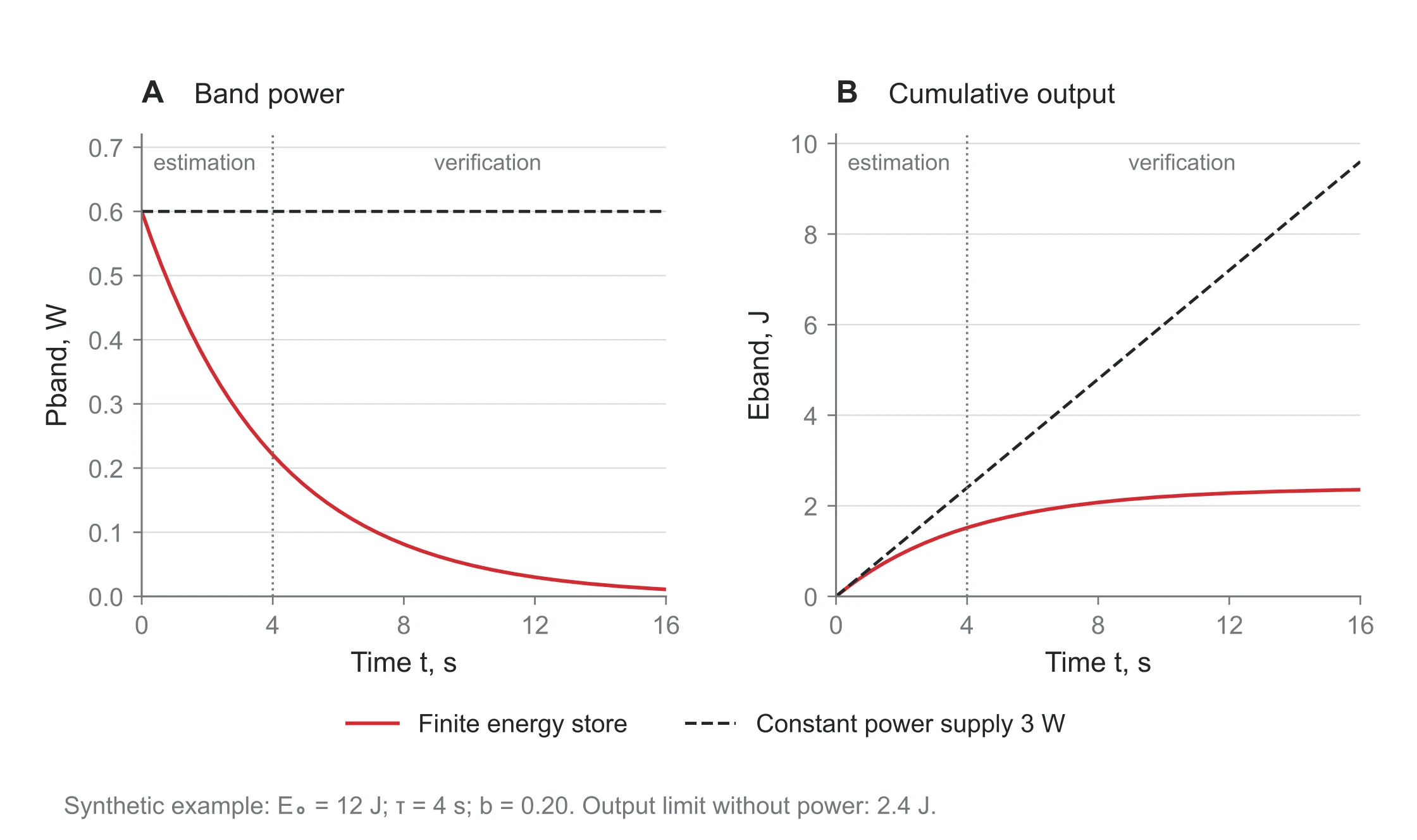
Figure 16. Finite supply and maintained glow. Synthetic energy-balance example: E₀ = 12 J, τ = 4 s, b = 0.20. Without power, the band power is 0.60 exp(−t/4) W, and the accumulated output is 2.4[1 − exp(−t/4)] J. With constant power supply 3 W, the reserve remains 12 J: the power in the band is 0.60 W, the output is 0.60t J. The first four seconds are allocated for parameter estimation, the subsequent interval is for checking the discriminative prediction. Measurement errors are not modeled.
A stable glow in itself does not disprove the finite supply: one can propose a very large E₀ and a different τ. Therefore, the limitation of the initial resource must have an independent basis, and the loss law must be checked separately. In the absence of such a basis, the conclusion becomes narrower: this exponential model with the estimated parameters does not describe the record. This is a complete result, after which one chooses between changing the loss law, external power supply, and a different interpretation of the measured light.
The custodian stores the original radiometric readings, spectral band, geometry and all saturated intervals. The metrologist evaluates the uncertainty of the integral output and its relationship to power calibration. The supervisor fixes the fit area before checking the later section. If the observation does not cover the beginning of the event, E₀ refers to the beginning of the available series, not the moment of birth of the object. This refinement preserves the usefulness of the model even for incomplete recording.
Chapter 24
Acoustics and mechanical vibrations
Two pathways behind one report
Humming, trembling of objects and sensations of pressure can refer to different physical channels. The microphone measures changes in air pressure in a specific band; the accelerometer measures the proper acceleration of the sensing element associated with the attachment point; a complaint record characterizes a person's experience. These data can be compared, but one cannot be replaced by another. An acoustic case is classified as AC based on an identified signal or a reasonable hypothesis of its presence. As long as only the experience is recorded, the physical channel remains a research question, even if the description seems very specific.
The main difficulty of low-frequency observation is that the usual recording of sound may not preserve the desired value. The band is determined by the entire path: the sensitive element, amplifier, filters, converter and program. The noise amplified during playback does not prove the existence of the same pressure in the original environment. In contrast, an empty trace of a consumer device does not exclude a signal outside its range. Therefore, the metrologist describes the tested frequency response and the limits of applicability, including the relationships between the significant influencing quantities [2].
Registration plan
The proposed protocol separates the air and structural channels. A sound pressure meter is installed at an accessible support position, and suitable motion sensors are installed on permitted structures. The method of attachment is recorded by photography and recording, since the movement of a specific point in a specific direction is measured. A time reference and a log of equipment operation are also needed. If the source is suspected of moving, first check the movement of the measurement platform itself. Wind, touching the sensor and operator actions are noted as events that can change the recording.
Frequency analysis is accompanied by viewing the original time series. Short beats, a steady tone, and a slow background change may produce a similar average, although they require different explanations. For each calculation, the interval, window and averaging method are indicated. Changing the method after identifying an interesting peak is allowed as an exploratory analysis, but the new result is checked on a different record. Collection parameters are selected based on the expected duration and frequency; a detected form that the path could not correctly register does not become evidence due to the detailed graph.
The control position is selected along the expected transmission path. An adjacent room may share the same foundation and therefore not be an independent control of mechanical vibration. A street point may have a different air background. It is useful to explain in advance what distinctions between positions should be maintained in each version of the source. Simultaneous observations protect against confusion of the spatial effect with a changed machine mode. Repeated recordings over different periods check the stability of the connection, but are not considered independent just because they are stored in separate files.
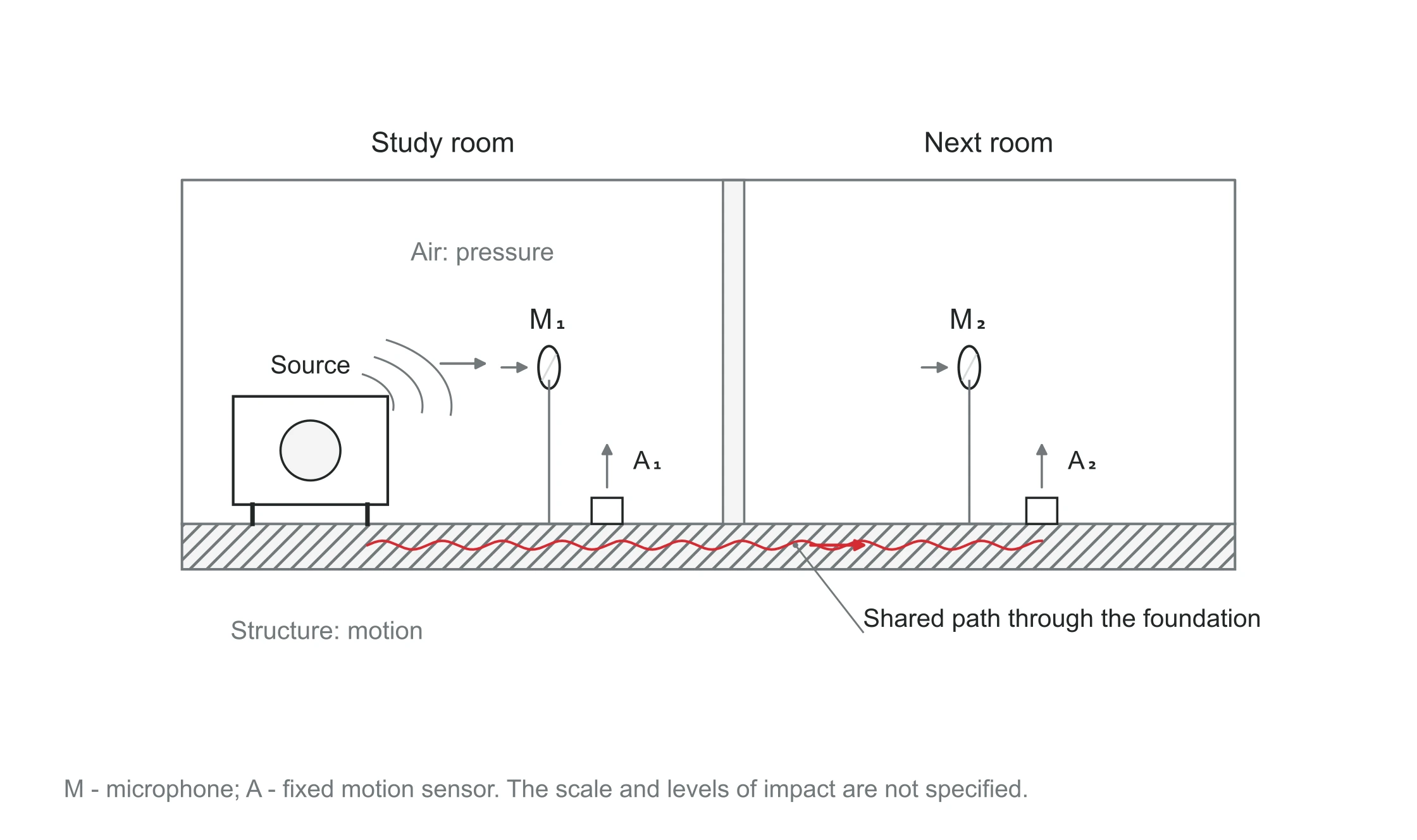
Figure 17. Airborne and structural transmission routes. Study section of premises with a common base. Microphones M₁ and M₂ observe air pressure, fixed sensors A₁ and A₂ monitor the movement of the structure in the shown direction. The scarlet path highlights a common mechanical connection through the base: the adjacent room therefore does not become an independent vibration control. The geometry does not specify safety distances, frequency response or insulation design.
Sensations and Causal Inference
Reports from people are placed on a separate timeline without suggesting a list of symptoms. Their relationship to the physical channel is assessed after the initial descriptions have been recorded. A negative finding in one study cannot invalidate every subjective experience. In a double-blind crossover study by Marshall and colleagues, the tested simulated-infrasound exposure did not worsen the measured outcomes relative to sham exposure; the conclusion is limited to the participants, exposure, and selected outcomes [35]. It neither defines a universally safe level nor explains every situation involving low-frequency noise.
If the experience coincides with turning on the equipment, several causal pathways remain: sound, vibration, accompanying room changes, and the participant's knowledge of the operation of the machine. They are differentiated by suitable observations and, if necessary, approved human subjects testing rather than home-based amplification. Clinical assessment of the condition is performed separately from physical reconstruction. The lack of an acoustic explanation does not invalidate the message, but it does not confirm an external source with unusual properties.
Forks and termination
When the signal is present in the microphone and is associated with the source mode, the air path is specified. When the structural channel changes more strongly, the mechanical connection is examined. When only the processed track is changed, the original recording and settings are returned. When different sensors produce inconsistent results, ranges, orientation, and timing are first checked. At each stage, the leader formulates the following question; the operator does not select a new stimulation based on the impression of the sound. Determining the cause and reducing the impact can proceed at different speeds.
The Safety Coordinator will terminate the research intervention if approved conditions are exceeded, people react unexpectedly, the stability of the structure is compromised, or source control is lost. Numerical limits are taken from the applicable estimate for the specific environment and task. The stop must maintain the necessary protective functions of the building. If the installed source can be routinely transferred to safe mode, the subject matter expert specifies the transition, and the team verifies that both physical channels change and the meters return to normal operation.
The training scenario completes the logic: periodic movement of a light object is noticed on the floor and a hum is heard. Simultaneous recording shows that the movement follows the mechanical impulses while the tone is maintained continuously. The general signature “acoustic anomaly” would hide two processes. Split analysis allows you to address the mechanical transmission and continue to study airborne noise separately. Even if the movement is successfully eliminated, the conclusion does not promise the disappearance of all sensations: it names the verified result, the remaining channels and the conditions for subsequent observation.
Chapter 25
Thermal processes and energy balance
Temperature, flow and energy reserve
The cold area of the image, the rapid heating of the object and the expected excess energy form three different problems. Temperature describes the thermal state within the chosen model; flow characterizes the transfer of energy; energy balance requires taking into account changes in supply and exchange across system boundaries. Low temperature in itself does not prove energy extraction by an unknown mechanism. High temperature does not set the power of the source. The first decision of the chapter is to select the statement to be tested and the system scale to which it applies.
In a thermal imager, between the object and the number on the screen there is a radiometric conversion model. The NIST thermal camera calibration report specifically addresses measurement procedures and uncertainty, including spatial blurring of the [36] signal. Research practice therefore retains radiometric data and processing information when available. Changing the palette only rearranges the display. The appearance of an expressive blue spot on an automatically extended scale is not equivalent to the appearance of a new physical cold.
Thermal Observation Check
The author's scheme begins with an accessible, still view. It indicates the surface under study, stable landmarks and control areas. The observation direction, distance within the established geometry, air conditions and surface features are recorded. Reflected radiation and changes in emissivity are considered competing explanations for signal changes. A contact sensor, if its use is permissible, provides a different comparison channel, but itself changes the conditions of local heat exchange. The disagreement between two measurement methods is analyzed through their physical models, and not by voting of instruments.
For repeated observation, the camera position is restored and identical areas are compared. The time series are combined taking into account the response delay: the camera and the installed sensor can smooth out the fast process in different ways. If the surface material, humidity or geometry changes, the previous signal conversion is checked again. The signal at the boundary of a small object may include adjacent background; Enlarging the screen image does not restore lost spatial resolution. The protocol explicitly marks areas for which the numerical temperature estimate is not confirmed.
Balance with designated boundaries
To test the energy hypothesis, draw the boundary of the system and list the flows crossing it. Heat exchange, the operation of external devices, and energy transfer with the substance are taken into account if the substance enters or exits. A convenient entry looks like: . Here ΔE is an estimate of the change in energy reserves within the boundary for a selected interval, Ein and Eout are the total inflow and outflow, R is the remainder of the accepted balance. The sign and definitions of all terms are fixed before analysis; different types of transfer do not include twice.
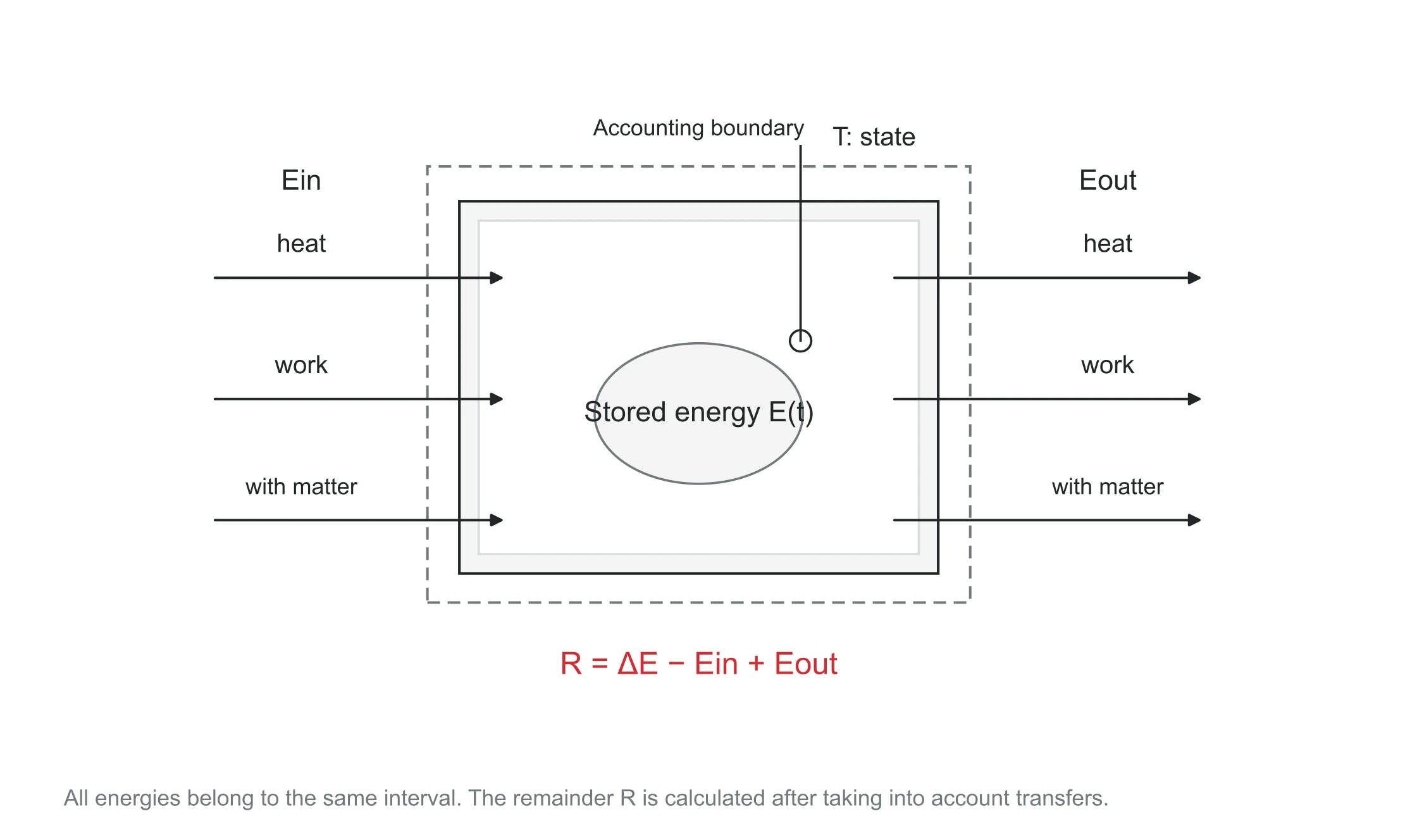
Figure 18. Control volume and energy balance balance. Accounting scheme for conditional control volume. Heat, work and energy transferred by the substance enter into Ein and Eout over the same interval; each transfer is included once in the matched model. The temperature channel observes the condition. The scarlet remainder R = ΔE − Ein + Eout is moved out of bounds as a result of the calculation and is not depicted as a new energy source. A set of arrows shows metering categories rather than already measured flows.
A non-zero R first characterizes the inconsistency between the data and the model. To discuss a new source, it is necessary to show that the remainder is conserved when the boundary, measurements, and known transport pathways are refined. The uncertainty of the remainder is not obtained by simply listing the accuracies: common sensors, corrections and background are able to relate the estimates of the terms [2]. If the significant flux is not measured at all, the beautiful numerical value of R does not have the status of a closed-loop energy proof. The report leaves an unfinished balance rather than a detected energy of unknown origin.
A calorimetric test project is drawn up for a material that has already been approved for the corresponding laboratory procedure. The manager determines the expected difference between the hypotheses; the heating engineer sets the model of accumulation and losses; the metrologist prescribes control measurements; the operator records each mode transition. Before an unknown object, the system itself is checked against an authorized reference process. Installation parameters are selected according to the required sensitivity and properties of the task. Transferring an object into a closed chamber is not considered a neutral action: it can change heat dissipation, gas exchange and the state of the material.
Intervention forks
If an independent measurement confirms the temperature change, but the balance is explained by normal heat exchange, the control is directed to the established path. If only the radiometric assessment changes, the surface and recording path are examined. If both channels are confirmed and the balance is incomplete, the flows are first clarified. Only after this is the residual hypothesis formulated quantitatively: under what change in admissible conditions does it predict a different result than the known models. Neither branch requires random heating of an unknown substance or testing the effects on humans.
A shutdown is declared when there is a loss of plant temperature control, an unintended change in material, damage to the containment system, or loss of a critical measurement. It means moving to a predetermined safe mode while maintaining the necessary cooling and monitoring. The return of readings to background is checked after the channel is restored to serviceability. If the surface has become optically different, the disappearance of the spot may reflect a change in observation rather than the cessation of the source. Therefore, confirmation of the result is based on the path of influence for which the decision was made.
Educational analysis
In a fictitious experiment, a closed case heats up slowly even though the visible load is turned off. The first estimate takes into account only the wall temperature and concludes that there is excess energy. The extended log detects continued power to the internal logger; the control case shows a different heat dissipation due to a different tabletop installation. After accounting for these differences, the remainder disappears within the limits of uncertainty. This outcome is not a failure of the study: an explanatory model has been obtained and requirements for the next trial have been established. If the remainder holds, it is these requirements that will make the new result meaningful.
Chapter 26
Movement of objects and apparent levitation
From image to mechanics
The observed motion requires the indication of a reference frame. An object can change position relative to the camera, table, building or earth's surface; These are different statements. The camera, mounted on an oscillating support, is able to attribute its own movement to the surrounding scene. Therefore, the first measurement of the MV class relates to coordinates and time, and the conclusion about force appears only after analyzing the geometry, mass and interactions. Apparent immobility in the air also needs to be verified: maintaining a position does not yet indicate how the acting forces are balanced.
Non-contact retention is known to physics. Berry and Geim consider diamagnetic levitation, in which magnetic interaction in a suitable non-uniform field can balance the gravity of [23]. This example is important as a test of the logic of the conclusion: the absence of a visible support does not establish gravity shielding. The conditions described do not constitute a proposal to build a field installation with a strong magnetic field. The unknown case requires its own reconstruction; external similarity with the published experiment does not prove the coincidence of the mechanism.
Trajectory and scene completeness
The author's protocol begins with an unalterable, general-view record that includes the subject, intended supports, and surrounding landmarks. The close-up complements it, but does not replace it: the lost periphery can hide the movement of the platform or external contact. With multiple cameras, time and geometry are confirmed separately. For each trajectory, the original image coordinates, object selection rules, and position uncertainty estimates are stored. Smoothing and calculation of acceleration are formalized as derivative operations; a sharp acceleration peak may arise from a small localization error.
If radar is used, it is useful to remember the independent branch of instrument explanation. In a study of automotive radar with multiple transmit and receive channels (MIMO), reflected multipaths created false moving targets; recognition depended on the scene model, and some filtering methods also removed real direct signals [18]. Therefore, the trajectory remaining after algorithmic cleaning is compared with the original data. The agreement between camera and radar strengthens the argument only after checking that both channels refer to the same object and do not share an erroneous time reference.
Force measurements are planned separately. A sensor on a support evaluates the interaction with that support; accelerometer—proper acceleration of the sensing element; coordinate motion is restored taking into account orientation and gravity; none of them alone describes all the forces on the body. For static holding, an estimated balance is drawn up, for movement - a model of the change in momentum in the designated reference system. Air flows, electrical and magnetic interactions, mechanical connections and support inclination are considered as channels to be tested. The entry “no forces detected” is replaced with a list of measured channels with sensitivity limits.
What follows the effect
If the study allows limited variation in conditions, select in advance which feature will distinguish between site, material, apparatus, and source. Rearranging an available inert reference object can test the observation geometry; changing the camera position - optical version. Any movement of an unknown object is considered as a separate intervention, and not as the usual preparation of an experiment. For field maps, non-uniqueness also remains: different distributions of sources can be consistent with the same measurements of the [22] field. One card does not replace a mechanical balance.
Dependence on the observer is treated especially carefully. The operator simultaneously changes lighting, body position, air flow, floor load and the moment the recording starts. If the effect disappeared when the person was removed, the involvement of consciousness has not yet been established. First, the changed physical conditions and launch method are examined. Blind processing of recordings helps to separate knowledge of the condition from the extraction of the trajectory, but does not correct poor shooting. The study of human participation requires a separate ethical basis and does not involve the presence of a person in the area of moving objects.
Acceptable Experience Limit
Before intervention, a specialized specialist considers possible falls, capture, rotation and load transfer to adjacent structures. The manager records the measurement goal, the safety coordinator records the access boundaries and termination signs, and the operator records the sequence of permitted actions. Observation is terminated when there is unplanned movement, loss of control over the source of force, change in the support system, or loss of a channel on which safety depends. Conditions are selected for a specific mass, geometry and environment; the same “distance from levitation” for all cases is not physically justified.
Exposure management is associated with a validated mechanism. If the movement is created by a standard drive, its engineered safe transition is used. If the source is unknown, the absence of a movement command is not considered a fixation. Turning off the camera or suppressing the signal by the algorithm means losing surveillance, not stopping the subject. After any restriction, the actual position, the condition of the restraints and the new mechanical loads are checked. The reversibility of the control command does not guarantee the reversibility of damage that may have occurred during the transition.
What remains established
Training scenario: A light plate appears stationary above the surface, but a side view reveals regular touches that are indistinguishable from an overhead angle. The former free-hold model is replaced by a contact-based movement model; The research question shifts to the periodicity mechanism. If contacts and known fields are excluded only within limited ranges, the conclusion preserves these boundaries. A working hypothesis for a new interaction must predict a dependence on an available parameter and withstand independent replication. The strong impression of movement does not negate the need for such a prediction.
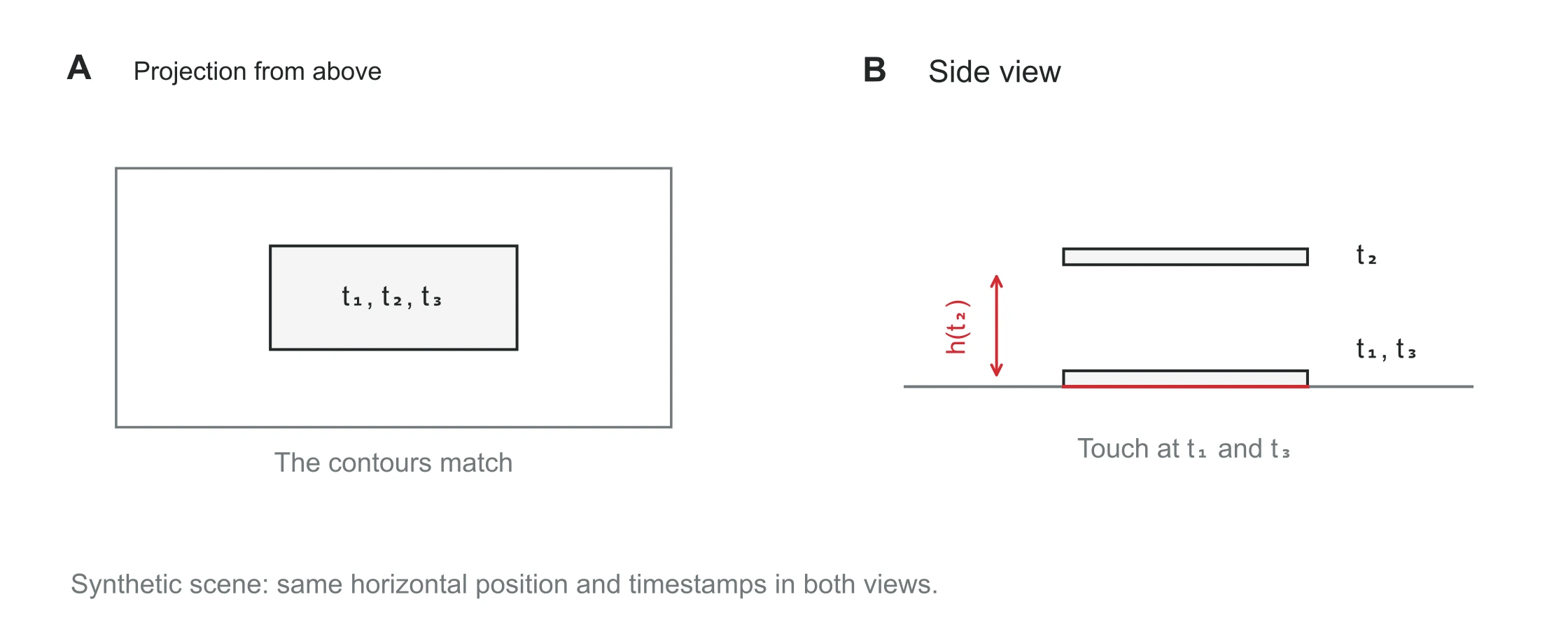
Figure 19. One plate from two viewpoints. Two software-generated projections of one synthetic scene. The plate maintains its horizontal position, so its contour from above coincides at t₁, t₂ and t₃. The side projection detects clearance at t₂ and contact at t₁ and t₃. The positions are schematic and do not set the amplitude of actual experiments; the drawing clarifies the completeness of observation without establishing the mechanism of movement.
Part VI