Matter and living systems
Chapter 27
Changes in mass and composition
What has really changed
The reading on the scale is not a direct record of the quantity of the substance. The measurement relates the interaction with the support, environmental conditions and the device model. Even when the result is expressed in mass units, it is necessary to establish what exactly was compared and what corrections were applied. The NIST Mass Calibration Guide covers air buoyancy, standards, and measurement conditions [37]. These foundations are especially relevant for a claim about the disappearance or reappearance of a substance: such a claim is much stronger than observing a change in the reading of a single device.
In the author’s protocol, the accounting object is first specified: a separate item, the contents of a vessel, or a system of “vessel, contents and closing elements.” The history of this border is being recorded. If a lid was opened, a tag was added, or an object was moved with a wet instrument between measurements, the sequence already contains a possible exchange of substance. Changes in mass, chemical composition and spatial distribution are studied separately. The coincidence of one indicator does not prove the immutability of the other two, and the difference between different parts of heterogeneous material does not necessarily mean a transformation over time.
Mass comparison
The plan includes the object under study, acceptable control containers and a suitable standard of comparison. The order of measurements is chosen so that the drift of the instrument does not automatically coincide with the difference in conditions. For each record, the time, object ID, container configuration, environmental conditions and installation status are stored. All valid duplicate measurements are also saved, not just the most unusual pair. The result is expressed as a change relative to a certain initial configuration; the unknown moment of loss of material is not replaced by the assumption of instantaneous disappearance.
If the reference changes, checking the measuring system becomes a priority. If the container and sample are changed in a similar way, the common factor is examined. If the difference is stable only in the sample, the available exchange paths with the environment and the condition of its surface are checked. The closed system assumption is tested by actual design and history, not by the word “closed.” The sealed or hermetic envelope is also part of the object and its own engineering task; unknown material cannot be enclosed in it without assessing the conditions that arise.
Composition and spectral features
The composition is determined by methods that answer a specific question: about chemical elements, compounds, phases or structure. Elemental spectrometry does not automatically answer all these questions. The description of energy dispersive X-ray spectrometry (EDS) published by NIST identifies the need for standards and matrix corrections, as well as spectral artifacts including output peaks and [38] hits. Therefore, one unrecognized peak does not receive the name of a new element. First, the calibration, background, response model, and consistency of the entire group of expected features are checked.
To test for compositional changes, comparable sites or a reasonable sampling scheme are needed. The sample keeper notes the position of each portion relative to the original object and all stages of preparation. Destructive analysis can provide qualitative data about its portion, but exclude subsequent measurement of its previous condition. If re-examination is allowed, the remainder is distributed among predetermined tasks. The independent method is chosen for its different physical basis and different set of errors, and not simply for the name of the second device.
Control materials undergo a comparable path whenever possible without additional risk. Empty containers help reveal the container's contribution; process control - changes made by preparation; repeated measurement of a verified standard—the state of the analytical channel. Their functions differ. If contamination is detected only after delivery, the entire chain to the laboratory is reconstructed. If the origin of the composition is uncertain, it cannot be confidently attributed to the place of discovery, even if the spectrum itself was obtained flawlessly.
Saving and limiting actions
Before analysis, a specialized specialist determines the admissibility of storage, transportation and the chosen research method. The appearance, absence of odor or absence of signal from one sensor does not provide general permission to handle the material. Treatment for safety may alter the characteristics being tested; World Health Organization (WHO) recommendations emphasize the dependence of decontamination on the material, conditions and validated process [39]. Therefore, the initial observation and the condition after treatment are recorded separately in the record. The scientific value of a sample is not a reason to keep a dangerous operation outside the laboratory's capabilities.
Stop work if there is an unexpected change to the container, signs of containment failure, actual material not meeting tolerance conditions, or loss of sample provenance rendering the next step pointless. The latter case does not always require emergency action, but does require stopping the interpretation. The manager can order re-registration or refuse the destructive analysis. The decision to renew is confirmed by a specialized specialist together with the safety coordinator; the specimen keeper conveys information about what remains unknown.
How an unusual result is formulated
Training scenario: two samples from the same stone give different elemental compositions, and the mass of the residue decreases after a series of operations. First there is a version of the transformation of matter. The selection map shows that the samples belonged to different inclusions; the log reveals an unaccounted portion consumed during preparation. The resulting balance explains observation without transformation of elements. If similar versions are verified and the remainder remains, a working hypothesis is formulated predicting a new independent comparison. An unusual composition in itself does not establish either the process by which the material appeared or its origin.
The conclusion contains the magnitude and uncertainty of the change, the definition of the accounting system, the distribution of the analyzed areas and a list of the transformations performed. They separately indicate which initial properties can no longer be verified. Such a report may retain the status of an open case without a dramatic title. The scientific result is reproducible differentiation and limitation of explanations; the words “materialization” or “transmutation” become valid only when substantially stronger requirements are met than a change in mass or an unexpected line in the spectrum.
Evidence-based ladder of substance change
A stronger claim requires new observations, not just a more confident description of the previous result. Changing the mass of a particular system, changing chemical bonds, and changing the composition of nuclei relate to different physical issues. Therefore, transitions between them are formalized explicitly. The table defines the author's research ladder; it does not constitute permission to analyze material for which an acceptable route of circulation has not been established.
Statement | Additional base | What has not yet been established |
The scale reading has changed | Saved initial reading and device status | System mass and reason for change |
The mass of the given system has changed | Comparable boundary; reference; amendments; uncertainty | Transfer or conversion path |
The distribution of components has changed | Representative selection and spatial map | Change in bulk composition |
Bonds or phases have changed | Method sensitive to the corresponding structure | Change of chemical elements |
Changed elemental or isotopic composition | Independent methods; sample balance; control of impurities and preparation | Mechanism of nuclear change |
Specific nuclear process model supported | Consensus products, balance and predicted additional features | Other processes outside the scope of inspection |
The first transition is well illustrated by a numerical example. Let synthetic measurements of one system give 100.0000 g and 99.9996 g, each with a standard uncertainty of 0.0002 g. If the errors are independent, the difference is equal to −0.0004 g, and its standard uncertainty is about 0.00028 g. Such a pair does not provide a convincing basis for discussing the disappearance of matter. If the errors are correlated, the difference budget must be recalculated based on their origin; the number of repetitions does not replace this work.
Even a significant loss of mass of the open part does not mean a loss of mass of the entire installation. Condensation on the wall, a separated portion, or transfer to another phase changes the local distribution. Therefore, in parallel, they keep records of the object, container, separated fractions and consumed samples. The same circuit is drawn up for the initial and final states. If part of the material cannot be safely taken into account, the result is limited to an open balance, maintaining a quantitative assessment of the missing link.
The following steps require methods with different tasks. Elemental composition, molecular bonds, crystalline phases, and isotope ratios are not four names for one analysis. Already the EDS description links the reliability of the elemental result with standards, matrix corrections and verification of spectral artifacts [38]. For a stronger conclusion, choose an additional method that is truly sensitive to the desired difference, and find out in advance which preparation transformations can change this difference.
The isotopic difference also needs causal testing. Comparison of different inclusions of a heterogeneous sample or a changed fraction ratio may change the measured ratio without the proposed nuclear transformation. Therefore, the model must predict changes in the abundance of specific components in the designated system and be consistent with the history of selection. Analysis of two portions of the same material is a test of heterogeneity and procedure, but is not automatically an independent repetition of the event.
If a certain nuclear mechanism is proposed, the expected products, the energy contribution, and the types of radiation that it actually provides are deduced from it. The universal requirement “there must be any radiation signal” does not exist in this research scheme: the prediction of the selected reaction is checked. The required sensitivity and recording time are calculated before the result is analyzed. The absence of a channel capable of noticing the predicted feature means that the test is incomplete, not confirmation of an unusual way to hide it.
A positive outcome may remain at an intermediate stage. For example, independent analyzes confirm a change in a certain phase after an observed event, while the elemental composition remains compatible with the original. This is a meaningful physical result with its own program for studying the conditions of formation. A premature transition to the word "transmutation" would make the conclusion less precise. The stage is stored along with what needs to be measured for the next transition, and the materials for safe and traceable handling are transferred to chapter 31.
Chapter 28
Ionizing radiation and detector failure
Indication and danger
The radiation case begins with the exact name of the quantity being measured. The number of recorded events, activity estimate, spectrum and dosimetric indicator are not interchangeable. The device converts the interactions available to its design and may not respond to a different type or energy range of radiation. Therefore, the IR class is assigned based on confirmed data or reasonable suspicion, and the decision on safety is made by a specialized specialist taking into account the entire situation. The inscription “radiation not detected” without the range, conditions and serviceability of the measuring instrument does not define a safe mode.
A particularly dangerous mistake is one in which the absence of evidence is perceived as an improvement. International Atomic Energy Agency (IAEA) guidance SSG-8 warns that some Geiger-Müller (GM) meters, especially older ones, may show zero [40] when saturated. This is a characteristic of certain devices and modes, and not of all modern dosimeters. The practical implication is that knowledge of the behavior of a particular channel under congestion is essential. A sudden drop in readings after they have increased requires diagnosis and a safe solution, rather than zooming in to confirm the suspected disappearance of the source.
Measuring channel qualification
The author's protocol begins before entering the site. The metrologist and radiation protection specialist agree on the measured quantity, type of device, range, observation geometry and signs of an unreliable result. The record includes an identifier, information about confirmation of characteristics, acceptable conditions, power status and malfunction signals provided by the manufacturer. The performance is checked using standard safe means in a competent organization. Such verification should not turn into an independent search or the use of unknown sources to test the device.
When recording, not only the average number is saved, but also the accumulation interval, position, timestamp and all warnings. A change in result may reflect a change in source, geometry, shielding objects, or sensor condition. If the operator moves at the same time as the band switch, the two influences are already mixed. The research record identifies areas of stable configuration, transitions and intervals for which interpretation is impossible. Data gaps are not filled with an assumption about the background level.
A reliable comparison requires a model of background fluctuations and alarm errors. NIST considers false alarm testing separate from detection performance; the statistical models used require their own premises [3]. Therefore, a series without alarms does not give the right to consider the probability of missing out to be zero. The test plan is formulated for a specific function and conditions. An artificially cleaned series, from which unusual readings are removed, is not suitable for an independent assessment of exactly those events for which the observation was carried out.
Three branches of the solution
The first branch - the reading in the confirmed range is consistent with an independent suitable channel. Then a specialist in the field interprets the value and determines measures for a real radiation problem. The second branch - the channels diverge, the device reports an overload or behaves in an unexpected way. Then the result is considered unreliable for access permission, the research step is stopped and the previously justified protective mode is maintained. Third branch - the readings are compatible with the background if the equipment is in working order. The conclusion is limited to the sensitivity, location, interval, and those types of radiation that were actually monitored.
The independence of devices is checked by the design of the entire system. Different enclosures can share power, software calculations, or the same time scale. A common cause can disrupt multiple backup links, so the number of devices is not equal to the number of independent acknowledgments [7]. If all loggers are losing data at the same time, this is a separate DI event that requires its own review. The radiation explanation for the electronic failure is also not automatically accepted: NASA distinguishes between single and cumulative effects in electronics, but the description of space systems does not establish the cause of a terrestrial device failure [41].
Exploration without dangerous escalation
The signal from the radiation device is not an invitation to find the item manually. The research director passes the assessment to the relevant service and limits the scientific task to the available data. The safety coordinator has the right to stop work if there is a loss of control, a change in the situation or insufficient equipment. Relocation, opening, shielding and processing of a suspected source are considered special activities with assigned responsibilities. The universal radius, shielding material, or approach order are not inferred from the IR class name.
If the phenomenon under study has disappeared, first confirm the operability of the tract and the preservation of the comparison conditions. The source could leave the field of observation, become obscured by an obstacle, or change mode. Neither of these outcomes by itself equals the removal of the hazard. Checking for possible contamination is a different task than measuring the external field; it requires an appropriate professional plan. Scientific uncertainty about the mechanism does not override organizational restrictions based on an already established risk category.
Training scenario: after an increase in readings, one device displays zero, and the log simultaneously records a sign of an unacceptable mode. An erroneous interpretation would declare neutralization. A correct entry highlights the measurement failure, pauses the next step, and maintains the limitations until independent evaluation. If a real field decline is later confirmed, this will become a separate output with its own time boundary. The final report distinguishes between the measurements taken, the intervals that were not available, the protective decisions made, and what questions remain open.
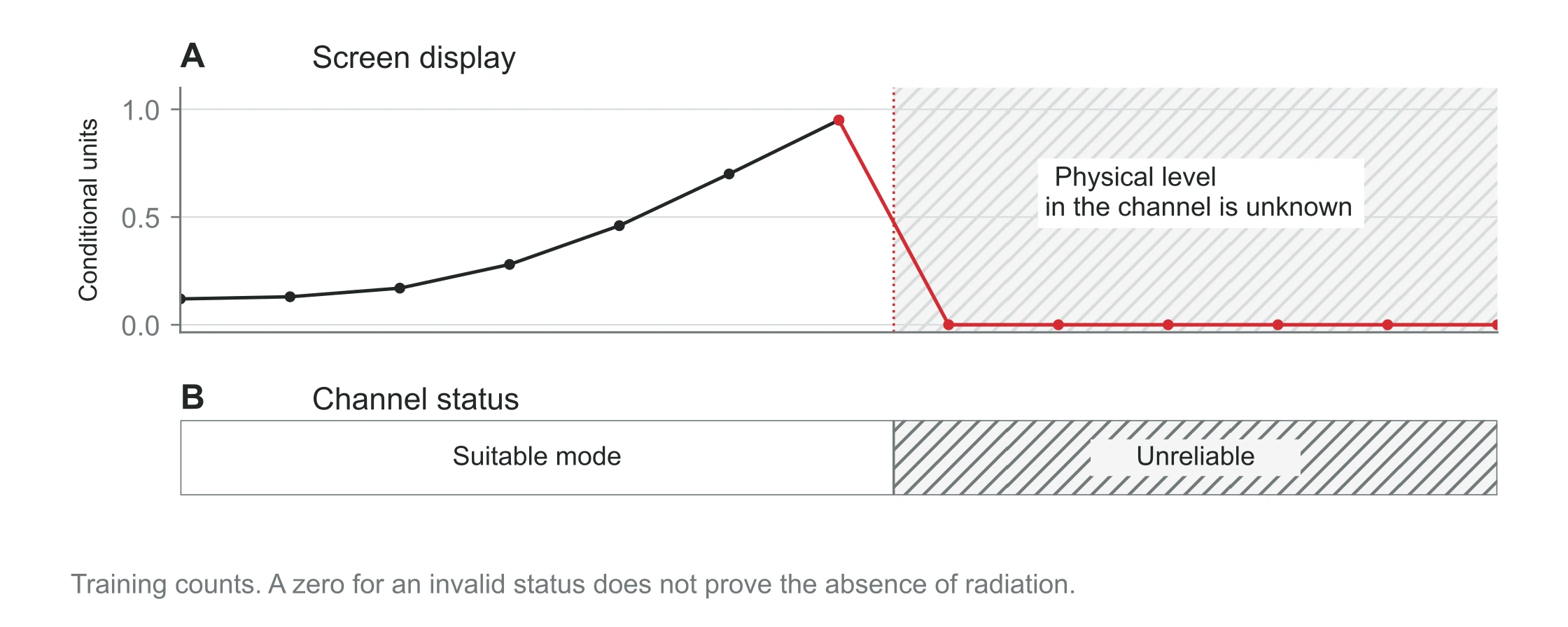
Figure 20. Zero reading when the channel becomes unusable. Synthetic readings of one conditional channel and a separate band of its suitability. After the invalid mode flag, the displayed number drops to zero and physical layer interpretation on that channel becomes unavailable. The hidden dose is not completed; The example does not specify the general saturation characteristics of the detectors and does not establish a tolerance threshold.
Chapter 29
Biological and environmental deviations
Levels of a living system
Unusual plant coloration, mass mortality of organisms, shifts in animal behavior, and an unknown laboratory result refer to different levels of organization. The BI class unifies the subject area, but does not specify a single reason. An observation is described in terms of an organism, population, community or ecosystem and a specific indicator: abundance, distribution, damage, activity or composition. External unusualness does not establish infectivity, and the absence of familiar signs does not provide a general conclusion about safety. The first task is to distinguish between a biological event, a state of the environment, and a recording error.
The work is based on known terrestrial mechanisms: changes in water and power supply, temperature, chemical influences, diseases, natural dynamics and human influence. The list is turned into testable alternatives, choosing measurements for each. Detection of a form not identified by the observer means a limitation of identification. It does not support extraterrestrial origin, special life basis, or intelligent behavior. Such hypotheses will require additional features that cannot be obtained by simply renaming an unknown organism.
Environmental surveillance plan
The author's scheme begins with a map of observations, site history and comparable control sites. The recording unit, area or duration of observation, season, weather and detection rules are recorded. The same area may appear deserted due to changes in shooting time or visibility. Therefore, zero observations and search effort are also stored. The control area is selected based on the similarity of significant conditions, and not just on remoteness. If water regimes or vegetation composition differ, simple comparisons of abundance may confound several causes.
In the U.S. Environmental Protection Agency's (EPA) wetland monitoring guidance, the BACI (before-after/control-impact) framework compares changes before and after exposure at the study and control sites. Repeated observations are needed to account for natural variability; the lack of baseline period and site differences limit the causal inference of [42]. Transferring this logic to an unknown case is the author's adaptation. If the event has already occurred, previous photographs and journals are assessed as historical data with a different completeness. They cannot be declared as equivalent replacements for the pre-planned original series.
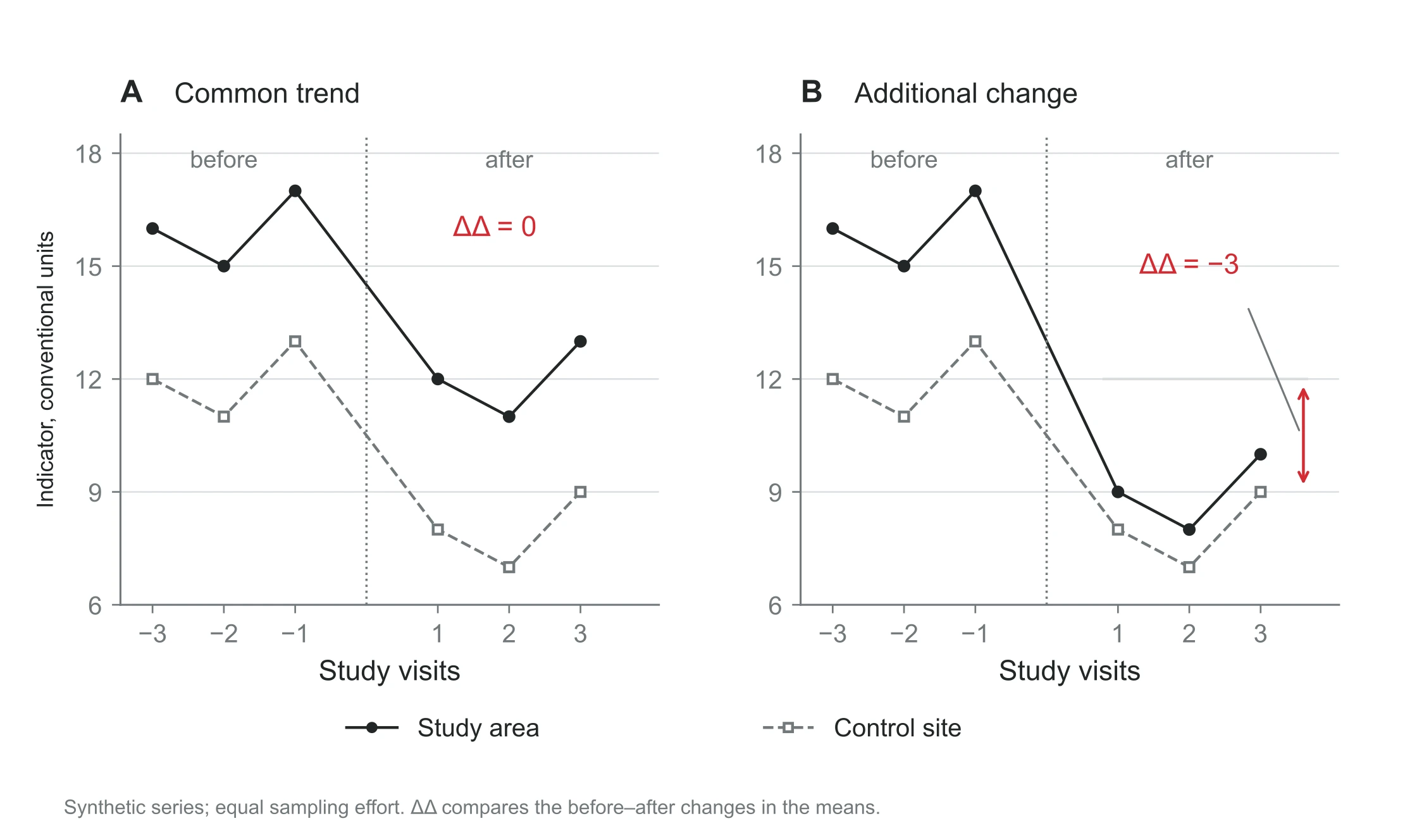
Figure 21. General trend and change in the study area only. Two synthetic comparisons of repeated observations with equal accounting training effort. On the left, the average decreases by four units in both sections: the difference in changes ΔΔ is equal to zero. On the right, the control is reduced by four, the studied area by seven: ΔΔ = −3. This is an illustration of a calculation, not an EPA data or proof of cause. The conclusion depends on the comparability of the sites and the reference period; without pre-exposure observations, these comparisons are not available.
It is useful to separate the response rate from the suspected cause. For example, changes in vegetation cover are recorded independently of measurements of water, light, and physical properties of the environment. Time course helps to choose a model: instantaneous visible change, gradual damage and recovery after changing conditions require different explanations. However, a delayed response does not prove a hidden agent. The plan specifies in advance which comparisons will support a particular version, which ones will weaken it, and which results will remain ambiguous.
From observation to sample
Selection is not a necessary first step. First, it is determined whether the proposed analysis will change the decision and whether a competent laboratory can accept the material in a known configuration. WHO relates biological risk assessment to the agent, procedure, equipment, environment and personnel competence; gaps in information affect the selection of measures [43]. Therefore, the unknown cannot be eliminated by prescribing an arbitrary universal protection kit. The issue of the admissibility of selection is decided before it is carried out, together with waste management and possible changes in the environment itself.
The Biosafety in Microbiology and Biomedical Laboratories (BMBL) guideline, prepared by the US Centers for Disease Control and Prevention (CDC) and the US National Institutes of Health (NIH), addresses risk assessment as the basis of laboratory work and the shared responsibilities of managers, biosafety specialists and participants in the procedure. Recommendations are advisory in nature; they do not list all possible combinations of threats and measures [44]. This principle provides the rationale for requiring a separate determination from the receiving laboratory rather than assigning a fictitious level of “abnormal protection” to any biological material. Known professional requirements remain regardless of the unusual nature of the find's history.
If sampling is permitted, the custodian records the location, time, observed condition, connection to the photograph, and any changes prior to transfer. Control samples and background observations are assigned according to the research question. Processing required for safe handling may change the characteristics intended to be analyzed; this is reflected in the choice of method and conclusion. Independent cultivation of unknown material, test infection of organisms and testing on humans are not included in the research route. They are not a necessary condition for obtaining useful field data.
Forks and boundaries of intervention
When the deviation matches the measured environmental change, the mechanism and independent alternatives are evaluated. When a general time trend is found across all sites, the regional factor is examined. When the effect is stable only in a separate zone, the local pathways of influence and the quality of the control comparison are clarified. If the laboratory result diverges from the field, the representativeness and preservation of the material are checked. A negative result from a particular test limits the trait tested; it does not prove the absence of any biological hazard.
Work is stopped if there are signs of unintended transfer of material, a violation of retention, a sample that does not meet the reception conditions, or a threat to people and the environment. The safety coordinator initiates the planned response, and specialized services solve the practical problem. The destruction of organisms or the cultivation of an area is not prescribed for the sake of testing a beautiful hypothesis. Even an action that reduces one type of impact can change a community and prevent the cause from being restored. Interventions require ecological and biological justification separate from scientific curiosity.
Training scenario: An unusual bloom appears near one shore, and then decreases a week later after a change in weather. Without control, this would appear to be a successful neutralization by the group's last action. Comparable observations show a simultaneous change in the area where no one intervened. The correct inference limits the causal role of the intervention and preserves the task of studying the conditions. The completed biological protocol describes the state of the system, possible transfer, the validity of the comparison and who is responsible for further monitoring; it does not replace this information with the name of an unknown creature.
Chapter 30
Mixed processes and cascading changes
Multiple classes in one case
The event may be simultaneously accompanied by light, temperature changes, movement of objects and recording failures. The list of classes OP, TH, MV and DI describes the manifestations, but does not yet explain their relationship. A single source with several pathways of influence, a chain of sequential changes, or independent processes that coincided accidentally in time are possible. Research must distinguish between these structures. Assigning many classes to one case does not mean the discovery of many new interactions and does not give the right to combine uncertainties into one expressive story.
The author's model represents the process as a network of causal assumptions. Nodes represent measurable states: device mode, field, temperature, air flow, object position, data channel state. The arrow indicates a specific expected impact and is accompanied by the expected direction of change or lag. Individual nodes describe the actions of the group. Such a scheme does not have to be completely correct; its task is to show which connections have been verified, which are only assumed, and where the measurements are not enough to choose between versions.
Common cause and sequence
Synchronicity does not always mean direct transmission of impact. Three sensors can simultaneously change readings due to a common power supply, a common time, or a common processing algorithm. NASA is separately considering a common-cause failure that could overcome the [7] redundancy. Therefore, the research design includes the instrumentation infrastructure, including environmental conditions. Dependencies between channels are clarified before acknowledgments are counted. Unless a common cause has yet been verified, the consistency of multiple screens receives less evidentiary value than independent measurements of different physical quantities.
The sequence of events also requires caution. The measured latency includes sensor response, data acquisition, transmission, and timestamping. An early signal in the log may be a late physics process if another channel reports the result after averaging. First, the order is estimated taking into account these uncertainties, then causation is discussed. If the possible start intervals overlap, the report retains the indeterminate order. It cannot be corrected by selecting those peaks that better fit the desired cascade model.
Research System Intervention
Distance reduces some contacts, but does not make observation physically absent. In a study of a pollution measurement system on an unmanned platform, the propellers changed the plume distribution and readings; the impact depended on the configuration and mode of [45]. Therefore, robot movement, lighting, fan operation and radio signal transmission are included in the impact log. A device that simultaneously observes and changes its environment can create positive feedback: a change in its mode triggers a new signal, and a new signal triggers another change in mode.
To distinguish between versions, an observable relationship is selected in advance, which can be verified without dangerous escalation. The passive stage is able to show a stable sequence. The permitted control mode of the equipment helps to verify its participation. A comparison with a stand-alone logger evaluates the role of the shared infrastructure. You should not change multiple conditions at once if their causal contribution is the issue. However, for the sake of the experimental purity, the protective function cannot be turned off: the inaccessibility of such a comparison honestly limits the conclusion, and does not justify the risk.
The mixed case especially requires a test of the usual hazards. Field gas sensors have limited selectivity and are application dependent; some types may give erroneously low readings in unfavorable [31] atmospheres. This means that the coincidence of unusual light with the normal reading of one device does not cancel the assessment of the environment. The UN class is retained for the insufficiently defined remainder, and the established factors are considered according to their professional rules. An unknown cause should not displace a practical risk that has already been identified.
Cascade control
For each connection, the consequences of breaking are specified. Stopping the drive may reduce vibration but stop the necessary heat dissipation; Closing the transport pathway can alter the accumulation of the substance. The study director and subject matter expert select the action for the entire design, and the safety coordinator checks that critical conditions remain observable. Preference is given to a change with a clear mechanism and a verifiable result. If the expected benefit depends on several unconfirmed connections at once, the intervention remains insufficiently justified, even when its name sounds like neutralization.
Stop signs are not limited to just one channel. These include an unintended combination of processes, acceleration of change, spread beyond the agreed boundary, loss of independent control and deviation of the protective system from the permitted mode. The operator transfers the installation to the intended state, preserving the necessary functions. The data custodian records the last valid configuration and moment of each command. After stopping, they check whether another branch of the cascade has arisen, which the previous circuit considered unimportant.
Educational reconstruction
In a fictitious room, the indicator light flashes, the light tape moves, the camera stops recording, and the body temperature rises. First, events are associated with a single unknown field. The log shows changes in the ventilation mode and the shared electrical line; a self-contained camera stores the recording, and the movement of the tape follows the air flow. The temperature delay is consistent with the heat transfer of the housing. This reconstruction does not require the claim that all mixed events are common. It demonstrates how a single testable network replaces an uncertain feature union.
If some manifestations remain unexplained, the scheme reduces the problem space. Established connections are saved, unconfirmed ones are marked, and the next series is sent to the most discriminating node. The result may be multiple mechanisms with varying confidence, rather than a single answer. Such a structure is also useful for management: limiting a confirmed path of influence is possible before the final theory, if the own risks of the limitation are assessed. Scientific explanation and practical control are related, but do not have to be completed simultaneously.
Chapter 31
Samples and preservation of the state under study
What exactly is saved
A sample is part of a process transferred to another research situation. Removal from a site changes the environment, support, lighting, temperature, gas exchange or other connections. Therefore, the expression “keep an object unchanged” is not sufficiently specific. It is necessary to name the properties that are important for the following conclusion: composition, structure, distribution of components, surface shape or time dynamics. If it is not known which link supports the observed state, in-situ logging within a valid mode is preferable first. Transfer is not considered the default way to deliver an anomaly to a more convenient laboratory.
The author's protocol shares three objectives: limiting the impact on people and the environment, preserving scientifically significant properties and proving the origin of the material. These tasks may conflict. Safe processing can destroy the trait being studied; Optimal analytical storage may not meet retention conditions. The decision is made by the competent group before selection. Rejection of a sample while maintaining quality observations is a complete outcome if a safe and scientifically meaningful handling route is not established.
Admission conditions
The manager formulates the analysis question and explains why it cannot be solved by the existing data. A specialized specialist evaluates the expected properties and hazards, the receiving laboratory confirms the available procedures, and the safety coordinator checks the application at all stages. In a biological context, BMBL relates risk to the agent, the material, and the activity itself; changing the methodology can change the necessary measures [44]. This principle does not provide universal permission to handle any unknown substance: it requires a specific description of the task and capabilities of the institution.
Before dispatch, the identifiers, expected state, valid container, and responsible recipient are agreed upon. Conditions of transportation and mandatory requirements are determined by competent specialists for the actual category of material and the applicable jurisdiction. In the book they are not replaced by the conventional label “anomalous sample.” If the initial data is insufficient to assign an acceptable treatment, further selection is suspended. The uncertainty does not disappear once the item is placed in a closed box; it is simply transferred to another person if not explicitly described.
Chain of origin and transformation
On site, each sample is assigned a persistent identifier and linked to the overall site record. The time, position, orientation, observed state, performer and the basis for choosing this particular part are recorded. The image must show a connection to the original object where such registration is possible without additional risk. Chunking creates child identifiers with a preserved relationship. Renaming a file or laboratory internal numbering should not interrupt this story.
For each transfer, the sender, recipient, time and actual condition of the package are noted. The discrepancy is not silently corrected: it is described as a separate event. The log includes storage changes, processing, opening, separating, and material consumption. The sequence of transformations is important, not just the list of owners. If the measurement was taken after treatment, the result refers to the treated condition; the assumption about the state before it requires a separate basis.
The control regimen is selected based on the possible source of the impurity or change. Container control shows the contribution of the container, transfer control shows part of the path events, and preparation control shows the impact of the laboratory procedure. Replicates are useful for checking for heterogeneity, but are not independent inputs. The content and number of controls are justified by the task and the admissibility of actions. A large number of samples does not compensate for the lack of a record of where they came from and how they were modified.
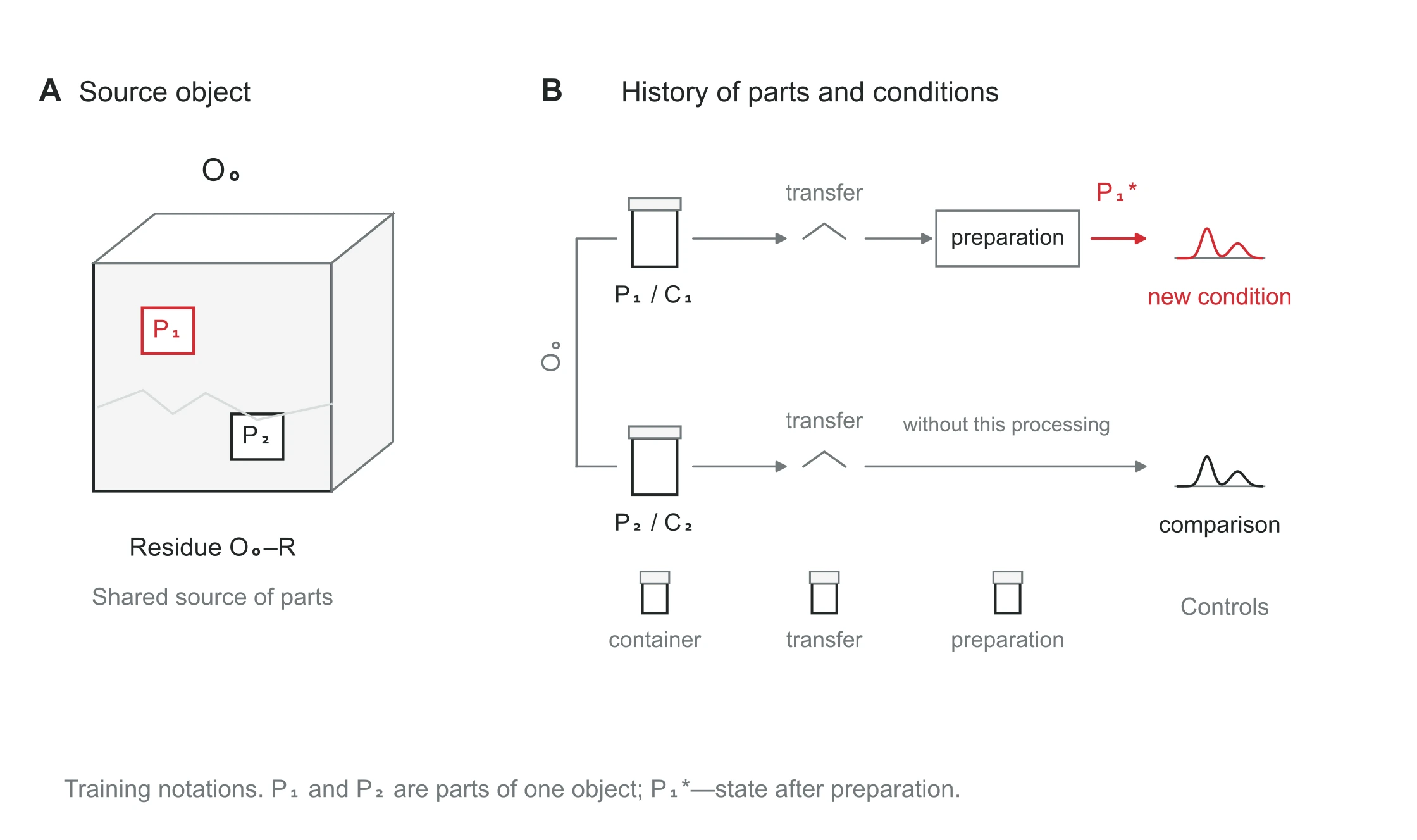
Figure 22. Sample map, child parts and state changes. A training map of one parent object O₀, its children P₁ and P₂, and the remainder O₀–R. The history preserves the connection of each part with the container, the transfer, and the subsequent state. P₁* denotes the portion after preparation, and the schematic response icons are not spectral data. Containing, transfer and preparation controls belong to different stages. Two parts of the same object do not become independent original objects; the method of handling an unknown material is not specified by the design.
Safe processing and preservation of features
WHO emphasizes the need to select and validate the decontamination process for specific conditions; material properties and actual execution influence the result [39]. The research chain therefore distinguishes between a specified process, evidence of its implementation and verification of effectiveness. External cleanliness does not replace the latter. At the same time, it is documented which analytical properties the treatment may have changed. Preserving evidence does not require sacrificing essential security; it requires an honest identification of lost inferential possibilities.
If the hypothesis relates to a transitional state, a synchronous recording design before selection, during permitted transfer, and after acceptance is useful. Time stamps describe not only the clock, but also the actual events: change of support, closing of the container, start of measurement. This sequence makes it possible to distinguish the disappearance of the effect during transfer from its natural attenuation, if there is enough data. The disappearance itself does not prove the attachment of the phenomenon to the place: the cause could be changed conditions or a loss of sensitivity of observation.
Stop and summary of the material
The operation is stopped if the hold is broken, the sample changes unexpectedly, does not meet the agreed conditions, or the possibility of safe acceptance is lost. If the problem is one of identification, the material is not renamed a guess, but is stored as an object with broken traceability to a solution. If continuation creates a threat, the established response plan determines action. The data custodian records which records remain valid; the manager does not demand that the transfer be continued just to complete the series.
Case scenario: An unusual coating loses color after delivery, but laboratory analysis reveals only normal components. Without history, this outcome appears to be a refutation of the original observation. The complete chain shows changes in illumination, surface condition and treatment before analysis. A correct conclusion says that the condition being examined does not reproduce the original symptom and lists possible causes. Checking the original color is saved as a separate task; the laboratory result does not gain strength that the chosen path of circulation could not provide.
The final status of the sample includes location, conditions for further circulation, remainder, permitted research, and custodian. Destruction, transfer or long-term storage are independent decisions with a documented basis. A data archive can retain scientific value even after the loss of material if it allows the limits of inference to be restored. A good chain of custody does not make an unknown sample safe by itself; it makes visible changes, responsibility and those questions that can still be answered.
Register of Outgoing Items
The accounting boundary is wider than the list of scientific samples. After work, the test site can be left by the holder, sensor body, packaging, control material, removable storage and the rest of the preparation. Their meaning is determined by the possible transfer path and state, and not by whether the item is called a sample. The G5 register includes all items for which the contact history is significant in the case profile. This is not a reason to declare any equipment contaminated: established contact, suspected transfer and lack of assessment have different statuses.
Before moving, the custodian compares the inventory item with the original record: identifier, completeness, location of use, and observed changes. The subject matter expert determines what status information is needed for the next call. The recipient confirms the ability to accept this particular item in the specified configuration. Laboratory approval for a single sample does not apply to holder, remnant, or altered packaging. Electronic transmission of data is considered separately from the transport of media.
1. For each outgoing unit, record the source, associated patterns, and transactions; new parts receive child identifiers.
2. Compare the intended route with the current map and reception conditions. Separately note operations that have already changed the condition under study.
3. If the recipient refuses, do not send the item to an impromptu alternative address. Review further communication with the person responsible for the current configuration.
4. If there is a missing unit, set the last confirmed entry and possible directions of movement. Do not substitute a lack of accounting for a statement that the substance has disappeared.
5. Close the line only with a specific status: transferred with confirmation, remains under assigned responsibility, processed according to a reasonable procedure, or the location has not been established and transferred for analysis.
Fictional case study: sample P1 was accepted by the laboratory, but its holder D1 was used in a different mode and is not described in the application. A positive entry about P1 does not allow packing D1 together with a regular tool. On the register, the holder remains a separate entity with an unvalued state and a designated custodian. If its further verification is not necessary for the scientific question, this still does not change the decision on acceptable treatment. Accounting ends with responsibility for the subject, not with the end of data analysis.
Part VII