Foundations of Inquiry
Chapter 1
The Subject of a Science of Anomalies
An unusual event becomes the subject of research when it is possible to formulate what exactly about it requires explanation. The clock diverges, the image doubles, the object changes position, the person senses a presence, the sensor produces an unexpected signal. These messages may relate to different physical processes and different levels of observation. The first action of the researcher is to isolate the statement being tested. Without it, any new measurement risks increasing the number of impressions without reducing uncertainty.
In this book, an anomaly is a deviation of observations from an explicitly stated expectation that deserves separate testing. The expectation can be a physical model, the previous state of an object, a control area, or a characteristic of a measuring device. This definition makes the term relative to knowledge and the procedure of observation. It does not attribute an unknown nature to a phenomenon in advance. Once the mechanism is elucidated, the unusual case retains research value: it becomes clear under what conditions the previous model stopped working.
From story to research object
The original message usually contains several layers. The sentence “time stopped in the room and someone else appeared” combines the experience of duration, the supposed change in physical time and the interpretation of presence. To work, they are asked to ask independent questions. Are there any records of the hours? What happened to the movement and sound? What was the state of the observer? What exactly did the external source suggest? The separation preserves the content of the story and opens up the possibility of independent verification.
The object of study may be an area of the environment, an event, a sequence of measurements, a pattern, an experience, or a discrepancy between channels. At the beginning of work, it is advisable to select one unit of analysis. If it declares an event, it needs to determine its beginning and end. If a territory is being explored, the boundaries of the survey and the conditions for changing them are needed. If a series of reports is being considered, a rule for including a case in the series is necessary. Otherwise, the composition of the data will subtly change in response to the preferred explanation.
The universality of the treatise is ensured by the way the problem is stated. For an as yet unknown class, all manifestations cannot be listed in advance, but a description of the observed quantity, the origin of the record, the expectation model, and the decision conditions can be required. This structure can be expanded. If a new phenomenon does not fit into the proposed classification, its original description is retained and the classification is revised. The mere lack of a suitable name should not be a reason for discarding data.
Assertion levels
A stated result in a book means a narrow statement provided by said research. A working hypothesis relates an observation to a proposed mechanism and can be tested. The conditional model explores the consequences of an additional assumption: for example, a certain change in the space-time metric. The author's protocol specifies the proposed procedure and requires verification of suitability for a specific task. These statuses answer different questions and can be present in the same chapter.
When describing an unusual time deviation, the records themselves and the characteristics of the watch may be established. An explanation through a local physical effect will remain a hypothesis. The geometry of the area allowing the expected readings to be calculated will be a conditional model. The station deployment scheme will become the author's protocol. The transition between levels occurs when new bases appear; the persuasiveness of terms does not replace it.
Tasks of extrascience
extrascience here refers to a research program for phenomena that go beyond the usual description, while maintaining the testability of reasoning. It involves searching for alternatives, developing measurements, and analyzing one's own limitations. If the intended effect does not yet have an established channel of interaction with the device, the first task is to find such a channel. If the explanation allows for several different outcomes without specifying the choice conditions, it is necessary to refine the model before the decisive experiment begins.
The practical outcome of the work may be the discovery of a new mechanism, a correction of a measurement procedure, a constraint on the parameters of a hypothesis, or a documented recognition of a data deficiency. Each of these results changes subsequent actions. A lack of sensitivity report is useful in showing how much improvement is needed. Reporting an instrument artifact is useful when it allows it to be recognized under other conditions. The criterion for advancement is reducing the space of acceptable explanations and increasing the quality of solutions.
Training scenario
A fictional research team receives three reports of a small object missing. In the first case there is only a memory, in the second there is a video recording with missing frames, in the third there is a continuous recording of two cameras with unknown synchronization. All three cases are reported but require different next steps. The first allows you to study circumstances and evidence. The second requires investigating the record break. The third allows the sequence to be restored after checking the clock and geometry. The general word “disappearance” does not create a general mechanism.
The work begins with a question that the available data can answer. As this issue is clarified, a case record is generated, classes of manifestations are selected, and the acceptable research regime is assessed. The next chapter considers how to maintain the boundary between the observation itself and the explanation that arises almost simultaneously with it.
Chapter 2
Observation and explanation
An observation is rarely reported in its original form. Between the event and the final description are the senses, the device, the software transformation and the language. Each transition selects some information and adds assumptions. Therefore, it is useful to begin a scientific description by restoring the chain: what interacted with what, what signal arose, how it was stored, and by what rule the conclusion was drawn. This chain is important both for the camera and for the eyewitness's story.
Four recording layers
The first layer contains the available source material: the file, the testimony, the direct recording of the person’s words, the sample and the conditions for obtaining it. The second layer describes processing: filtering, synchronization, unit conversion, highlighting event boundaries. The third layer represents the result of the measurement or reconstruction. The fourth contains the interpretation of the cause. Connections must be maintained between the layers, allowing you to return to the previous state and change the analysis method without changing the source.
The video recording of the luminous point is the original material. The coordinates of the point after frame stabilization refer to the processed data. Angular velocity is the result of the measurement model. The trajectory and acceleration statement requires additional information about the camera's range and motion. The assumption about the flight mechanism is even further down the chain. The more transitions there are, the more important it is to document the parameters of each of them.
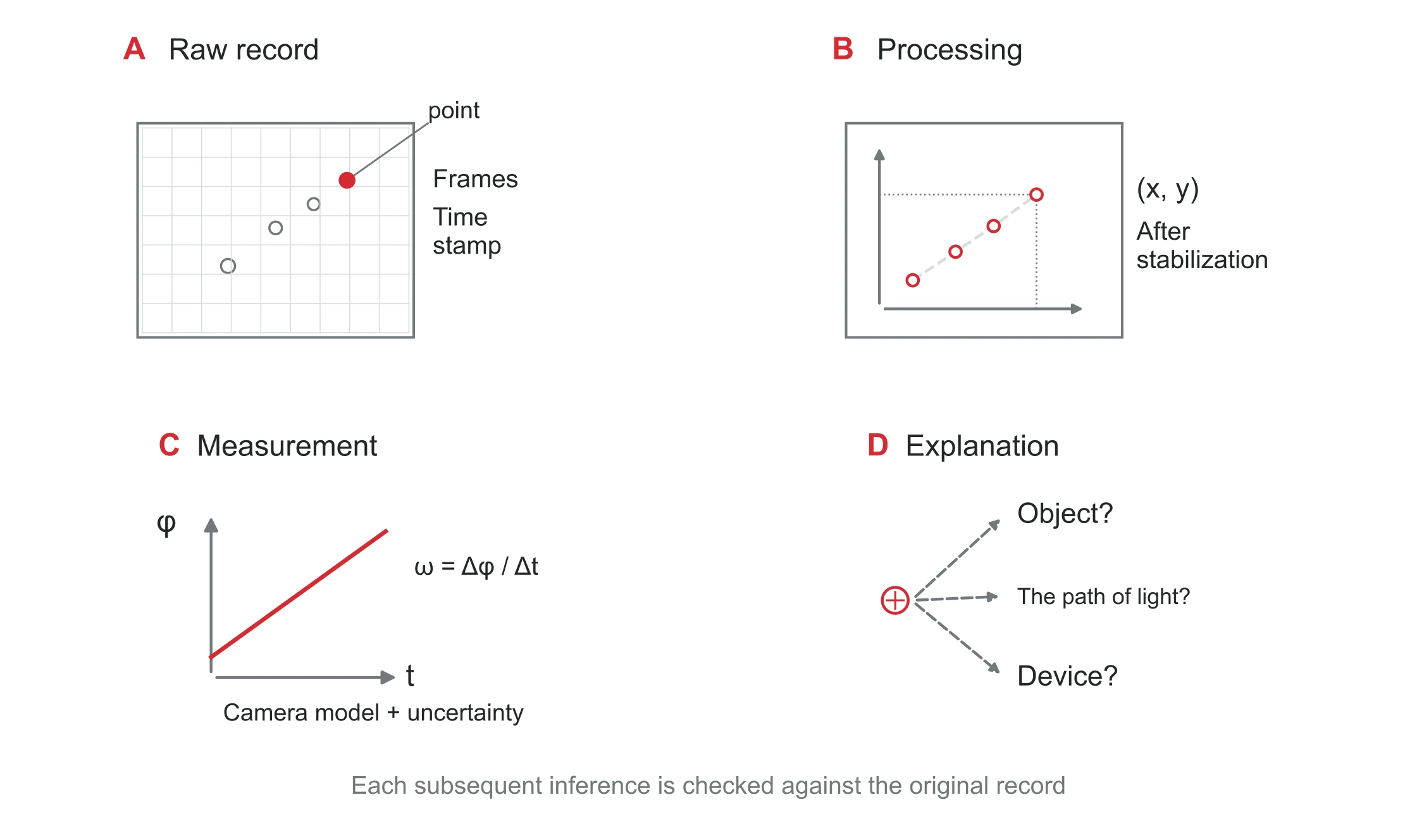
Figure 1. Four layers: record, process, measure, explain. Method diagram. One material goes through four layers: recording, processing, measurement model and possible explanations. The line of movement is conditional and does not contain a numerical result. Question marks indicate competing hypotheses; You can return to the original recording at any stage.
For evidence, the structure is similar. The initial free description is kept separate from the answers to clarifying questions. Information obtained after viewing someone else's recording or talking with another eyewitness is noted according to the time of receipt. This allows the history of a message to be examined without accusations of unreliability. Experiments with eyewitness memory show that subsequent discussion can influence the content of a memory; a specific message requires its own analysis. [1]
Neutral wording
Neutrality consists in the accuracy of the statement. The wording “the sensor detected an excess of its background range” is more useful than the general phrase about the release of energy, while it is not known what value the sensor measured. The formulation “the observer reported a sensation of presence” preserves the fact of the report and allows a possible external stimulus to be examined separately. Words are preferred whose meaning does not change when the hypothesis changes.
Interpretations should not be removed from the journal. They show why the next experience was chosen and what expectations might have influenced the operator. For them, a separate field is allocated with the author, date and reasons. When a version is rejected, the record remains. Such a story explains the progress of the work and helps to distinguish a pre-proposed prediction from a successful explanation that appeared after getting acquainted with the result.
Checking the measuring intermediary
The device perceives a certain type of interaction and operates within a limited range. The description of an unusual reading requires the device model, mode, unit, averaging period, settings, and status information. It's rare for a screenshot to contain all of these options. For reproducible testing, save the original stream or the earliest available format, then note the inevitable conversions.
A decrease in signal after changing settings may indicate a change in sensitivity. An increase in image detail may be a consequence of processing. Therefore, before comparing two records, the metrologist determines whether the modes are comparable. If they differ, a way to bring them to a common measurement model or a separate assessment of each mode is needed. Comparing beautiful final images does not replace this work.
Author's order of layer separation
1. The data custodian stores the original material and assigns it an identifier; the absence of the source is clearly noted.
2. The operator describes the circumstances of receipt, available settings and any known omissions.
3. The analyst lists the operations necessary to obtain the result under consideration and stores versions of them.
4. The metrologist specifies assumptions for converting the signal into a physical quantity and significant limitations.
5. The research director formulates individual explanations and relates each to the prediction being tested.
6. If it is impossible to restore a critical transition, the result is limited to the layer that is actually provided with data.
Stopping analysis does not necessarily mean stopping recording. If recording continues without added risk, the original materials can be preserved while the processing problem is investigated. On the contrary, if the operator changes exposure to an unknown environment in order to obtain the desired image, a new experiment arises. It requires a separate solution because both the state under study and the safety conditions change.
Educational analysis
The fictional camera shows a figure emerging from a dark corridor. Automatic contrast enhancement makes the outline clearer. The researcher saves the source file, the processing result and the algorithm parameters. At the first level, the presence of a certain structure in the record is established. The next check determines its stability in the original frames, neighboring pixels and an independent channel. Until then, the shape of the outline does not specify either the physical nature of the source or its intent.
This separation allows the explanation to be changed without rewriting the history of the observation. It also makes the argument productive: participants discuss the specific transition between data and conclusion. The next step is to evaluate how accurate the result is and what deviation can be considered meaningful.
Chapter 3
Evidence and uncertainty
The number on the screen takes on a scientific meaning along with the definition of the value and the conditions for obtaining it. The reading can be repeated with high accuracy and still contain a stable offset. It may be true in the laboratory but unreliable once transferred. Investigating an anomaly requires evaluating the entire measurement model, including the relationships between its inputs. The Introduction to the Guide to the Expression of Uncertainty in Measurement (JCGM GUM-1) discusses just such an approach to measuring and expressing uncertainty. [2]
What compares to waiting?
For any deviation, record the observed value, the expected value and the rule for comparing them. Waiting can also be uncertain. For example, the background temperature changes over time, the geometric model has a coordinate error, and the instrument’s forecast depends on the state of the environment. The difference between two numbers cannot be estimated by knowing the accuracy of only one of them. General corrections are especially significant: they can simultaneously shift both results.
It is useful to distinguish between the spread of repeated observations, systematic influences, model uncertainty, and lack of data. These components require different actions. Additional averaging may reduce random variation within acceptable conditions, but will not eliminate miscalibration. A more detailed model may change the expected value, but its extra parameters may make the test less certain. Therefore, each improvement must answer a specific question about the origin of uncertainty.
Levels of evidence
A one-time message ensures the existence of a message. The saved recording allows you to examine the recorded signal. The tested measuring path gives grounds to discuss the value. Repetition under controlled conditions maintains the connection with these conditions. Independent verification shows the transferability of the result to another implementation. This is a sequence of tasks, not a mandatory ladder for each case: a rare natural event may not be repeated, but high-quality multi-channel recording will still limit possible explanations.
A weak link cannot be compensated for by the amount of subsequent reasoning. If the distance to the source is unknown, the accuracy of estimating its angular motion does not translate into accuracy of linear velocity. If a sample is no longer traceable, detailed chemical analysis describes the material examined but does not automatically reconstruct its location. The report should indicate which claim is limited by the specific deficiency.
Detection limit and negative result
The absence of a registered signal is informative only regarding the known ability to detect it. You need to name the range, time window, geometry, background level and applied criterion. If a signal is expected in a band that the sensor does not measure, the result does not constrain the corresponding hypothesis. If the device worked only part of the time, observation cannot be transferred to the missed intervals.
False alarms and misses are different characteristics. A device with infrequent alarms may have difficulty detecting the effect of interest. The US National Institute of Standards and Technology (NIST) report on testing false alarms links the findings to the test design and volume; such an inference does not automatically specify the probability of missing. [3] For a research complex, it is required to separately confirm both properties in those conditions where they are important for the solution.
Numerical tutorial example
Consider a fictitious comparison of two temperature channels. The first shows the difference with the background 0.4 degrees, the second - 0.3 degrees. If the unknown correction of the first channel is comparable to 0.5 degrees, and the second one is comparable to 0.4 degrees, the proximity of the central values does not yet provide accurate confirmation of the effect. If both channels share the same erroneous estimate of background temperature, their agreement may be maintained under a common bias. The numbers here serve to illustrate the structure of the problem and are not a criterion for the actual instrument.
The next useful step is to check the common background channel or independent reference. Repeating the same readings many times without changing the source of bias will produce a longer record of the same ambiguity. When choosing the next measurement, it is useful to ask what part of the uncertainty it will reduce and how much it will change the decision.
Practical recording of the result
• Magnitude and unit; coordinates, time and averaging boundaries.
• Model of transformation of the original signal and the origin of its parameters.
• Uncertainty assessment indicating covered and uncovered impacts.
• Comparable waiting model and reasons for choosing background interval.
• Information about saturation, skips, failures, and general channel dependencies.
• A claim that is supported by evidence and a nearby stronger claim for which there is currently insufficient evidence.
Statistical oddity also applies to the chosen model. A small probability value given its premises is not the probability of the truth of the new explanation. If the search covered many windows, channels and filtering methods, you need to consider the search procedure itself. To assess the robustness of a finding, a new data set with a pre-fixed rule is useful. Fitting the noise model after an event is detected should remain a visible part of the analysis.
The last point protects the study from imperceptibly expanding the conclusion. The cause of the deviation has yet to be determined. This requires multiple competing models and experiences whose outcomes will vary.
Change of distribution as a research object
The subject of the study may be the distribution of ordinary events. Each individual registration fits into a known range, but the frequency, spread, sequence or dependence between channels changes. The description of such a case begins with many possibilities, among which the event stands out. For a match, this is a list of pairs being compared and an acceptable time window; for device failure, the number of usable cycles; for a rare impulse - a suitable observation duration. The number of successful examples without this denominator does not determine the frequency.
Before observation, the inclusion rule is written down. It includes the channel, threshold, duration, permissible state of the device and the method of combining adjacent alarms. One long interruption can produce a hundred log lines but remain one episode. Changing the merging algorithm requires recalculation of all compared material. If the previous original records are lost, the comparison of the old and new frequencies is correspondingly limited.
Change being tested | Necessary denominator | A significant alternative |
Pulse frequency | Suitable time and efficiency of the selected detector | The threshold, idle time, or background have changed |
Match rate | All valid pairs and pre-selected window | The number of comparisons increased after viewing |
Range of readings | Comparable series taking into account the connection of samples | The temperature or averaging duration has changed |
Event grouping | Entire sequence, including intervals without events | One source generated multiple entries |
Conditional dependency | All combinations of predefined conditions | Conditions are related to operator, location or schedule |
In the training example, the network logged 20 messages in the first period and 60 in the second. The number of active nodes has increased from 10 to 40, and the duration of the periods is the same. Even with the same sensitivity, the original numbers do not support an increase in frequency per node: the ratio changed from 2 to 1.5 messages. These numbers are not yet an estimate of the frequency of independent events: first it is necessary to combine repeated messages, take into account the real time of each node and check the comparability of places. The example shows why a message archive and a physical event stream are described by different units.
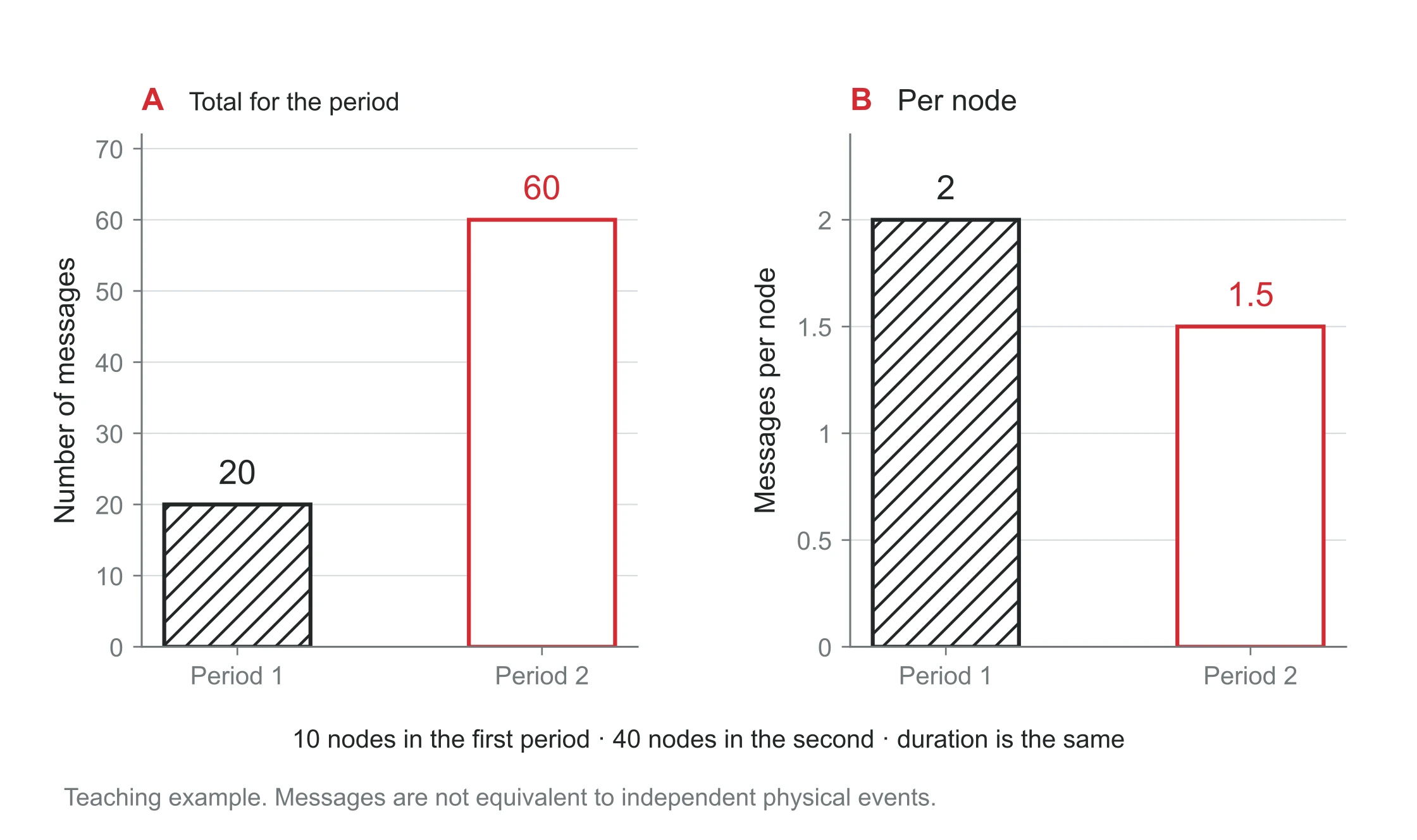
Figure 2. Why more messages don't mean more events. Synthetic training example. The number of messages increased from 20 to 60, and the number of nodes increased from 10 to 40. Over the same period, the load on one node decreased from 2 to 1.5 messages. The frequency of independent physical events cannot be deduced from these numbers.
Confirmatory series and moment of completion
An exploratory series is used to select a feature and evaluate the feasibility of the next measurement. The confirmatory series begins after fixing the feature, background model, suitability criteria and termination rule. If, based on its data, a new coincidence window or a new subset of people is selected, the result of this selection becomes a search result. The presence of a large number of samples does not return it to a predetermined status.
The simple study plan provides four tests after 100, 200, 300 and 400 eligible attempts. For each, a correct confidence interval is constructed in advance with an error probability of no more than 0.0125 in the accepted model. By the union bound, the probability of at least one non-coverage at these four fixed steps does not exceed 0.05. The independence of the four tests themselves is not required for this reasoning, but each interval must be valid in its own data model. The plan does not allow additional unscripted views with the new decision rule.
More flexible sequential methods are able to maintain their stated properties while updating the result multiple times. In particular, confidence sequences construct intervals with simultaneous coverage in time under the specified premises [58]. Before use, select a specific design and check its conditions. An ordinary confidence interval for a fixed amount of data cannot be automatically declared valid at any stopping point.
The result of the distribution study is formulated through the estimated dependence and the limits of its transfer: the frequency of certain impulses is higher in the specified mode with the given registration rules; or the effect is not detected with the established sensitivity. A change in distribution does not in itself establish an interference with causation, intention, or a new law of nature. It creates the following task: to find out which changes in the source, environment and observation reproduce the found dependence.
Chapter 4
Causal models and discriminative tests
An explanation becomes a working hypothesis when it can yield an expectation that differs from the expectations of the alternatives. The phrase “an unknown field is at work here” currently gives the name of the possible cause. To check, it is necessary to clarify what the field affects, how the response changes when conditions change, and what observation would be incompatible with the proposal. The more precisely the interaction channel is formulated, the easier it is to select the measurement that will actually change the evaluation of the hypothesis.
Cause Map
At the beginning of the analysis, it is useful to depict the causal diagram in words or arrows. The intended source affects the environment, the environment affects the object, the object affects the sensor, and processing creates the result. Individual arrows relate external conditions to the sensor and the observer's behavior. This scheme allows us to see alternative causal pathways: one factor can simultaneously change the reading of the device and the sensations of a person, although there is no direct causal connection between them.
The diagram does not have to be complete. Unknown connections are designated as questions. In this case, it is advisable to link each observed variable to a specific record. If a suspected cause cannot be measured directly, its expected effects are considered. Multiple consequences are useful when their co-occurrence is predicted in advance by the model and when known interferences do not produce the same combination.
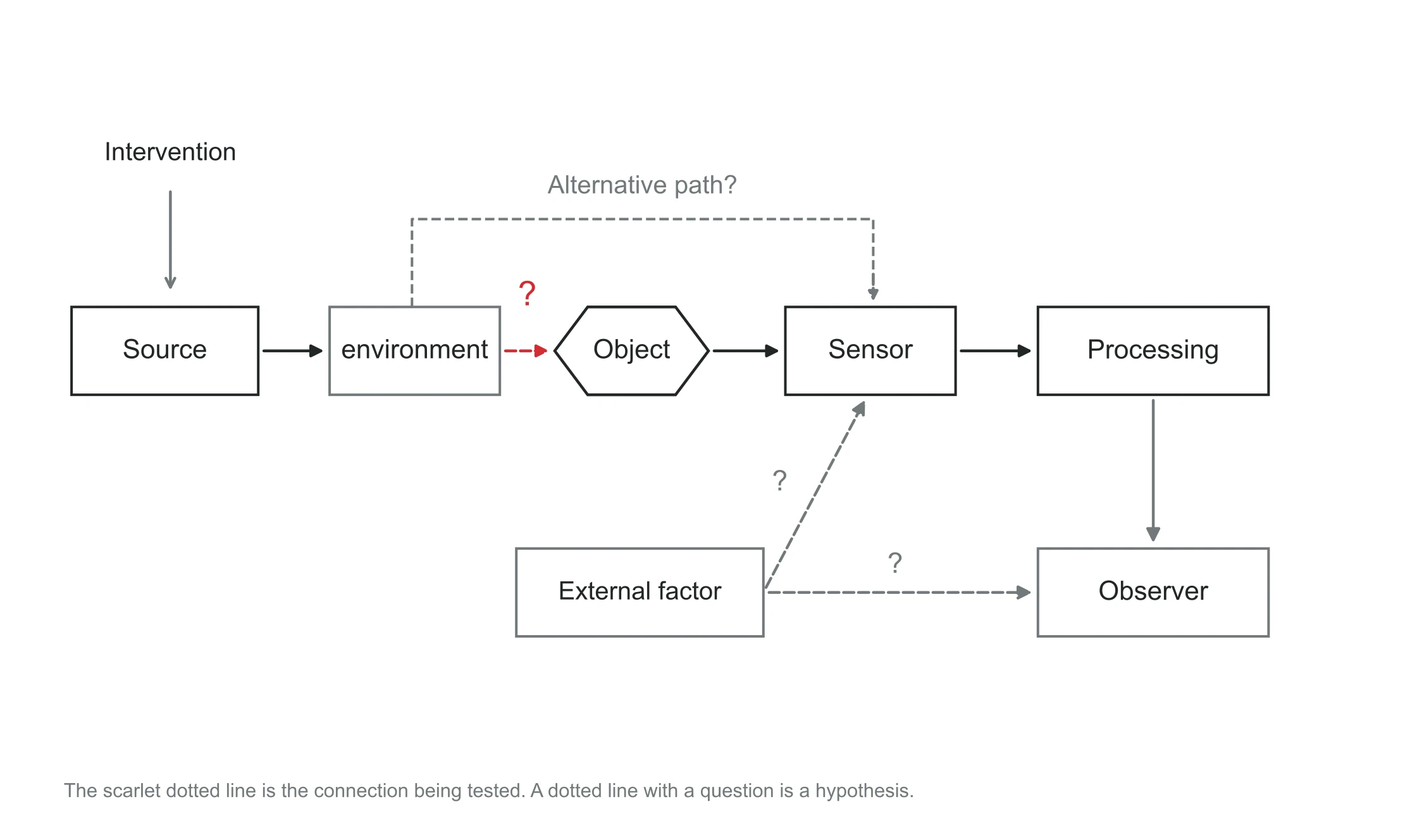
Figure 3. Causal map and alternative causal pathways. Author's causal scheme. Source interference is mapped to the state of the environment, object, sensor, and processing. There may be a workaround to the sensor and a common cause of instrument and observer changes. The scarlet section highlights the connection being tested without establishing its truth.
Matrix of Competing Explanations
For an unusual time shift, you can consider a change in the local oscillator, a time transfer error, software recalculation of marks, and a physical difference in the tempo of the standards. Each version receives its own predictions: whether the deviation will remain after an autonomous comparison, whether it will appear in the original signal, whether it will be associated with a certain transmission system. Substitution of one version for another is allowed, but must be visible in the history of the study.
Hypothesis | Discriminating expectation | Useful check |
Time stamp failure | The original generator reading and the mark diverge | Compare independent label generation logs |
Influence of the environment on the device | The response is related to the design or condition of the sensor | Compare heterogeneous channels and registered environment |
Changing an Observable | The change is saved when you change a suitable method | Perform an independent measurement under comparable conditions |
The matrix also shows useless repetitions. If all versions predict the same outcome of a proposed experiment, a positive outcome will provide little help in selecting an explanation. Such testing may be necessary to verify the reliability of the recording, but its purpose should be described as such. A discriminating experiment requires a zone in which predictions diverge more than the uncertainty available.
Prediction to result
Before the experiment, the main indicator, time window, conditions for including data, processing plan and termination rule are recorded. Pre-registration makes the history of research decisions verifiable; it does not in itself guarantee the quality of the selected model or design. [4] Exploratory analysis also has its rightful place: it helps to find patterns, which are then tested on new material.
Changing the plan during the study is sometimes necessary. Then they save the original version, record the reason for the change and indicate the moment after which the new procedure takes effect. Data already seen does not retroactively turn into an independent verification of the idea that arose from it. This is especially important for rare events, where the temptation to use every unusual detail as expected confirmation is great.
Intervention as a source of new causes
By changing the environment, the researcher adds exposure. Turning off the device changes the heat, noise, electromagnetic environment and team behavior. Moving the robot changes the geometry and sometimes the state being explored itself. Therefore, the experimental variable must be described physically. If multiple conditions change at the same time, the result refers to their aggregate until additional checks separate the contributions.
Interventions that are reversible, observable, and have clear consequences in the chosen environment are preferred. This is the author's rule for organizing experience, and not a promise of safety for an unknown phenomenon. The decision depends on the established channel of influence and the admissibility of a particular operation. If the ability to distinguish between outcomes is lost, the experiment is stopped: continuing in this mode may add risk without adding testable knowledge.
Training scenario
In a fictional laboratory, a strange impulse occurs when the door is opened. Two versions are proposed: the movement of the door causes a change in the field, or the entering person affects the object. Opening without entering and entering via a different route could distinguish the versions only when controlling for the other conditions. If, along with the door, the lights turn on every time and the ventilation changes, the initial experiment checks a whole set of reasons. The team first describes these relationships, then selects the minimum valid variable.
For a unique event, discriminative checks can be aimed at surviving traces and the compatibility of different channels. Replication of the natural process itself is then not available, but the calibration, geometry reconstruction, and physical consequences of each version can be independently verified. Statements for which such indirect verification is sufficient should be distinguished in advance from statements that require reproducible intervention. Uniqueness limits the method, but does not make all explanations equal.
A result that does not agree with any of the provided versions is retained without forcing a winner to be selected. It may indicate an incomplete list, a measurement failure, or a new question. The causal analysis ends with a specific decision: which connection was limited and which next observation is most meaningful.
Executable Discrimination Table
Before the confirmatory experiment, it is useful to complete the outcome table, including inconvenient results. For each version, indicate the value, range of the forecast, conditions for its validity and signs of invalidity of the experiment. An empty cell “that will reject the version” means that the version is not yet ready for verification. Incompatibility is established according to a pre-selected rule, taking into account uncertainty, dependence of observations and whether the parameters were adjusted to the tested series.
Outcome of a valid test | Valid output | Next action |
Model prediction is inconsistent with data | The specified model version is not supported | Save calculation; indicate the changing assumptions of the new version |
The effect of a given size is excluded | Limited effect size in tested conditions | Specify range and coverage; do not extend the result to other modes |
Several versions describe the data | Mechanism not identified | Select a configuration with different forecasts |
Sensitivity is insufficient | The experiment did not distinguish between hypotheses | Change the measurement task or justify a new device |
Suitability criteria violated | The main hypothesis of this series has not been tested | Analyze the failure; do not consider the series negative |
Work stopped due to clearance conditions | The study ends at this stage | Save status, responsibility and reasons for stopping |
The tutorial example specifies two versions of the residual signal. Version A predicts a change in sign when the source is rearranged, version B predicts preservation of the sign. When rearranged, the state of the cable simultaneously changes. Such experience does not distinguish between A and B until the effect of the cable is verified: the planned operation has implemented a package of changes. After the introduction of independent reading, the table is supplemented with version C on mechanical transmission through the base. Expanding the list is acceptable, but new parameters cannot be assessed and tested on the same data without taking into account this procedure.
Completing the program also has a certain meaning. The formulation “available methods do not distinguish between A and B” may be a sufficient result of the stage. The report stores what additional observable attribute would be required to proceed. This allows another researcher to evaluate the usefulness of a new instrument without going through the entire previous journey. The completed analysis of the stable balance is given in case 2.
Chapter 5
Limits of knowledge and research ethics
Exploring the unknown affects people even before there is a physical explanation. The message could change the reputation of a place, cause alarm, reveal personal information, or lead to interference in someone else's life. Therefore, ethics is included in the design of research along with metrology. It determines what information is permissible to collect, who makes the decision, and what is considered sufficient grounds for proceeding.
The dignity of an eyewitness
The eyewitness provides a description of the experience, and not the obligation to confirm the picture of the world proposed by the researcher. His story is recorded without pressure to accept a medical, religious or physical interpretation. Uncertainty is formulated in relation to data. The phrase about the impossibility of establishing a cause from the available material does not invalidate the experience and does not automatically turn it into evidence of an external mechanism.
If the study involves a human participant, the purpose, acceptable procedures, methods of termination, and handling of data are determined in advance. Consent relates to an understandable task and can be withdrawn within the limits of the explained rules. It is impossible to obtain the imaginary independence of observations by hiding a significant risk. Decisions about physiological effects and condition assessment require appropriate competence; the research team does not acquire it due to the unusual nature of the item.
Right to stop
The safety coordinator has the ability to stop work regardless of the manager's interest in the outcome. Such authority must have material content: access to communications, a clear stop command and predetermined actions for operators. Formal law without the ability to implement a decision creates the appearance of control. Restarting requires recording the reason for the shutdown and confirming that clearance conditions have been restored.
The participant's right to terminate his participation is considered separately from the technical stop of the installation. A person can refuse even when the measurements remain standard. Its failure is not interpreted as a sign of an anomaly impact or as a failure of the experiment. The protocol provides in advance how to complete the interaction and save the data already received without putting pressure on the participant.
Proportionality of the study
The proposed action is evaluated on the expected knowledge, added impact, and available alternatives. While the same issue can be resolved by passive recording or analysis of data already obtained, active intervention requires a separate justification. For an uncertain process, reversibility is especially valuable: the ability to return to observation without continuing to change the environment. At the same time, the reversibility of the control signal itself does not prove the reversibility of all caused consequences.
Preservation of the sample does not have absolute priority over human safety. At the same time, the safety decision should not destroy information unnecessarily: the description, remote data and chain of actions can be preserved. The conflict between research value and risk limitation is addressed openly, including the rationale for the choice. This allows the decision to be assessed later on the information available at the time rather than on knowledge of the subsequent outcome.
Privacy and Publication
Information about the place, time and features of the experience can identify a person even after removing the name. Before publication, it is determined what level of detail is necessary to verify the scientific conclusion. The source archive and the public set may differ, but the transformations must be described. If, due to the protection of personal data, independent verification is limited, this limitation is reported along with the result.
Names that suggest contamination, danger, or impact can create consequences even before verification. The public description must correspond to the established level of knowledge. The research journal can store alternative versions; When communicating to an external audience, you must not turn a list of suspicions into a list of confirmed threats. Responsibility for such a boundary is assigned in advance.
Intellectual Honesty
Missing information is not filled in with fictitious precision. If the safe limit is unknown, the basis for the chosen organizational limit and the conditions for its revision should be specified. If the instrument is not tested for this mode, its readings are described with this limitation. The conditional model retains its designation even when its mathematical consequences look convincing. Verifying the calculation and confirming the initial premise remain separate tasks.
When a contradiction appears, the researcher must also consider the error in his own procedure. This does not automatically require that an unusual result be rejected. The productive position simultaneously preserves two possibilities: there is a new effect in the data or the existing explanation was incomplete. The decision is made based on checks available to both versions. Research ethics protects both the individual and the ability to discover what the previous model did not predict.
The environmental implications of the study are also included in the decision. Adding material, changing lighting, or moving equipment may affect the environment outside the area being measured. The proportionality assessment covers these changes, even if the main issue concerns only the device. Preserving a research site means preserving its state within the limits of a reasonable task, and not the right to arbitrarily rearrange conditions for the sake of a more expressive result.
A fictitious case study illustrates this principle. The participant reports severe discomfort only in the experimental area. The team terminates his participation, maintains a neutral description, and reviews the environment. Neither the absence of an immediate instrumental cause nor the coincidence with the area of interest provides a reason to continue the impact for the sake of a more convincing recording. The research problem is transferred to valid independent measurements.
Part II