Classification and description
Chapter 6
Multidimensional anomaly classification
The classification should help you choose the next test. If the name of a class immediately suggests a cause, the researcher runs the risk of looking only for evidence of that cause. Therefore, the proposed designations relate primarily to the observed manifestation. One case may have several labels, and some information may remain undefined. This is the author's navigation system intended for this book and allowing for development.
Main classes of manifestations
Code | Observation area | Primary Research Question |
TM | Time | Which time value diverges from the expectation? |
SP | Space | Which geometric relationship is not consistent with the model? |
GF | Gravity and inertia | What acceleration or field component is measured? |
MV | Movement and forces | How the position or mechanical interaction changes |
EM | Electromagnetic fields | Which component and band are measured |
OP | Optics | What relates to the source and what to the path and registration of light |
TH | Heat and Energy | How temperature and energy balance boundaries are determined |
IR | Ionizing radiation | What response is recorded and is the detector suitable? |
AC | Acoustics and vibration | What frequency and amplitude are measured and how vibration transmission is assessed |
MT | Substance | How the mass, composition and origin of the sample are confirmed |
BI | Biology and ecology | How change and comparable background are determined |
PC | Perception and cognition | What is experienced and what is independently confirmed |
DI | Digital data | At what stage of recording or processing did the deviation occur? |
CA | Causal correlations | How the order of events is established and alternatives are tested |
AG | Apparent agency | What predetermined cues support a meaningful response? |
UN | Insufficiently defined case | What information is missing to select the first check? |
The GF class differs from MV in its research setting. The movement of an object first refers to mechanical observation. A gravitational deviation label appears when there is a corresponding measurement or an explicitly testable hypothesis; the trajectory itself does not establish a gravitational mechanism. Similarly, a light object receives an OP label, but its energetic nature is not determined by the color or brightness of the recording.
The AG label means that the apparent meaningfulness of the behavior is being examined. It does not verify the consciousness, intent, or identity of the source. The CA label captures the problem of causal order or unusual dependence and does not confirm reverse causation. The UN label is needed to save cases about which a sufficiently precise question cannot yet be formulated. Its use is preferable to premature selection of a spectacular class.
Additional axes
To the class of manifestation, spatial character, temporal mode and method of registration are added. The spatial description may include a limited area, a distributed network, a moving source, or an unknown location. Temporary - one-time occurrence, repetition, permanent condition, or connection with a specified condition. The recording method distinguishes between message, single device, multiple channels and controlled experience. These axes do not replace the assessment of reliability, but make the recordings comparable.
The explanatory status is recorded separately. The cause may be established within the model, remain a working hypothesis, or not be proposed at all. A case with a known cause retains the manifestation class: an electromagnetic deviation, after identifying the technical source, remains a useful example for the EM class. It is the explanation and the required action that changes, not the observational history.
Class assignment rule
The recorder first writes down a minimal statement without a causal interpretation. It then selects classes directly related to the available data and separately notes the classes of hypotheses being tested. For each label, the basis is indicated: file, measurement, evidence or calculation. When a label is revised, the previous version remains in the log with the date of modification. In this way, the classification becomes part of the traceable analysis.
Excessive number of tags is also a nuisance. If at the time of the event there was simply a working radio station, this is not yet a reason to add EM. If the participant felt something, PC relates to the recorded experience, but does not necessarily become the main focus of the study. The main label is chosen on the issue that now determines the method of work. The rest are saved as linked observations.
Composite tutorial example
In the fictional episode, the camera records the glow, the magnetometer shows the pulse, and the computer clock jumps by one second. The primary description is received by OP, EM and DI. The TM mark remains hypothetical until it is verified whether the independent reference clock rate or just the software mark has changed. If the pulse originates from a common power supply to the equipment, three observations may describe one technical process. If they persist during separate checks, the research program is expanded.
Another fictional case begins with the feeling of an endless corridor. Only the person's narrative is available, so the primary label PC is accompanied by the research hypothesis SP. Measuring the layout and route can create independent spatial survey data. Until this occurs, the hypothetical geometry cannot be treated as an established property of the building. This consistency maintains openness to an unusual explanation and accuracy of the current status.
Classification answers the question about the method, but does not yet determine the danger. Two cases of the same class may require different restrictions, and a subtle phenomenon may be significant for safety. Therefore, the next element of the record is an independent risk profile.
Chapter 7
Hazard profile and decision boundaries
Danger is determined by the possible consequences of interaction and the conditions under which they arise. The unusual nature of an observation does not in itself determine the degree of risk. A bright light effect can be well explained, but a subtle meter failure can be significant for safety. Therefore, the hazard profile is compiled separately from the class of the anomaly and separately from the confidence in its explanation.
The engineering approach relates risk to scenario, probability and consequences, taking into account the uncertainty of the initial information. This method of setting is presented in the NASA manual on systems engineering. [5] For an insufficiently studied phenomenon, the numerical probability is often not justified. In this case, it is more useful to describe the possible scenario and the dependence of the decision on the missing knowledge than to assign an exact score without a measurement basis.
Profile axes
Axis | What is being described | What is required to solve |
Consequences | Possible damage to people, environment and equipment | Specific contact or refusal scenario |
Contact Availability | Who or what may be affected | Routes, presence and admission conditions |
Distribution | Source movement or impact transfer | Observable Paths and Undefined Boundaries |
Duration | Continuation and repeatability of the process | Observation window and conditions for possible return |
Reversibility | Possibility to restore the previous state | Confirmed Termination Methods |
Observability | Ability to notice change in time | Eligible Channels, Latency and Detection Limit |
Controllability | Available actions with predictable results | Proven influence channel and resources |
Uncertainty | Spaces that change the choice of actions | List of required information and alternatives |
For each axis, it is useful to write down not only the score, but also its basis. The distribution boundary may be measured, inferred by analogy, or not known at all. These conditions cannot be combined into one mark. The presence of an unknown boundary does not prove infinite expansion; it limits confidence in the chosen organizational perimeter and requires revision with new data.
Decision with incomplete information
The first to consider is an action whose consequences are clear without accepting a controversial hypothesis. Restriction of access to the site of an apparent technical accident may be justified by observable damage, even if the cause of the damage is unknown. In contrast, expanding the isolation zone based only on the name “spatial anomaly” has no measurement support. Any limitation is associated with a specific scenario, purpose and condition of the revision.
It is useful to determine in advance which additional observation will change the decision. If operation is stopped due to loss of communication control, restoring communication does not in itself eliminate the cause of the failure, but allows you to check other conditions. If the restriction on interaction is due to an unknown material composition, a new optical image usually does not resolve the original issue. This way it becomes clear what information is really valuable for admission.
Author's evaluation procedure
1. The leader describes the planned activity and its research purpose, including the impacts it will introduce.
2. The safety coordinator identifies plausible harm scenarios based on available data and known properties of the operation.
3. The metrologist indicates what significant changes the team will be able to notice and with what delay.
4. Operators confirm the availability of communications, resources and a method for terminating their own action.
5. The command records the permissible mode, the basis for the tolerance, and the events that require stopping.
6. After the situation changes, the assessment resumes with a new version; the old resolution is not transferred automatically.
The stopping criterion must be observable: loss of a specified control channel, a parameter going beyond a reasonable limit, a barrier state violation, an unexpected process change, or an inability to execute an exit plan. The phrase “stop at danger” is not sufficient if participants have different understandings of danger. At the same time, the list does not limit the right to stop in case of a new significant circumstance.
Training scenario
A fictional group investigates rare flashes at an abandoned site. The glow itself does not determine the risk, but collapsed decking and loose equipment create known injury scenarios. Passive shooting is chosen from an accessible, stable place; entering the damaged area is not necessary for the primary question of timing of the flares. The uncertainty of the nature of the glow remains, but it does not prevent one from making an informed decision on the known infrastructure.
Later, the signal appears in several devices simultaneously. This changes the research task, but does not automatically give permission for active influence. First, shared dependencies and the ability to control the change are tested. The profile is updated in those axes that are affected by the new data. This step-by-step approach allows us to avoid inaction due to uncertainty and unjustified escalation.
The profile is accompanied by a mandatory review deadline or event. Changes in weather, crew composition, equipment conditions, or source conditions may render the previous basis insufficient. The shift manager must know which of these changes have already occurred. If the transfer of information is not completed, a new action is postponed until the overall picture is restored. The admission decision operates in conjunction with its conditions, and not independently of them.
The result of the evaluation is a record of an acceptable action under given conditions. It accompanies the case record, but does not replace it: scientific data must be preserved even when a decision is made to temporarily not continue the interaction.
Three layers of dynamic map
The boundary on the working map answers a specific question. The line within which the deviation is registered does not have to coincide with the physical impact limit. It depends on the placement of devices, sensitivity, observation time and the adopted sign. Therefore, the case map contains three separate layers. The common substrate helps to compare them, but does not allow replacing one layer with another.
Layer | What is marked on it | What does not follow from it |
D - detection | Places, intervals and channels of registration of the selected characteristic; positive and negative results with sensitivity limits. | Everything outside the positive marks is free from influence. |
N - observability | Really surveyed directions and volumes, blind areas, suitability of channels and spatial reference conditions. | The surveyed area is fully characterized for any mechanism. |
P - access mode | Allowed actions, positions and routes; the basis of each permit, the person responsible and the condition of review. | The administrative boundary is the measured surface of a physical process. |
Each version is assigned a card identifier and a status record. For the mark, the source of coordinates, the original reference system, the event interval and the moment of receiving the information are stored. If the position is known only relative to the camera, this is what is written down: “frame sector”, and not fictitious geographic coordinates. The empty area is marked with the reason for the void: not observed, temporarily closed, the channel is unsuitable, or the suitable channel did not register the selected sign. These conditions require different solutions.
The update begins with a comparison of two versions of layer N. The appearance of a mark in a new location may be a consequence of the expansion of the view; disappearance is the result of a change in exposure or blocking of the signal path. Only after these changes have been taken into account is a change to Layer D discussed. The Coordinator then revises Layer P for the affected conditions. The old card is retained: it remains evidence of the previous state, although it may no longer be suitable for the current admission.
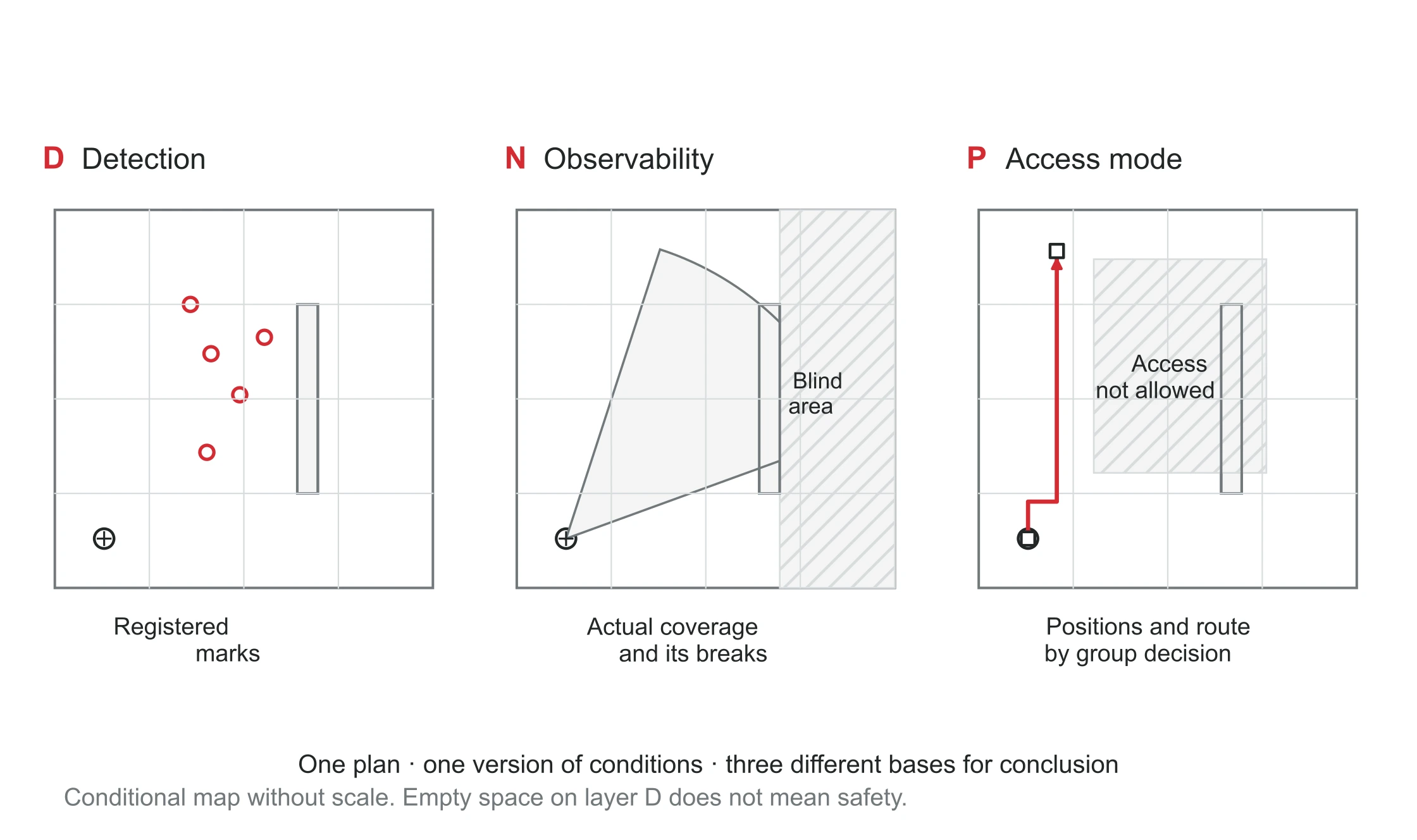
Figure 4. Three maps of one area: detection, observability, access. The author's diagram of three layers of one area. D contains registered marks; N - actual visibility and blind spots; P - allowed positions and route under specified conditions. The geometry is conditional. An empty area of layer D does not automatically receive safe status.
When the route loses ground
The route is specified not by one line, but by a sequence of tested sections and transition conditions. His card indicates what confirms the position, what protective and observational functions are necessary, what is known about the final position and at what change the permission ceases to be valid. The fact that the previous pass was successful does not confirm the return pass after the environment has changed. This difference is especially significant for the conditional models of unusual connectivity from chapter 18.
1. When changing the map, the operator compares the current position with the last confirmed one; an uncertain position is not replaced by the forecast of the navigation program.
2. The coordinator lists affected areas rather than automatically canceling or saving all routes. The paths of people, equipment and transported materials are checked separately.
3. If further movement is based on a lost condition, new movements on this basis are not allowed. Perform the transition provided for the current configuration; the return itself needs a valid basis.
4. Renewal requires a new version of the map and confirmation of specific route conditions. Visual fading is not sufficient confirmation.
Fictional tutorial example: the mark is first visible only on the west wall. After reconfiguring the second camera, it also appears on the eastern one. In the M02 map, the N layer changes; the physical area extension has not yet been established. Then the connection with the second camera is lost. Version M03 contains a loss of observability of the eastern sector, rather than a record of the disappearance of the effect. Permission to place equipment there that was dependent on this control is suspended. Filling out Form G1 makes each of the three solutions visible without drawing an arbitrary safe circle.
Chapter 8
Case Record and Data Provenance
The case record combines observations, decisions and the history of their changes. Its purpose is to allow the other group to understand what exactly happened based on the data available, what actions were taken, and what conclusions remain valid. This is a working structure that is filled in as information becomes available. The unknown value is left unknown by specifying the way in which it could be obtained.
Case ID and boundaries
The identifier must remain the same when the explanation is revised. It should not include the supposed nature of the phenomenon as a mandatory part. The TM, OP or AG marks can be changed separately. For an episode, set a time interval and a rule for combining records; for the territory - surveyed boundaries; for a sample - storage unit and connection with the place of receipt. This prevents different events from being undetected under one name.
If there is reason to split a case, create related records and store the original join in history. Similarly, several cases can be combined into a series based on an explicit criterion. Common external shape, proximity of location, or similar date provide evidence of a connection, but are not necessarily sufficient to infer a common mechanism.
Contents of the record
Section | Required content | Common mistake |
Registration | Who, when and in what way provided the information? | Replacing event time with recording time |
Observation | Minimal statements and Source Materials | Causal explanation in the field of facts |
Measurements | Devices, modes, units and limitations | Only screenshot saved |
environment | Geometry, background, infrastructure and change | An unknown background is considered constant |
Hypotheses | Predictions, alternatives and status | Version added after unmarked result |
Solutions | Author, reasons, mode and conditions of stopping | There is no reason to continue work |
Materials | Origin, transmission and condition of samples | Loss of connection between sample and event |
Versions | Changes in findings and reasons for revision | Latest version erases history |
Each record is associated with the source and time of its creation. Event time, detection time, reporting time, and system entry time may vary. If the exact moment is not known, record the interval or relative order with an explanation of the basis. An artificially precise label creates a false opportunity to compare episodes that in reality cannot be positioned with such precision.
Origin of material
For a digital recording, the original media, the copying method, the available metadata, and the sequence of transformations are important. For a physical sample, location, circumstances of receipt, packaging, movement, and changes in condition. The general meaning of these requirements is to maintain a connection between the material being studied and the statement about its origin. When part of the chain is lost, this restriction is reflected near the corresponding conclusion.
Storing digital evidence requires considering the integrity and history of files; NIST guidance addresses these issues separately from the overall material acquisition process. [6] In the proposed record, the checksum is associated with a specific version of the file. It helps to compare saved copies, but does not restore the reliability of the event before the moment of recording.
Access sharing
Not all information is needed by every participant. The operator may need a measurement plan without eyewitness information. It is sometimes useful for the independent analyst to transfer recordings without implied explanation, preserving the necessary instrument information. At the same time, blinding should not deprive the performer of information essential to safety. Access rules are set before transmission and are recorded along with the set version.
A public card may contain abbreviated geographic and personal information. The internal record preserves the basis of the abbreviation and the relationship between versions. If critical data cannot be provided to the reviewer, the conclusion should reflect the limit of independent verification. The presence of a closed archive does not in itself make the statement more reliable.
Tutorial example of filling
The fictitious case is given the identifier “Case 0042”. The initial recording reports two flashes within approximately five minutes. The camera turned on after the first flash; her watch had not previously been checked. In the record, the first flash remains a witness message, the second is associated with the file. Instead of a general statement of “two recorded events,” two different grounds are retained. Later, an external recording can refine the interval without destroying the original uncertainty.
The decision log indicates why the team chose passive observation and what additional data they expected to obtain. A few days later, a camera calendar time error was detected. The new version of the record corrects the mapping, but the original file and the previous solution remain available. This history allows us to understand what knowledge existed at each stage.
When transmitting a data set, it is useful to keep a list of the objects actually received. The recipient matches it with the content and notes missing elements before starting analysis. This allows one to distinguish between missing recording in the original study and loss in transmission. A later discovered copy is added as a new version with a description of the origin; it should not quietly replace material on which decisions are already based.
The record becomes especially useful when handing off work to another team. The transmitter lists unresolved issues, the status of devices, current restrictions and conditions for the next action. The recipient confirms understanding of these points. On this basis, the initial registration turns into a controlled research effort.
Chapter 9
Initial registration and mode selection
The initial job is to save the information and determine a valid next step. At this point, there may not yet be a specialist in the supposed class of phenomenon, a proven instrument, or a clear explanation. Therefore, the proposed order relies on available observations and known properties of actions. It does not require immediate determination of the nature of the event.
First priority
If there are signs of a normal accident, they act according to the appropriate response system and transmit information to the competent service. Scientific registration should not delay necessary actions to protect people. Information about smoke, destruction, damaged infrastructure or deterioration is recorded specifically, without adding an unverified explanation. If the situation does not require an immediate response, you can organize an initial recording without approaching or changing the environment.
Passivity means a lack of intentional research influence, but not a complete lack of influence. Light, sound, heat from equipment, the presence of people and traffic can change conditions. Therefore, even the initial observation is described physically: where the operator is, what device is working and what has changed since its appearance. If possible, already available records are used first.
Five operating modes
Registration collects the message and stores the material. Remote passive monitoring checks repeatability and background with minimal added impact. A limited study solves a specific measurement problem under specified conditions. A controlled intervention deliberately changes a parameter to test a hypothesis. Stopping stops the selected activity and places the system in the intended state. These modes do not form a mandatory sequence: the study can end after registration or return from experiment to observation.
The transition is justified by the question, measurement suitability and performance conditions. The very fact that the unusual effect persists does not require intervention. Sometimes a long passive recording distinguishes between versions better than a new active operation. Sometimes further observation is meaningless without repairing the measuring path. The decision relates to a specific state of the system and is revised after a significant change.
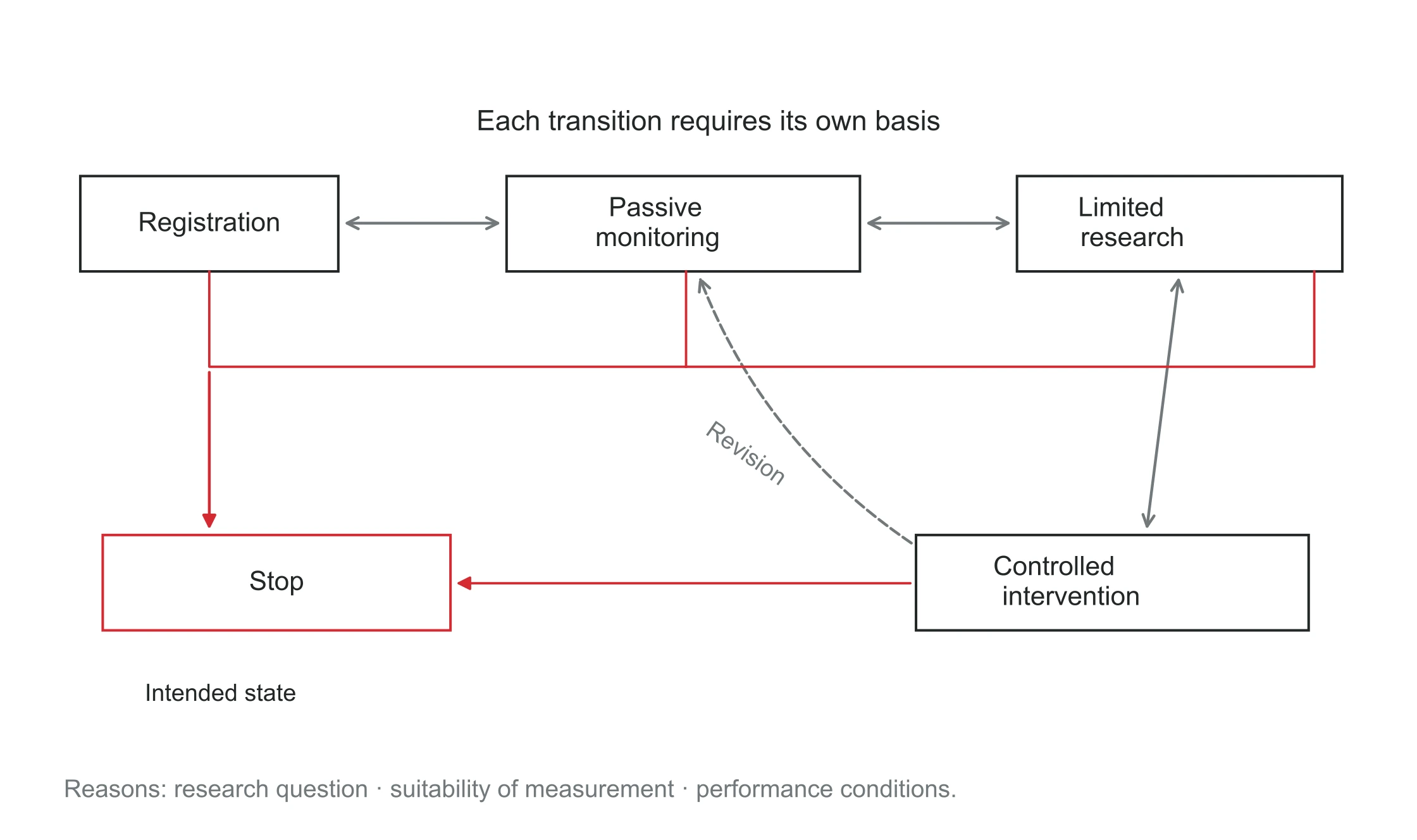
Figure 5. Five modes of exploration and transition grounds. Author's mode map. The transition to the next action requires a separate justification; return, revision and completion are possible. Stopping relates to the selected activity and results in a predetermined installation state. The scheme does not require mandatory intervention or complete power outage.
Author's operating card for initial admission
1. The recorder records the message, time of receipt and available source; keeps the original wording separate from the refinements.
2. The site manager reports known hazardous conditions, current restrictions, and people present.
3. The Safety Coordinator determines whether it is acceptable to continue the selected surveillance without the added contact.
4. The operator describes the device and mode, checks the available signs of its performance outside the test influence.
5. The metrologist formulates the minimum question that this device is capable of answering and the conditions for an uninterpretable result.
6. The manager assigns the mode and boundaries of the task; The command confirms the connection, termination of the operation and the order of data transfer.
7. After the first series, a suitability assessment is carried out. Only then is a decision made to continue, change the method, or terminate.
If the listed functions are performed by a small group, the role names are stored in the log as responsibility functions. One person may keep multiple records, but should not pretend to independently validate his or her own decision. For actions with significant consequences, it is necessary to determine in advance what external competence and review will be required.
Stopping Criteria
Work is stopped if the intended connection is lost, a significant protective element fails, an unforeseen change occurs, a clear route to completion is lost, or the participant’s condition deteriorates. Specific thresholds, if needed, are taken from the applicable requirements and characteristics of the selected operation. The book does not assign universal numbers for unknown environments. In the absence of a reasonable threshold, the action is limited so that its permissibility does not depend on a fictitious value.
The stop command must specify an operator action, not just a word. For one installation, this means stopping the supply of the control signal; for another, it means maintaining power to the recorder when the movement stops. A safe state does not automatically equate to a complete shutdown: the shutdown itself may remove observability or a supporting function. The specific sequence is determined by the system architecture before launch.
Training scenario
A fictional employee notices an unusual sequence of sounds in a technical room. The employee preserves the available record and reports it to the person in charge of the equipment. The first study compares the timing of sounds with the modes of known systems without changing their operation. Disabling the intended source is allowed only after its functions have been clarified. This way, a scientific question does not lead to the accidental cessation of ventilation or other necessary systems.
After the false alarm stops, a short debriefing is also performed. It turns out what sign caused the decision, what information was available and what helped clarify the situation. If the stop met a predetermined criterion, it should not be declared an error simply because the anticipated harm did not occur. Improving the procedure consists of increasing the discriminative power and understandability of the conditions, rather than prohibiting the reporting of uncertainty.
If the initial record is insufficient, the outcome may be an observation plan with a suitable path rather than a statement of no event. If the cause is established, the conditions for its occurrence are recorded. If a new measured residue occurs, the record and hazard profile are clarified. Initial registration is considered successful when the next step has become more reasonable and verifiable.
A person is injured or unaccounted for
The transition to help begins based on observable circumstances, even if the mechanism of the event is not determined. A report of an injured person, the absence of a participant in the designated place, or the inability to confirm his condition is not considered a regular research series. The coordinator announces the transition to response, the leader stops scientific activities that could interfere with assistance, and the designated liaison contacts the competent service in accordance with the current local order. Filling out the form should not delay your request.
The organizational basis for separate planning of roles, communication and interaction with external services is available in the US Occupational Safety and Health Administration (OSHA) standard 29 CFR 1910.120, within the scope of work regulated by this document [64]. The map offered below is the author’s adaptation for organizing the study. It does not prescribe medical actions, rescue powers, or methods of entry into an unknown environment.
1. Name the actual event: what is being observed now, by whom and through what channel; separately indicate the unverified message. Do not replace the description with a diagnosis or name of the anomaly.
2. Check the list of participants with direct confirmations. For each, write down: counted in the indicated place; contact has been established, the situation requires clarification; location not confirmed. Loss of radio communications does not in itself prove the disappearance of a person.
3. Provide the service with the known location of the event, the number of people counted and uncounted, observed danger signs and access restrictions. If the coordinates are unreliable, name the last confirmed landmark and method of contacting the informant.
4. Provide up-to-date map layers, recent reliable observations, information about existing barriers and supporting functions. Note what may worsen if the equipment is completely turned off.
5. Agree on the channel for further updates and the person receiving the information. Record the contents of the received message and instructions received; an undelivered notice shall not be considered a completed transmission.
6. Maintain accessible records without delaying assistance. The custodian maintains a time track of responses separate from the research hypotheses; later clarification completes the original entry.
A research position does not create life-saving competence. The possibility of a particular approach or extraction is determined by the prepared response system and actual conditions. Unauthorized entry of the next participant does not become acceptable out of concern for the first. However, the unknown cause does not serve as a reason to refuse available help, which can be provided within the limits of one’s own training and current instructions. Both boundaries are recorded before the expedition: what the group can do and what activities require external capabilities.
If a previously known path is no longer confirmed, the messenger reports this directly. You cannot greet arriving people with an offer to take the “usual path”, hiding the loss of its foundation. Nor should a route be declared physically impossible simply because of a navigation failure. Form G2 distinguishes between a confirmed obstacle, a loss of observability, and an unappreciated opportunity. This allows the profile party to choose their own assessment without an imposed explanation.
The transfer is considered organizationally completed when the receiving party has confirmed receipt of essential information and the further distribution of functions has been determined. Until then, the group maintains an assigned communication channel and an available record of people. The study does not automatically resume after contact is restored: the condition of the participants, space restrictions, serviceability of controls and the basis for new admission are separately considered. A person's refusal to participate further is not considered a technical failure.
Chapter 10
Combination of effects and development of events
An unusual event can manifest itself in several channels at once. The glow is accompanied by sound, the temperature change coincides with electronic failure, and participants report discomfort. This combination increases the amount of information, but does not provide a single causal story. It is necessary to check whether the observations belong to the same process, have a common external cause, or coincided within the selected time window.
Three causal structures
In a sequential structure, one process creates the conditions for the next: a change in the environment affects the device, then the data processing. In the structure of a common source, one factor influences several channels in parallel. In an independent coincidence structure, events are not causally related, but are combined by the researcher by time or place. A real system may contain all three structures simultaneously.
A physically meaningful time sequence helps to distinguish them. However, the order of marks is not itself equal to the order of causes. Channels have different delays, recording frequencies and time generation methods. Before building a cascade, the metrologist evaluates which differences in time are generally solvable. If the uncertainty exceeds the expected interval between events, the direction of the relationship remains uncertain.
Common Cause
Common causes can simultaneously disrupt the operation of backup elements. NASA engineering materials highlight the limits of improving reliability by simply increasing the number of similar systems and the importance of diversity in technology, power sharing, and control. [7] In anomaly research, this logic applies to evidence: multiple records may be different manifestations of the same common vulnerability.
Therefore, next to the effects map, a map of equipment dependencies is drawn up. It includes physical placement, power, synchronization, networking, software library, and general processing stage. For evidence, the possibility of mutual discussion and a common source of information are taken into account. The presence of a dependency does not make a record useless, but it does change the independence of its confirmatory role.
Process Development
A cascade involves changing conditions over time. After the first event, the system may find itself in a different state: overheated, damaged, overconfigured, or lacking some control. Repeating the same operation in this state does not necessarily reproduce the original experience. The log needs to note changes that could affect subsequent observations, including the actions of the team itself.
It is useful to distinguish between the original state, the transition, the new state, and the return condition. If the return is not confirmed, the next series starts from a new starting point. Such a description prevents the error in which a dozen sequential reactions of one changing set are considered a dozen independent experiments. The series design must be consistent with the physical history of the property.
Author's protocol of a composite event
1. Save individual source recordings of each channel and describe their timing.
2. Determine which matches are resolvable, taking into account delays and uncertainties.
3. Create a common cause map and overall log of installation and environment changes.
4. Separate the serial link, common source and independent match versions.
5. Select a test that changes one significant section of the circuit with an acceptable added effect.
6. After verification, update the scientific model and hazard profile separately; do not transfer confidence from one to another without reason.
The stopping criterion also takes into account the loss of observability. If the effect has disabled the channel on which the tolerance was based, continuing with the previous operation is no longer consistent with the previous decision. Additional equipment is introduced after assessing its compatibility, since it itself can change the chain of dependencies. A reserve is useful when it is known what kind of failure it can withstand.
Training scenario
In a fictitious series of experiments, a light pulse, a magnetic channel jump, and the loss of several packets are simultaneously recorded. The first version connects all three signs with a new impact. Checking shows that the camera and network share a common power source, and the magnetometer is located near its wiring. This creates a concrete alternative. Independent power recording and separate recording allow it to be verified without assumptions about the nature of the unknown object.
If, after eliminating the shared dependency, only one channel remains, the original composite event splits into different research tasks. If the agreed sequence is maintained, there is reason to clarify the mechanism and geometry of propagation. In both cases, all the source material is useful, including the channels that were later explained.
The choice of time window changes the number of matches. A very wide window combines processes between which there is no established connection; too narrow may eliminate a physically possible delay. It is justified by the propagation model and channel characteristics before analyzing the main series. If the window was selected from the data, the sequence found becomes a candidate for a separate test. Events that are not included in the selected combination are also saved in the report.
The result of the analysis is a causal diagram with marked uncertain connections and a list of verified dependencies. It links the general methodology to the thematic sections of the book. The next chapter examines the origins and maintenance of the observed regime. The study then moves to temporal processes, where the distinction between event, signal, and time stamp becomes particularly significant.
Life cycle and state memory
The status record must include sufficient history to compare subsequent actions. The same current readings may hide different internal temperatures, accumulated strain, composition, charge, settings or program status. Hysteresis here is the dependence of the observed response on the path by which the system arrived at the current conditions. Specifying this property does not explain its mechanism or prove unusual physics. It prohibits considering two regimes the same based on only one indicator.
The lifecycle card distinguishes between discovery, condition clarification, allowed change, state hold, termination of active activities, and follow-up. These are statuses of working with a phenomenon, and not mandatory stages of its nature. A case may be reported after the peak; visible subsidence may be replaced by repeated manifestation. Card branching captures such possibilities without assuming that any object will necessarily go through the entire cycle.
Transition Recording | Required content |
Initial state Sᵢ | Observed quantities, configuration, map version, previous impacts and unknown intervals. |
Event or action Tᵢ | What has changed; noticed by whom; command, actual execution and incidental changes. |
New condition Sⱼ | What is confirmed after the transition; what previous foundations have been preserved or lost. |
Return | What observable sign would indicate a return; Is verification acceptable? what properties could remain changed. |
Next observation | What issue does it solve; comparability conditions; to whom responsibility is transferred. |
A fictitious example: when the control parameter of a training stand is successively decreased, the light response remains where it was not yet present when increased. Both branches, the exposure duration and the state of the measuring path remain in the log. Repeating only a “successful” direction does not confirm a stable boundary. If a reverse pass is unsafe or not allowed, it is not performed for the sake of a symmetrical graph; output is limited to one branch. The missing background is designated as unknown, rather than being filled in with the most convenient reconstruction.
The difference between the branches still needs to be separated from the delay of the measurement itself and the transition regime. To do this, under acceptable conditions, the response is compared for known sequences and exposures, maintaining information about the rate of change. If there is no such comparison, the result is called the dependence of the recorded response on the sequence performed. This is more accurate than attributing a set hysteresis to an object based on a single loop on the graph.
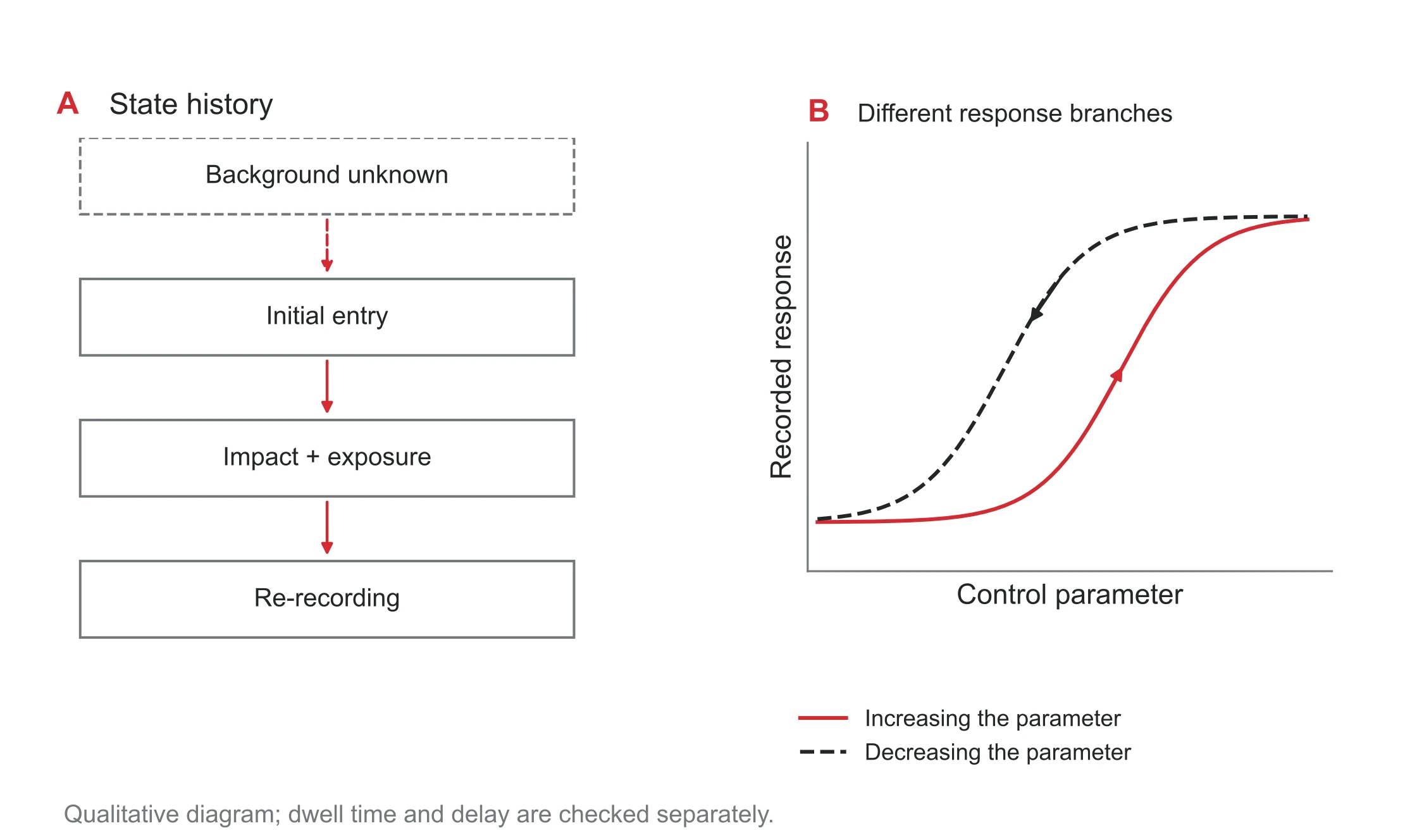
Figure 6. State history and two response branches. Qualitative teaching diagram. The result is associated with the background, sequence of influences and exposure time. The difference between the branches when the parameter increases and decreases is not yet separated from the measurement delay and the transition mode. The curves are arbitrary, the numerical scale is not specified.
Register of Executable Protocol Prerequisites
Even a careful procedure makes use of the premises: the events are distinguishable, the command has a destination, the record preserves the origin, and the test refers to the desired object. These should be listed before selecting an intervention. The STPA system hazard analysis method examines the relationship between the state of the controlled process, control actions and feedback; delays or incomplete information may render the action inappropriate for the actual condition of [62]. Here this engineering logic is applied to tolerance limits, without claiming that it covers any conceivable change in the laws of nature.
Premise | Sign of loss | Which output or tolerance is being limited? |
Local order can be reconstructed | Restart without a connecting record, number conflict, unknown fragment origin. | Sequence of actions across the gap; If individual fragments are preserved, their independent analysis can continue. |
Essential configuration known | Unaccounted for replacement, mode change, mismatched versions. | Carryover of calibration and resolution from previous configuration. |
The required spatial relationship has been confirmed | Loss of reference or inconsistent position observations. | Allowing movement along the previous route and inferring propagation. |
Object and channel distinguishable | It is not possible to distinguish between sample replacement, data replication, or another source. | Comparison “before - after” as the history of one object. |
Status available for solution | Unknown latency or feedback source, loss of required channel. | Management that requires timely knowledge of this condition. |
Termination can be confirmed | The command has been sent, but its execution and result are not observed. | Application to stop exposure and subsequent action depending on it. |
For each line, a verification certificate and a loss action are assigned. The prohibition applies to a dependent decision; he is not obliged to prohibit any activity. For example, a local spectrum may remain valid when the global time scale is lost, while the causal order comparison is no longer justified. The acceptable residual regime is selected from actually confirmed possibilities, and not from the general desire to continue.
If a conditional model simultaneously eliminates the distinguishability of states, the preservation of records, and the ability to confirm an action, an executable verifiable protocol is not specified for it. An external camera or mechanical watch does not solve this logical problem by itself. First, the model must name the conserved subsystem and its relationship to the observed process. The register of premises makes it possible to show the exact location of the limitation, rather than promising a universal defense against arbitrary causation.
Chapter 11
The Emergence and Persistence of Anomalous Regimes
The manifestation class indicates what should be measured. The explanation of the occurrence must additionally show how the system came to the observed state. To do this, it is not enough to name the interaction or suggest a signal shape. It is required to connect the initial conditions, the formation process, the source of maintenance and the observed fate of the object. Such an analysis is useful both for an ordinary phenomenon encountered by the research group for the first time, and for hypothetical new physics. The confirmation of premises varies, but the requirement to obtain consequences remains common.
The reason for its occurrence does not necessarily coincide with the reason for its continued existence. A short impulse can start a process that then uses up the internal supply; continuous external influence can maintain a state that is impossible after its cessation. The observability condition is also a separate link. Changing lighting can make an existing object visible without creating it. Therefore, the history of a case distinguishes between the appearance of the condition itself, the beginning of available recording, and the moment when the observer recognized the event as unusual.
Four questions to the origin
First, a state variable is selected. For heating, this can be the reserve of internal energy, for oscillations - amplitude and phase, for composition - the number of certain components. The variable must be related to the observation through the measurement model. The brightness of a pixel is not directly the energy reserve, and the clock reading is not the state of the entire environment. If the variable is currently only indirectly available, additional assumptions necessary to recover it are listed.
Then the system boundary and exchange paths are specified. Energy input, matter transfer, mechanical work and information about external influences receive their own records. The transition mechanism is then described: what changes when triggered, what connections become significant, and why the effect has a given spatial scale. Finally, the preservation and termination conditions are formulated. An explanation that describes only a beautiful stationary pattern does not yet explain its birth or stability.
Mechanism in working hypothesis | What maintains the condition | Discriminating observation |
Finite internal energy store | Initial resource consumption | Consistent Decay and Limited Integral Output |
External power | Measurable flow across the border | Changing the output when this flow naturally changes |
Mode transition | New stable connection configuration | Threshold, delay and history dependence |
Moving heterogeneity | Transfer of an existing structure | Sequence of responses at spatially separated nodes |
These lines indicate explanatory structures that can be combined. For example, a moving area can receive energy from the outside and simultaneously consume the accumulated resource. In this case, the model must predict speed, duration, and intensity change together. The addition of each mechanism increases the number of conditions that need to be tested. It is useful when it explains a new independent feature, rather than just providing another free parameter.
From diagram to equation of state
The simplest author's storage model connects the reserve E with the incoming power P and the relaxation time τ. At constant P and τ it has the form given below. E is measured in joules, P in watts, τ in seconds. The term E/τ denotes the chosen model loss law; it is not assigned to any unknown object based on external similarity.
The equation immediately separates several scenarios. With no energy input, the stored energy decreases; with a constant input, it approaches Pτ; after the input changes, it approaches a new level over the characteristic time τ. This already defines an observation program: record a transition curve, estimate the parameters from one portion of the record, and test them on another. If the instrument measures output power only, the initial stored energy must be reconstructed through an additional relation. An arbitrary claim of unknown energy does not independently confirm the model.
Changing regimes requires different dynamics. To illustrate, consider a dimensionless variable x, such as the normalized sign position deviation, and a dimensionless control parameter μ. The following equation is an independent educational model, and not a universal law of anomalies. When μ is less than zero, the only stable state is at zero. When μ is positive, two stable non-zero states arise, and the zero one becomes unstable.
Indeed, the derivative of the right-hand side with respect to x at a stationary point determines the sign of the small perturbation: at zero it is equal to μ, and at points ±√μ it is equal to −2μ. This results in a verifiable change in stability. Near the threshold, the characteristic response times also change. However, such an equation does not yet name the physical source of energy or the substance that realizes the required coefficients. For a specific object, this is the next required level of explanation. One cannot mistake a mathematical transition of a regime for a ready-made technology for its creation.
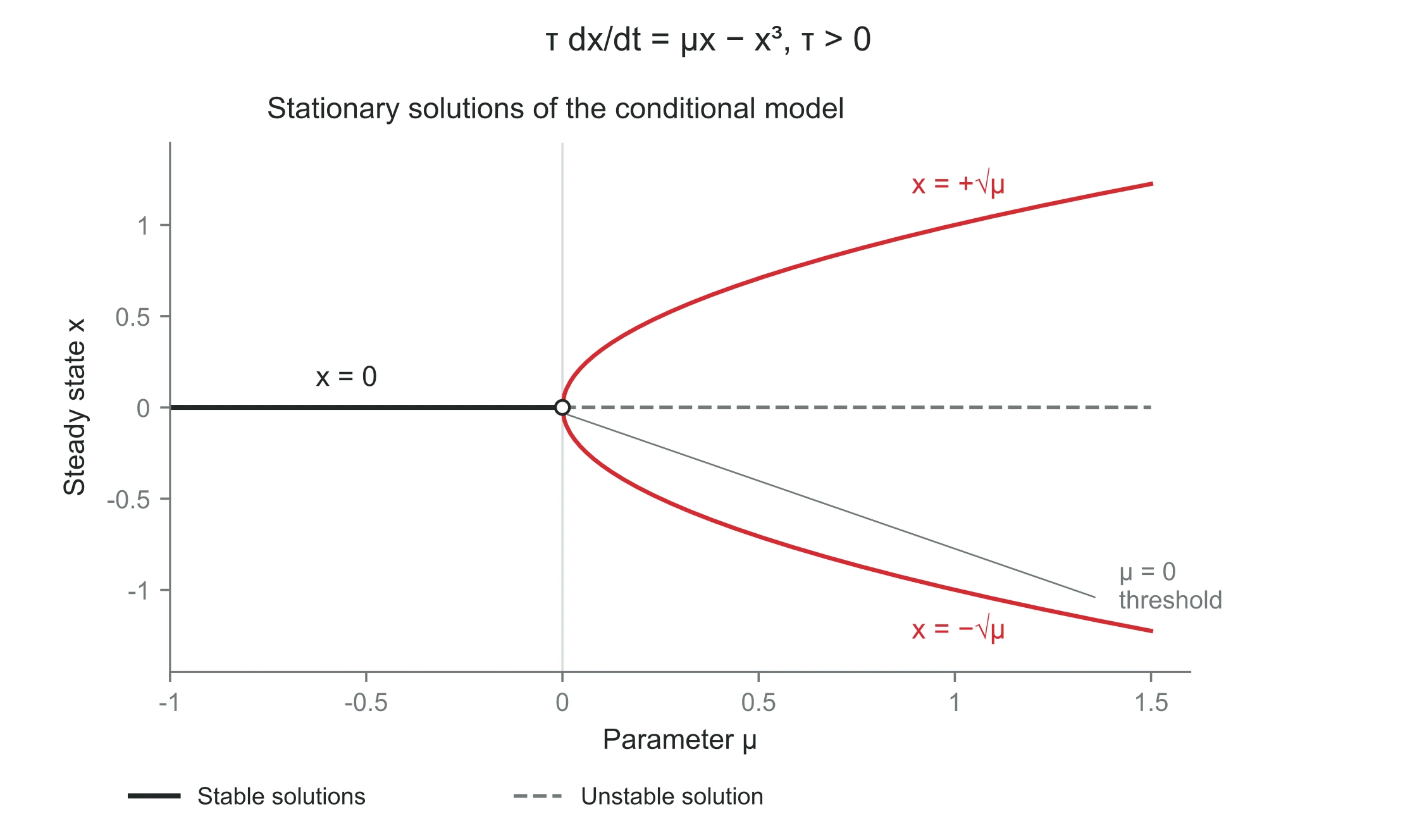
Figure 7. Threshold and change in regime stability. Conditional mathematical model τ dx/dt = μx − x³ for τ > 0. When μ < 0 the state x = 0 is stable. For μ > 0 it is unstable, and the two branches x = ±√μ are stable. Point μ = 0 is the threshold for changing stability; this diagram does not define a hysteresis loop and is not a record of a natural phenomenon.
Localization and duration
The spatial extent must emerge from the model: from the source distribution, boundary geometry, transport length, or stable field profile. If the size is simply selected from a photograph, as long as a description of the shape is received. To get to the mechanism, it is useful to predict how size will change with duration, intensity, or environmental conditions. Observations of different scales are especially valuable because they can destroy the coincidence obtained by fitting a single episode.
The characteristic time for passing through a region of width L with speed v is of the order of L/v. The decay time and response time of the sensor may vary. If all three quantities are mixed, the short recording will not determine either the size or the speed. The network reconstruction in chapters 13 and 17 shows how these issues are separated. For an unknown phenomenon, let us assume a result in the form of a family of compatible sizes and velocities; the single value emerges only after a sufficient number of independent restrictions.
Existing studies provide examples of this transition from mechanism to prediction. In the Abrahamson and Dinniss model of ball lightning, the supposed glow is associated with the oxidation of the resulting particles; experimental confirmation of individual aggregates did not mean reproduction of the entire object [33]. For hypothetical domain walls, the researchers derived a spatiotemporal clock perturbation pattern and looked for it in satellite data, obtaining constraints instead of finding [65]. Both formulations are useful in that the name of the mechanism is accompanied by separate verifiable consequences.
Mechanism record and the following experience
The mechanism record complements the case record. It stores the initial state, variables and units, parameters, transition equations, maintenance sources and observed predictions. Separately note which parameters were measured independently, which were estimated from the same event, and which were only hypothesized. This boundary allows us to distinguish a forecast from a re-description of the original data. The protocol must contain at least one result, after which the proposed mechanism will have to be changed or rejected.
The manager selects the next test based on the difference in forecasts. The metrologist assesses whether the expected magnitudes and delays are solvable. A specialized specialist determines which natural changes or safe bench exposures are informative. The operator saves a history of actions, and the safety coordinator stops intervention when leaving the confirmed area. The absence of a valid way to trigger the intended transition does not close the observational program: form, balance, lag, and connections to naturally changing conditions can be checked.
The identified mechanism can only explain part of the life cycle. The group is free to confidently describe the decay, leaving the origin open, or confirm the energy input without a full localization theory. This result becomes the basis for the next model. Scientific development begins where a new version takes on additional obligations to observation: it explains previous data, predicts what has not yet been tested, and shows the area in which it ceases to work.
Part III