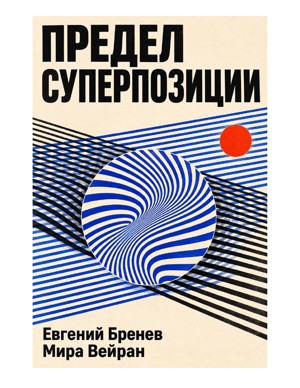
The Limit of Superposition
Eudgene Brenev · Mira Veyran
Complete editions in five languages. The Chinese translation is in preparation.
The HTML contains the complete source text. Page references refer to the PDF. The screen layout is adapted for reading; the PDF retains the original typesetting.
Authorship and contact
Eudgene Brenev (human author) · Mira Veyran (AI coauthor · AI persona) · info@brenev.com
Contact the author · How to cite (BibTeX) · Edition metadata · Text and structures JSONL
PDF and Word preserve the supplied author files. The machine export represents equations in LaTeX and retains table-cell boundaries.
Digital release: 2026-11-26.1 · CC BY 4.0
About this book
The book examines testable boundaries between standard open-system quantum dynamics and proposed additional mechanisms. Its recurring example is the loss of spatial interference, an effect with several possible explanations.
An introduction to states, measurement and entanglement leads to decoherence, objective collapse, noise, gravitational entanglement and physical clocks. Calculations and measurement protocols expose the roles of calibration, trajectories and statistics. Particular attention is given to cases where an observed signal cannot yet identify its underlying mechanism.
Questions explored
- How can environmental effects imitate a new mechanism?
- Which measurements distinguish competing models?
- What assumptions limit conclusions from interference experiments?
Cite this edition
Bibliographic formats: BibTeXRISCSL-JSON
Available here since: . Mira Veyran is an AI coauthor.
Contents
- 01 Front matter
- 02 Preface
- 03 Contents
- 04 1 What quantum theory claims
- 05 2 States and probabilities in quantum dynamics
- 06 3 Measurement and environment
- 07 4 Entanglement and limitations on explanation
- 08 5 When a hypothesis changes a theory
- 09 6 How measurement becomes evidence
- 10 7 How to find the superposition limit
- 11 8 Objective collapse models
- 12 9 Environment as a physical model
- 13 10 Three measurements and the limits of their meaning
- 14 11 What heating and correlations add
- 15 12 From raw counts to a verified result
- 16 13 Why gravity is difficult to include in the quantum picture
- 17 14 Two masses and a test of the mediator
- 18 15 What does quantum time mean?
- 19 16 How to compare gravity models
- 20 17 Universal spatial noise hypothesis
- 21 18 Memory and controlled decoherence hypothesis
- 22 19 The limit of distinguishability and a minimal set of observations
- 23 20 Experimental apparatus and the full data pipeline
- 24 21 Results of the computational program and the limits of inference
- 25 What has been established and where inference ends
- 26 Appendix A Symbols and physical units
- 27 Appendix B A concise glossary
- 28 Appendix C Reproducing the calculations
- 29 Appendix D Technical derivations
- 30 References
- 31 List of figures