Part V Map and Meaning
Chapter 15
A Map with Branches
What does the map represent?
After considering separate groups of evidence, it is tempting to collect them into a single sequence. Separation from the body, transition, encounter, review of life, stay, choice and rebirth form a clear narrative. But the understandability of a sequence and the confirmation of transitions between its links are different properties.
The map offered in this chapter represents the relationships between the motifs described. Its nodes indicate classes of experiences. Arrows show possible transitions within stories or research assumptions about the connection between groups of sources. Where complete transition has not been observed in one individual, the relationship should remain conditional.
Such a construction is useful even without solving the question of the external reality of the described space. It allows you to see which elements are examined in sufficient detail, where different meanings of the same word are used, and in which areas it is especially easy to quietly fill in missing information.
The map has two scales. On a large scale, functions are visible: changing the attitude towards the body, meeting, staying, deciding. On a small scale, specific details are preserved: the shape of the conductor, the method of communication, the feeling of one’s own body, the sequence of actions. You should move on to a generalization in such a way that the opportunity to return to a separate story does not disappear.
Comparison Map Nodes
Knot | What is being compared | Ch. |
Bodily perspective | Position of self and access to information about the environment | 4 |
Transition and meeting | Change of environment, recognition and communication | 5 |
View and space | Appeal to biography, objects and ways of obtaining meaning | 6 |
Stay | Rest, recovery, waiting and exercise | 7 |
Decision | Consent, refusal, delay and limitation of choice | 8 |
Previous biography | Returning to your old life after an experience | 3, 4 and 8 |
Supposed new life | Memory before birth and testing the connection of biographies | 9 and 11 |
Time | External cues and subjective duration | 10 |
Other evidence | Dreams and stories of those accompanying | 12 |
Initial section
The initial node can be called a change in the usual bodily perspective. This is a more cautious description than the ready-made statement about the separation of an independent entity. It covers what is available in the story: the location of the observer, the appearance of one’s own body, the change in pain, lightness, the absence of familiar boundaries.
The next node relates to changing the environment. It is important here not to assume physical movement just based on the story of the transition. In the descriptions discussed in chapter 5, there is a path with a sequence of landmarks, and the appearance of a new scene without a detailed transition. For a map, these are different options for communication between states.
The meeting forms another node. Its function may be recognition, assistance, communication or restriction of further movement. These functions do not require you to consider each person you meet as a guide in advance. The being who communicates the need to return and the familiar person with whom the emotional encounter takes place may occupy different roles.
The biography review, options for which are discussed in chapter 6, should be indicated separately. The role of the greeter and the way the biography is addressed do not necessarily coincide. Its contents include memories, assessment of consequences and a sense of understanding. The map should not infer the mandatory existence of a court solely from the presence of an assessment.
Stay and decision
The middle area of the map brings together a relatively stable stay. Here it is necessary to maintain the distinction of rest, recovery, communication, learning and waiting. If a person does not describe activities, this does not yet define an empty state. If treatment is mentioned, it is important to find out whether it refers to well-being, memories, emotional consequences, or an image of bodily recovery.
The decision to transition forms an independent area. It distinguishes between offer, consent, delay, persuasion, assignment and the experience of coercion. Replacing all options with the word “choice” would destroy some of the material. On the other hand, the message about the need to return does not yet reveal the mechanism of this need.
There is a fundamental difference between returning to a former life and the supposed preparation of a new birth. In the first case, the story is usually associated with a person who continues the previous biography. The second requires establishing a connection between the biographies, or at least the origin of the assertion of such a connection. These branches should not merge in the drawing just because both are described by the word “return.”
Dreams of loved ones are located next to the map, but do not replace the missing part of the deceased’s path. They provide information about the dreamer's experience and sometimes contain statements that can be verified. To use a dream as an observation of a certain stage of another person's existence, an additional argument is needed. The mere recognition of the deceased does not establish the date of his rebirth or the length of stay.
Places of rupture
The most significant gap lies between a temporary departure from an ordinary state and the irreversible end of a biography. A living survivor provides a near-death account. The source may contain no account of what would happen beyond the point of return. Filling that section with material about prebirth creates a research model that still needs to be connected to independent data.
The second gap arises between the story of the preparation of life and the confirmation of the specific circumstances of this life. If an adult describes the choice of his parents, subsequent knowledge of his own family is already included in his accessible biography. Testing prior knowledge requires early fixation to limit the influence of that knowledge.
The third gap concerns the preservation of the subject. Even if the transfer of unusual information could be established, the question would remain whether the recipient is a continuation of the previous experiencer. Information connection, similarity of character and personal identity require different criteria.
A break does not mean that communication is impossible. It denotes a place where existing information is insufficient for the next inference step. A scientific map becomes more useful when its incompleteness is visible. The reader can then understand what new observation would change the design of the circuit.
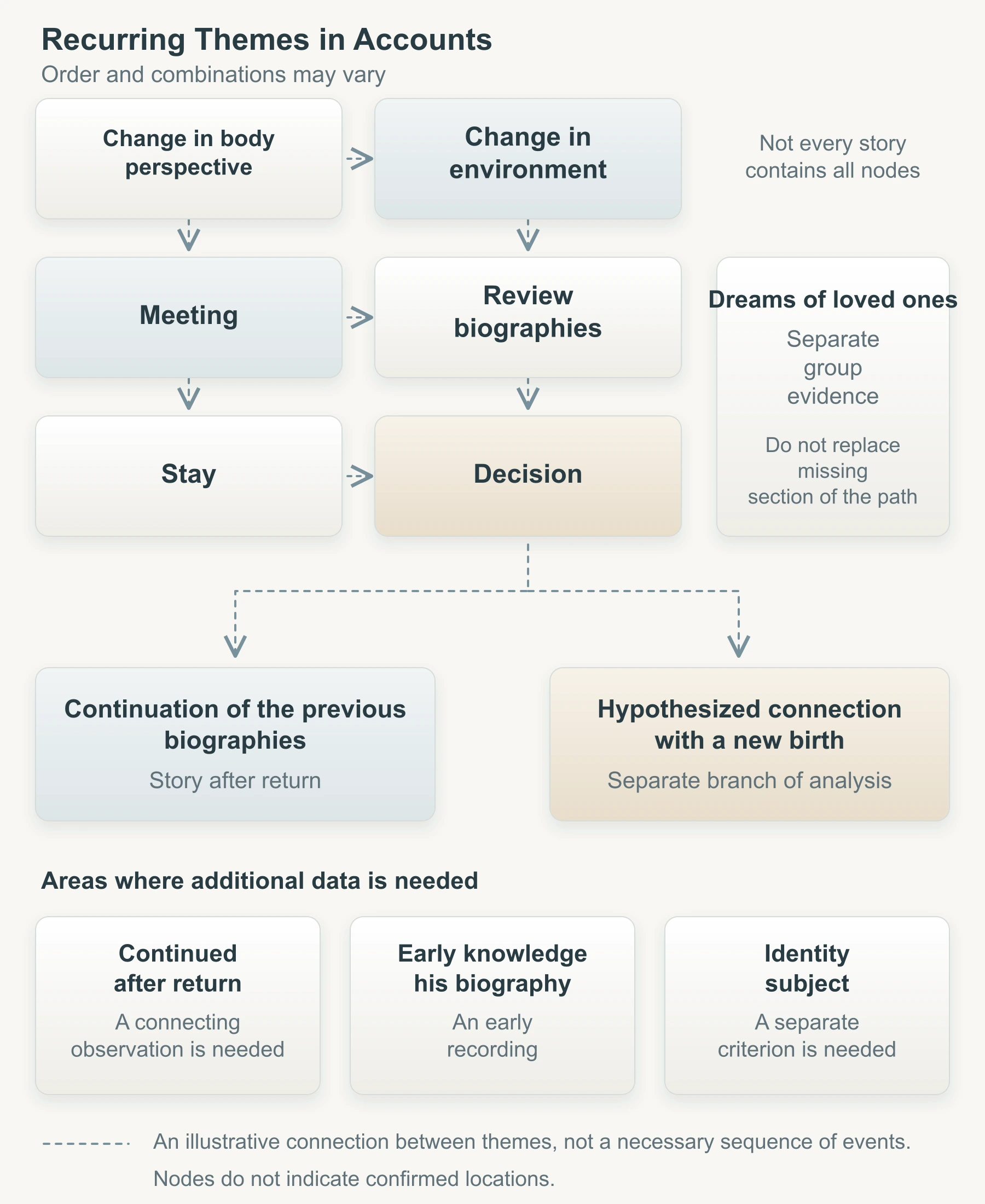
Figure 28. A map of motifs with forks and breaks. The connections are conditional and do not specify a mandatory order. Not every story contains all the nodes.
How to compare branches
One possibility is that we have different forms of a common process. The other allows several processes with partially similar content. Another one connects the similarities with the common means of experience and storytelling. To choose between them, it is not enough to list common words.
You should look for combinations of signs. A separate mention of light says little about the order of events. More meaningful would be a stable combination of a rare method of transition, a certain type of interaction and the same restriction of action. In this case, it is necessary to determine the matching criteria in advance and check how much they depend on the culture and questions of the interviewer.
Contradiction is also assessed at the level of assertion. Variations in room color do not necessarily disrupt the overall functional pattern. The distinction between free refusal and compulsory return may affect the intended mechanism itself. The more important a rule is for a model, the less reason there is to explain its absence only by differences in scenery.
Therefore, the final map must remain a map with branches. It retains the possibility of a common path, but does not require a single path where the sources do not establish one. The next question relates to the meaning of the proposed movement: what exactly could justify or cause a repeated return.
Chapter 16
Why Return?
Reason, function and meaning
The question of the cause of rebirth seems uniform until the meaning of the word “why” is clarified. Sometimes people ask about the mechanism: what causes the next transition? Sometimes it’s about function: what result is achieved by repetition? Sometimes it’s about a personal meaning: why would a person agree to a new life? These questions allow for different answers and different ways of testing.
A mechanism can act without a conscious purpose. The goal may exist for the actor without determining the structure of the entire system. Personal meaning can appear after an event, even if it was not its cause. Therefore, the experience of a mission cannot automatically be considered a description of the general law of existence.
Previous chapters discussed messages about tasks, training, return, and the possibility of deferment. Now, several analytical models can be distinguished from them. These are constructs for comparing putative rules. None of them become established simply by helping to read the story coherently.
Each model should be asked what persists between lives, what changes, why bodily life is required, and on what basis the process could be completed. If answers are missing, the name of the model indicates a line of thought rather than a ready-made explanation.
Training model
The most understandable version suggests that repeated lives teach something. However, the word “learning” needs content. Obtaining information, mastering a skill, changing one's attitude towards another person and moral development are different processes. Each requires its own characteristics of the result.
If access to very broad knowledge is expected before birth, the question arises of what knowledge still needs to be acquired in life. One possible answer distinguishes between description and living. One can know the wording about pain and separately have the experience of pain. Such a model logically allows for the value of embodiment as the acquisition of a certain type of experience. But it does not yet explain why this particular experience is needed and why it must be repeated.
Another answer relates learning to a change in the way of doing things. In this case, it is important to establish what is carried forward: memory, inclination, ability to make decisions, or attitude towards others. Without a transferable result, the connection between successive lives becomes uncertain. To justify accumulation, it is necessary to determine the transferable result and signs of its persistence.
Forgetting can be included in the model as a self-selection condition. However, this explanation comes at a cost. The more complete the presumed forgetting, the more difficult it is to test the continuity of learning. If any character of a person is declared to be the result of past lessons, the hypothesis covers all outcomes and makes almost no difference between them.
For research development of the model, restrictions are needed. For example, what changes should be more common in a certain sequence of biographies? What messages would refute the hoarding assumption? How does the proposed transfer differ from the normal development of the current person? These questions do not require you to deny learning in advance. They give it a certain meaning.
There is also the question of completion. If the goal is finite, a criterion of sufficiency is needed. If the goal is constantly changing, you need to explain in what respect the next cycle continues the previous one. The word “development” itself does not convey any direction, no limit, or who evaluates the result.
Relationships and correction
Another model places relationships at the center. A new life is supposed to be an opportunity to continue the connection, to repair what has been done, to change roles, or to help another. Here the unit is no longer an individual person, but a network of interactions.
Such a scheme raises a complex coordination issue. If the circumstances of one life affect many, whose decisions are involved in their choices? Is disagreement possible? Does the plan change when the other person acts differently? A model in which everyone chooses their own destiny entirely must explain the intersection of these choices.
It also cannot be concluded from the hypothesized choice of circumstances that the current person actually gave consent to every event that happened to him. For such a conclusion it would be necessary to establish the existence of choice, its content, understanding of the consequences and the continuity of the decision-making subject. These conditions are not replaced by a general belief in purpose.
The connection between suffering and learning especially needs precision. That a person later finds meaning in what he has endured does not establish that the suffering was pre-ordained for that purpose. Subsequent understanding and the original cause remain different statements. Thanks to this distinction, research can discuss meaning without attributing unproven solutions to people.
The relational model would become more meaningful if there were independently recorded interrelated messages. However, even such a match would require checking the usual channels of information and matching rules. Explaining each meeting by a past agreement can only be done at the cost of losing the distinction between the assumption and the result.
Experience, Participation and Service
Another model assumes that the goal is variety of experience. The new life then represents a different way of seeing and acting. The question of the end of the cycle changes: if diversity is valuable in itself, completion does not necessarily take the form of a graduation test.
This option explains the possibility of many different lives at the level of a general idea. But it does not explain why these particular conditions are required and who evaluates their value. It is also necessary to determine whether there is a common carrier of diverse experience or whether each subject receives only a separate part.
The participation model emphasizes action in the world. The return is intended for the sake of help, a relationship, or a specific task. For her, it is important to distinguish between the meaning that a person ascribes to his life after the experience and the task that can be independently traced back to it. Both options can have personal meaning, but serve different roles in verification.
Finally, a mandatory cycle model is possible. In it, the transition occurs according to a rule that does not depend on the current desire. This assumption requires establishing what makes a rule mandatory. Pointing to a teacher, council, or higher authority shifts the question to the authority of that actor. The name of the authority in itself does not reveal the basis for its decision.
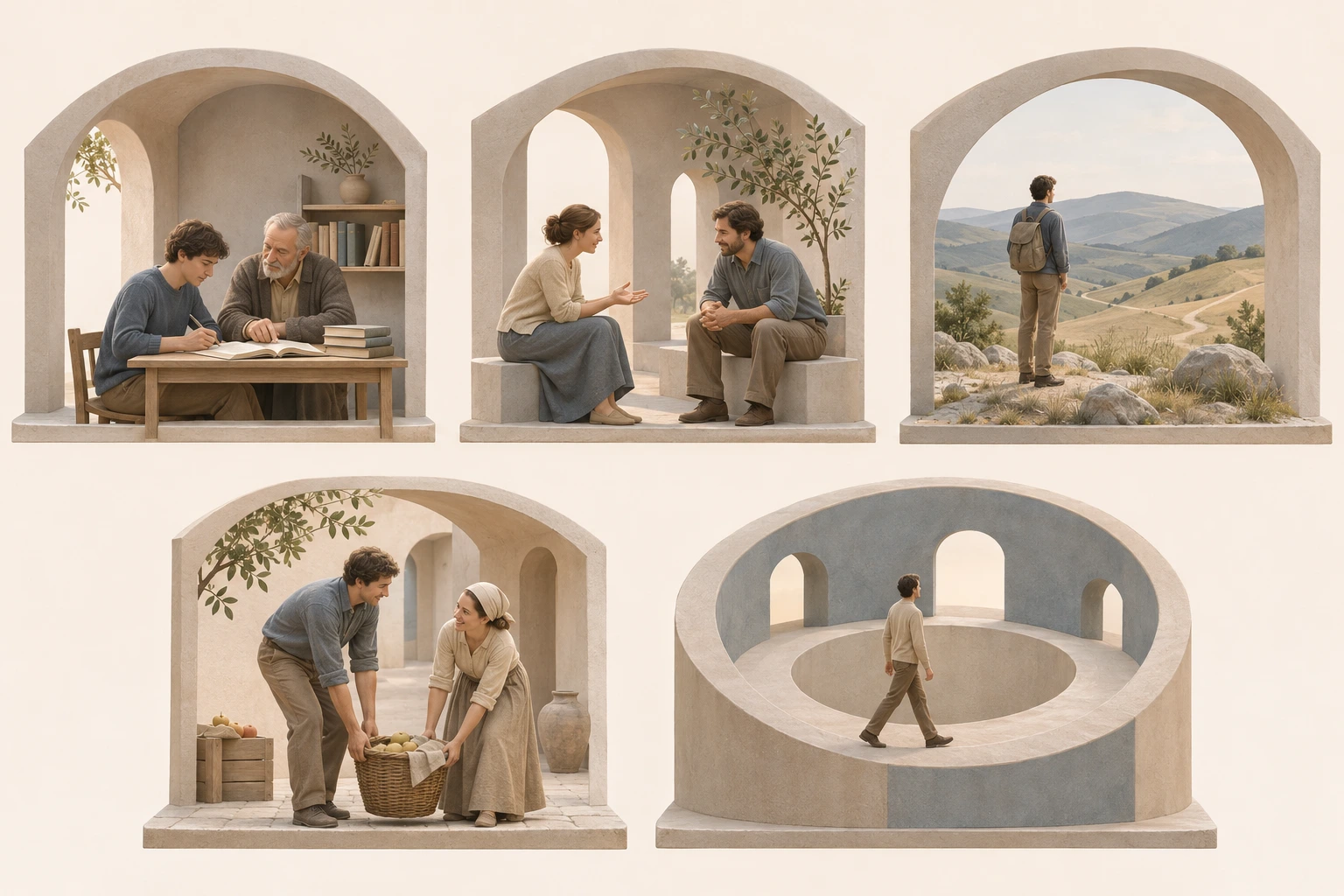
Figure 29. Five explanations for the supposed return. From left to right, top to bottom: learning, relationships, diversity of experience, assistance and the mandatory cycle. The author's composition compares analytical models that require clarification of the result, transition rules and the possibility of completion.
Freedom to stay
The question of renunciation of birth contains several steps. The experiencer may want to stay, say no, get a reprieve, or be able to finally break out of the cycle. The transition from one stage to another requires additional information.
Final failure is especially difficult to examine. The sample of people talking about the present life, by its design, contains those who exist in the current life. It is not possible to directly calculate the proportion of those who were never born again. This selection constraint persists even if the entire degeneration model is temporarily accepted.
The message “after this life I will no longer have to incarnate” refers to the expected future. To test it, one must determine what would be considered a refutation, how a new incarnation would be established, and how long one should observe. Without such conditions, the word “last” remains part of the content of the story.
There is also a difference between the freedom to choose a particular parameter and the freedom to reject the entire system. The ability to choose family, time or task does not mean control over existence at all. The map must keep these freedoms separate, otherwise a private decision will be quietly transformed into absolute autonomy.
Who is called God
When discussing purpose, the question of a higher source arises. In the descriptions of chapters 5 and 6, the word "God" means different things: a recognizable interlocutor, a luminous presence, an all-encompassing unity, and a subsequent explanation of the experience.
These values should not automatically convert to each other. Personal appeal presupposes a relationship between participants. The experience of unity may, on the contrary, be accompanied by a weakening of the boundary between oneself and the environment. The same word in the final story does not eliminate the difference in the structure of the experience.
The personalized presentation hypothesis assumes that one source takes forms that are understandable to different people. In order for it to lend itself to research, it is necessary to indicate that when the shape changes, it remains constant. If the appearance, rules, sequence, and meaning of decisions can change, it becomes difficult to determine what data would generally testify against the unity of the source.
The question of the meaning of existence therefore remains broader than the question of a repeating plot. Similarity of messages can reveal a consistent way of experiencing the target. To draw a conclusion about the objective purpose of the entire system, it is necessary to connect the content of these messages with independent grounds. The book maintains this boundary while making room for the human meaning of experience.
Chapter 17
How to Test a Picture of the World
Statement before explanation
After comparing the stories, the next step is to formulate statements that can be individually tested. The question “does the entire described world exist” is too large for one observation. A more specific question concerns specific information, the sequence of events, or the dependence of images on conditions.
A research program can begin in several directions. You can check the accuracy of a report about an object that is inaccessible to normal observation. You can compare early and later versions of the story. You can find out whether the content changes with different methods of questioning. You can study the sequence of messages about the death of another person. These tasks do not have to provide the same explanation in advance.
Each statement requires conditions under which the result will be considered a coincidence, error or uncertainty. It is advisable to ask them before reading the answer. If the rule changes after the result, it is difficult to distinguish the found pattern from a classification adaptation.
The schemes proposed below are directions of research, and not a description of the experiments carried out in this book. Their implementation would require appropriate professional training, agreement on ethical conditions and protection of participants.
Surveillance for a medical event
The clinical review must relate three records: the objective sequence of medical events, the conditions of information availability, and the person's early free narrative. Even an accurate report of an object is of little help in localizing an experience if it is not known when the object might have been seen or heard in the usual way.
Possible test stimuli should be separated from the normal information of the chamber. For timing purposes, predetermined stimulus changes and an independent time log are useful. In this case, the interviewer evaluating the answer, if possible, should not know the correct content before recording the story.
Before such a study begins, a dictionary of acceptable matches, a time window, and a method for assessing the answer are recorded. If the stimulus changes, content correctness and timing accuracy become two separate outcomes. A match with any image ever shown has a different meaning than a match with an image from a predetermined interval.
Any such procedure is subject to treatment. It does not involve creating a dangerous condition or changing the necessary assistance for the sake of observation. The challenge is to record a naturally occurring event while maintaining medical priorities.
A positive result would require an investigation into available channels of information and reproducibility. A negative result must also be read within the boundaries of the task. If an individual has not reported a target stimulus, this may limit the specific perceptual inference about that stimulus. It does not necessarily answer all questions about the experienced content.
Early reports of another biography
In researching children's stories, fixation before finding matches is central. Free utterances are recorded with date and context. Then, clarifications, questions from adults, and information that appeared after meeting the supposed former family are stored separately.
The list of statements should be divided by verifiability. Common phrases like having a family have many possible matches. A rare combination of name, place and event is potentially more informative, but needs to be checked for spelling variations, breadth of search and usual sources of knowledge.
It is important to retain errors and inconsistencies. If only successful details are published, it is impossible to evaluate the entire set of statements. It is also advisable to distinguish between information verified by a document, the story of one relative and the consent of several people after a joint discussion.
One possible additional control is to independently compare the original list with multiple biographies according to pre-established rules. The evaluator does not know which family the participants believe matches the story. This approach does not eliminate all the difficulties of the search, but it allows you to check how much the choice depends on knowing the desired answer.
The search for a supposed biography itself becomes part of the history of information transfer. Therefore, its stages need to be documented. Independence of subsequent verification means, first of all, the ability to reconstruct what information the participants had at each moment. This procedure is useful no matter which explanation ultimately turns out to be preferable.
Dreams and messages about death
For dreams, registration before receiving news related to them is especially promising. The diary should contain not only unusual coincidences, but also a sequence of ordinary entries. Otherwise, the background against which a successful case stands out is unknown.
Pre-defined compliance rules are needed. The coincidence of a name, image, general mood and a specific event has varying degrees of accuracy. The time period allowed also changes the number of possible matches. The freer these parameters are, the easier it is to select a connection after familiarizing yourself with the result.
In the case of multiple witnesses, notes should be obtained prior to mutual deliberation. Already existing communication is noted separately. If the separation occurred too late, this is not a reason to destroy the data, but a reason to limit the conclusion about their independence.
A possible control comparison consists of assessing the correspondence of records to real events and comparable control events without prompting the evaluator which pairs are considered putative matches. The rule for forming pairs is set in advance. The result then refers to the ability of the established procedure to distinguish between these pairs, rather than to the impression of the separately selected story.
Even a well-documented match requires an assessment of available information channels and the frequency of such messages. One episode can pose a question, and a series with predetermined conditions helps to understand its reproducibility.
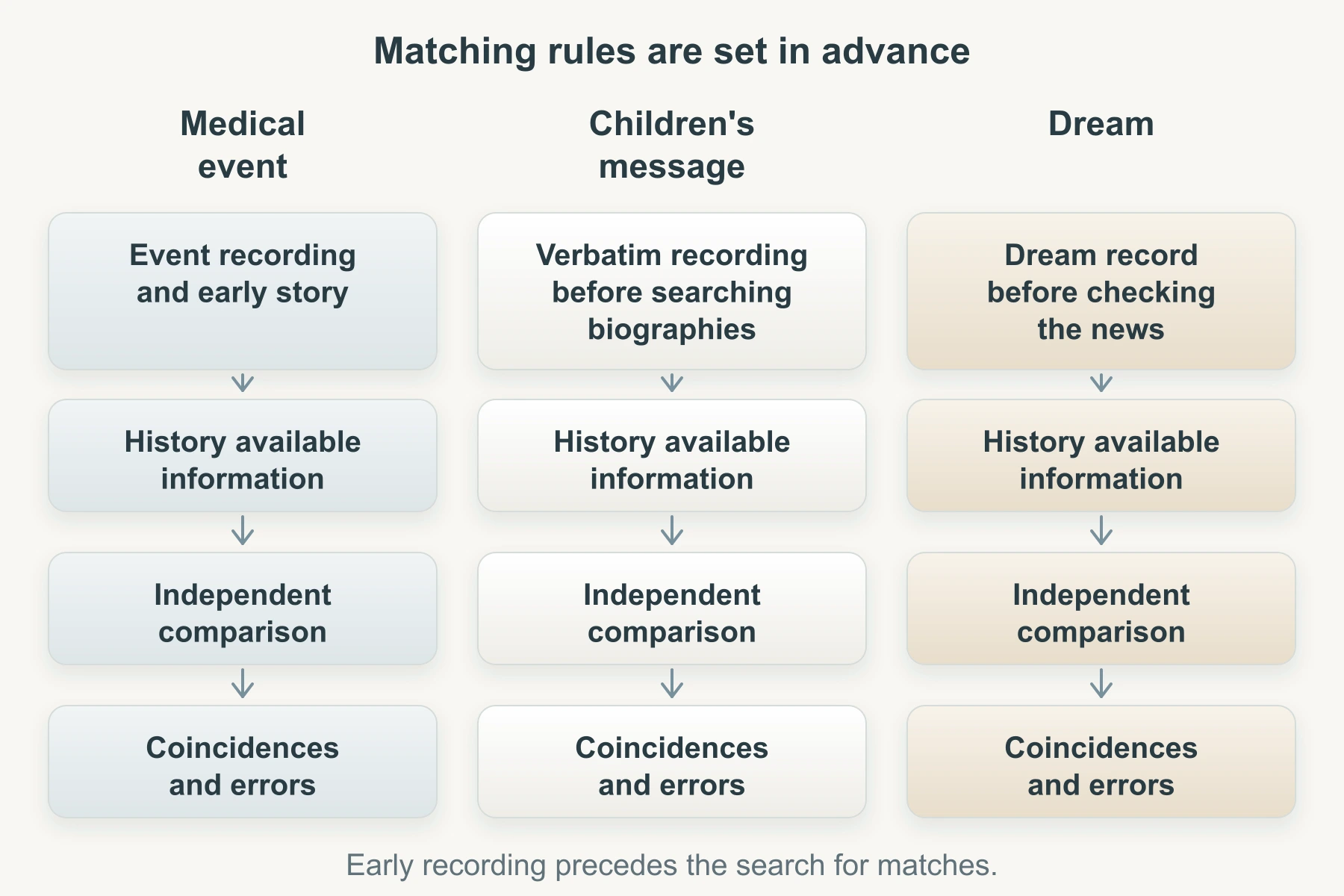
Figure 30. Three ways to verify accounts. The design juxtaposes a medical case study, a child's report, and a sleep study. Early fixation, verification of available information, and independent comparison include storing matches and errors.
Personalization and shared itinerary
The common path hypothesis with individual design requires comparison of two sets of traits. The first relates to images: figures, objects, spaces and religious symbols. The second is about relationships and rules: who decides whether refusal is possible, what precedes the transition, how information is communicated.
The similarity of the second set while the difference of the first would be compatible with the personalization hypothesis. But it may also be compatible with the general properties of human storytelling. Therefore, comparisons with other experiences and testing of the impact of the questions will be required. A cross-cultural list of similar topics is not enough.
It is desirable to obtain a description of culture regardless of the content of the experience. You cannot first call an image Christian and then use its presence as the only proof of a person’s Christian expectations. Consideration should be given to actual beliefs, exposure to stories, and changes in views before and after the event.
Coding should be entrusted to several people who apply predefined rules. Their discrepancies themselves provide useful information. If the same scene is consistently assigned to different phases by different researchers, this may indicate ambiguity in the map, rather than a special property of the supposed world.
What results would really change the conclusion?
Strong advances would occur through repeated acquisition of predetermined information under conditions that exclude known conventional channels and allow the outcome to be accurately linked to the timing of the event. This would increase the validity of a particular unusual information effect. Further conclusion about the information carrier would still require a separate analysis.
Another important result might be the consistent dependence of stories on interview mode. It would help identify which parts of the map are created or enhanced by the procedure. Similarly, independent reproduction of a certain combination of elements under controlled influence would clarify the mechanism of this combination.
The study must maintain the possibility of change in both directions. More rigorous evidence may strengthen an unusual hypothesis, limit it, divide it into multiple phenomena, or show that the original category was too broad. This is what makes the program research-based.
Until such results appear, it is permissible to maintain several explanations with different areas of applicability. It is important to understand at what step the verified ends and the assumption begins. This clarity allows work to proceed without the need to determine the final answer in advance.