Part II The Proposed Path
Chapter 4
Separation from the Body
Where is the observer
The out-of-body experience seems especially compelling because it relates to the very condition of observation. The person reports that not just the object in front of him has changed, but the position of the one who sees. The body can become part of the surrounding scene: it is located below, to the side or at a distance, while the point of presence remains where what is happening is perceived. This formulation describes the meaning of the message for now. The question of the physical movement of consciousness has yet to be raised separately.
A few differences are sufficient for an accurate reading. Seeing an image of your own body and feeling outside of it are different characteristics. These may be accompanied by the impression of movement, lightness, lack of weight, or a new bodily form. There is also a separate question about belonging: whether the visible body is perceived as one’s own or whether it appears to be someone else’s. A story containing only one of these characteristics should not be supplemented with the others to fit the known plot.
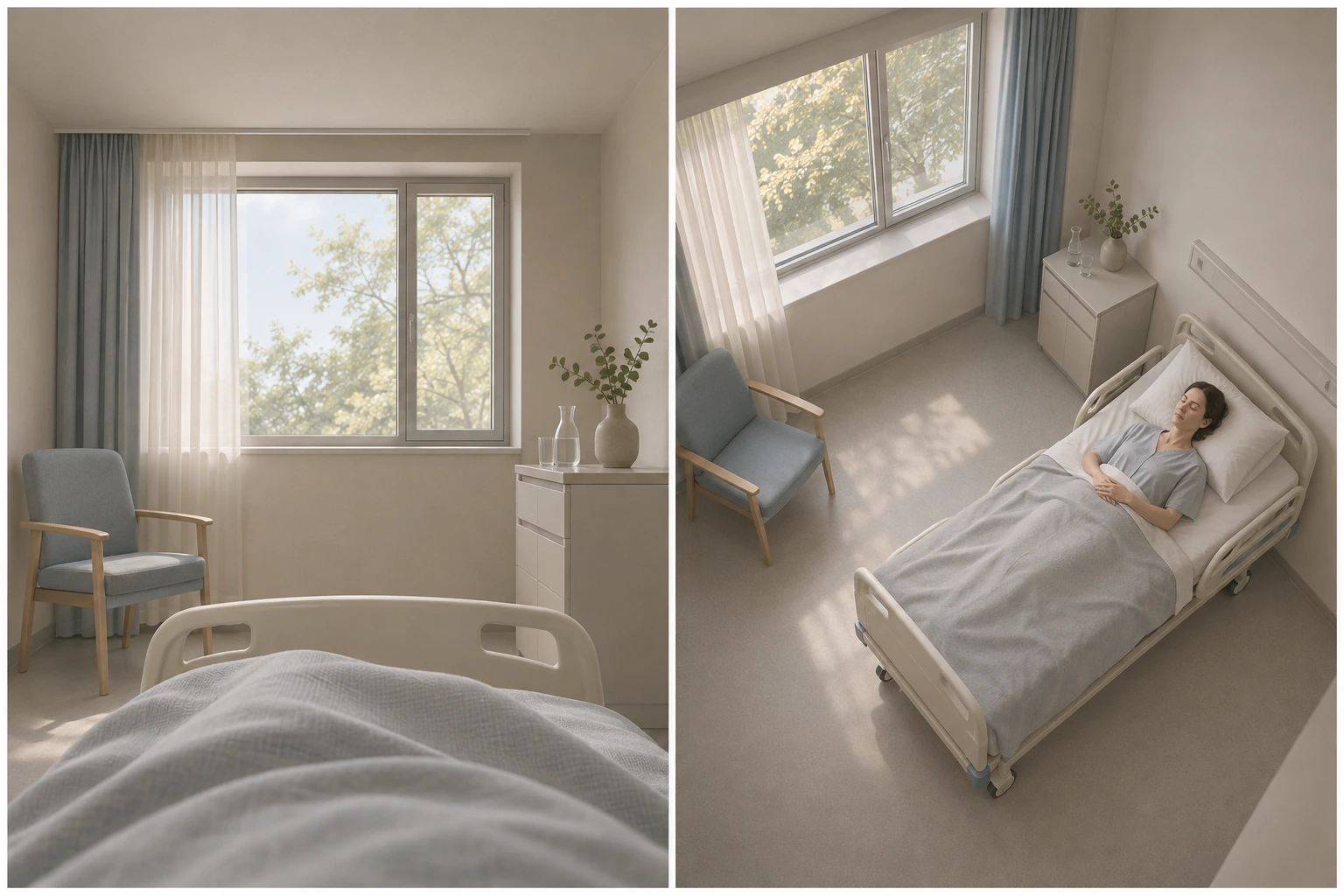
Figure 5. The body and the experienced point of observation. One conditional room is shown from the position of a lying person and from above. The author's illustration distinguishes between the visible body and the position from which the scene is perceived.
A mental example is possible. A person imagines a photograph of himself from the outside and understands perfectly well that he is looking at an image. It does not follow from this that his experienced location was transferred to the shooting point. Conversely, one can report one's displacement in space without describing the visible double at all. The word “exit” brings these options together faster than research can distinguish between them.
A change in perspective also does not mean the disappearance of self-awareness. Self-recognition, interest, surprise, and decision-making may be maintained within the story. But the message “I understood what was happening” does not reveal all these properties. It is useful to ask what exactly the person understood at that moment, and what he concluded later. The meaning of the experience may be quite clear to the narrator, although the sequence of its comprehension remains unknown.
A perspective that can be changed
In 2002, Blanke et al described a patient with epilepsy in whom stimulation of the right angular gyrus repeatedly produced sensations of looking down at the legs and lower torso. There was also lightness and the impression of being above the bed. When attention and limb position changed, bodily illusions changed. These episodes did not constitute her usual attacks; the stimulation area differed from the identified epileptic focus. [8]
In a study by Ehrsson 2007, healthy volunteers saw their own back through displays from the position of cameras located behind them. Coordinated visual events and touch enhanced the sensation of being in this new position. When the perceived body was threatened, skin conductance, a physiological indicator of response, changed. Comparison with inconsistent conditions allowed us to examine the influence of the organization of sensory signals. Information about the environment came through cameras and eyes. [9]
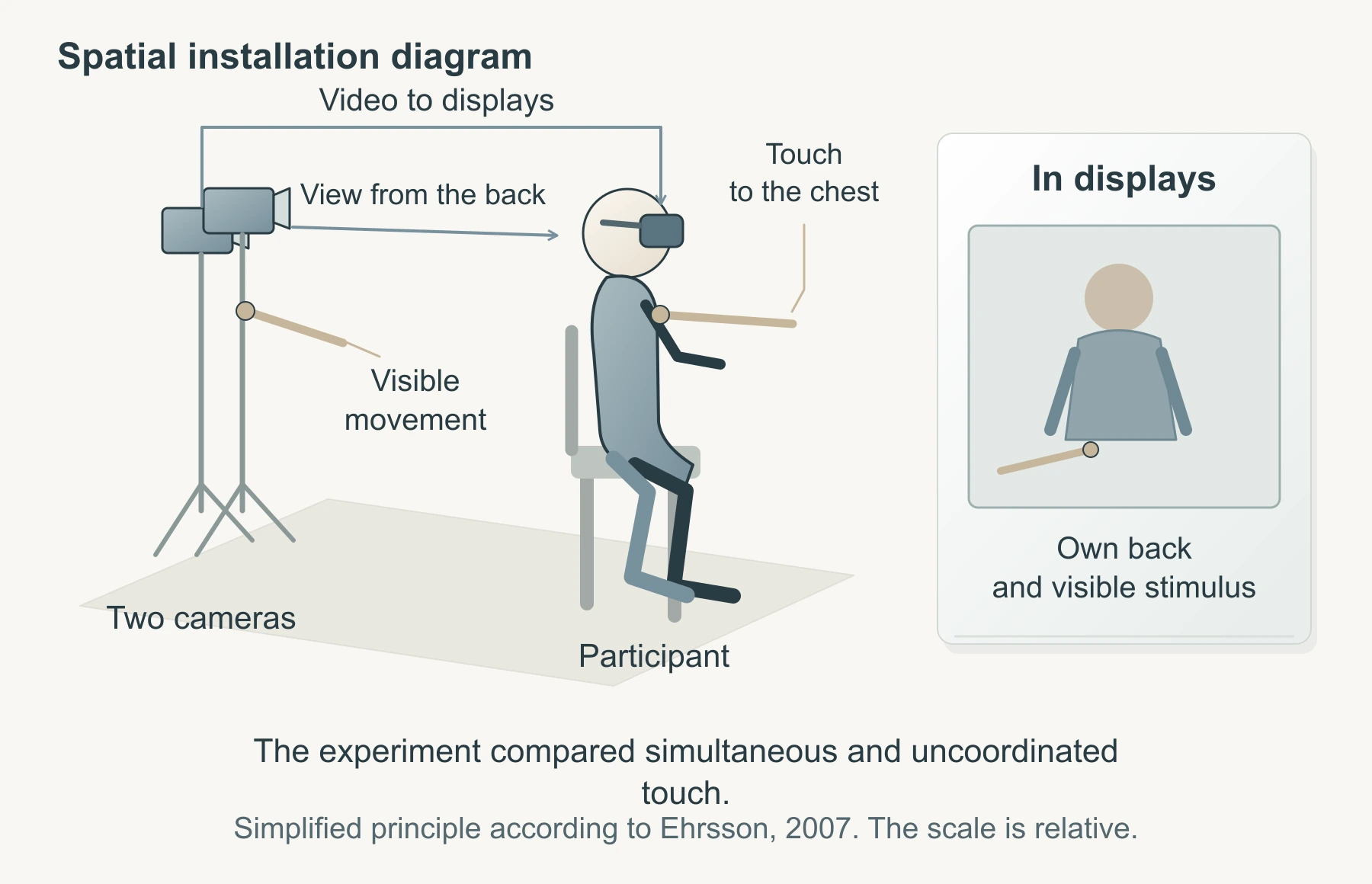
Figure 6. Experimental change in perspective. A simplified diagram of Ehrsson's study shows camera images and the matching of visual events to touch. Information about the environment comes through the normal visual channel. [9]
Such results are important for determining the subject of the dispute. The experienced location of the self is susceptible to experimental change. Therefore, immediate certainty about where an observer is is not itself an independent measurement of his physical position. This is a general conclusion about the verification method: spatial experience and an external source of information must be examined by different means.
This does not provide a ready-made explanation for any story. A specific experiment reproduces selected conditions and measures certain characteristics. Another story may contain additional elements that were missing. An informed comparison begins with a list of similarities, then moves on to the differences. The phrase “they called the same thing in the laboratory” too quickly erases this work if only one point of the description turned out to be the same.
Causal intervention is especially valuable where it helps to separate properties that are usually combined in ordinary experience. It is possible to study whether perspective changes when biographical memory is maintained, whether the sense of belonging depends on movement, and how threat to the body is related to the experienced position of the self. In such a study, the question of consciousness becomes more precise: instead of a single indivisible "I", characteristics are considered that can be distinguished in messages and compared with conditions.
When another one appears
Separation from the usual bodily position is sometimes discussed next to the feeling of someone else's presence. These topics are linked by the question of the source of action. A person feels a touch or movement and perceives it as his own or as coming from someone else. For a map of meetings this is essential: the feeling that someone is nearby may arise before a discernible image and before an explanation of who the person present is.
Blanke et al., in work 2014, combined observations of neurological patients with experiments in healthy participants. In the robotic setup, the mismatch between the hand movement and the touch on the back increased the feeling of another person nearby. The authors investigated precisely such presence and associated bodily impressions. The experience did not establish the identity of the deceased, did not verify the message of the guide, and did not reproduce the entire afterlife. [10]
To analyze a story, it suggests a sequence of questions. First, you should find out what was given directly: a feeling of proximity, a silhouette, a voice, a face, or an action addressed to a person. Then - how recognition arose. It could be related to appearance, to the content of the message, or to immediate confidence without discernible signs. These options are not interchangeable, although later they can be expressed by the same phrase about meeting a relative.
The last level is information. Even if presence has a known possible mechanism, the claim of unknown information obtained requires its own verification. Conversely, the accuracy of individual information does not automatically establish all the properties of the person to whom it is attributed. Separation allows you to work with each question without forcing one result to immediately answer for the origin of the image, its identity and the structure of the world in which it appeared.
What does it mean to see
The word “see” seems simple until research begins to clarify its content. In a story, it can mean a colorful scene with a point of view, instant knowledge of the location of objects, an image without the usual visual perspective, or the belief that the entire event was available. The distinctions are important both for describing qualia and for testing a possible information channel.
Ring and Cooper in 1997 published an interview with 31 a blind participant who reported near-death or other out-of-body experiences. The authors separately discussed the ambiguity of visual language: “seeing” could convey a combination of spatial knowledge and other impressions. In the case of Nancy, it was possible to interview a witness, but his story also contained the usual auditory channel: he addressed the patient by name. The study offered an unusual interpretation, but the published information did not turn each episode into a controlled test of vision without eyes. [11]
A useful principle that does not depend on the attitude towards such stories is that the knowledge being tested should be described separately from the intended method of obtaining it. If a person correctly identified someone present, you need to know what distinguishable signs he reported before confirmation. If you named an object, accuracy, location and the ability to find out about it in advance or later are important. Even the correct answer may have several sources, and the task of verification is to gradually distinguish between them.
This requires careful attention to the language of the narrator himself. The researcher should not turn an unusual sensation into an ordinary picture just because the picture is more convenient to retell. At the same time, the vague “I knew everything” cannot be considered exact knowledge of specific objects without additional information. A verifiable part receives weight due to its certainty, recording time and independence of comparison.
External Event and Narrative Accuracy
In the case detailed by the authors of AWARE I, 57, a year-old patient, described resuscitation information, which the authors compared with medical records and the operation of an automatic defibrillator. They reconstructed the temporary connection within approximately a few minutes. There was no individual EEG for this episode, and there was no hidden visual target in the room. Therefore, the published test refers to recognizable resuscitation events, but not to the reading of a pre-hidden image. [3]
Similar attention to the origin of information is required in the famous story of the surgeon Lloyd Rudy. Rivas and Smit's publication is based on his later video story and the assistant's confirmation after viewing the recording. The patient, they said, described details of the operating room, including a monitor with notes. The patient's identity and medical record could not be restored; sequence accuracy remained limited. The monitor in this case refers to the terrestrial operating room. It cannot be included in the list of techniques of the supposed afterlife. [12]
Such messages remain valid as cases requiring explanation within the limits of available documentation. But the strength of evidence and the number of repetitions of history are not the same. Repeated retellings do not restore lost medical documentation. Confirmation after reading a story is different from an independently stored description. These circumstances determine how narrow the scope of explanation can become, not how much credit the storyteller deserves.
A specially prepared test also requires a real chance to get a verifiable answer. In Holden and Joesten's hospital project with hidden cards, no usable test interviews were obtained during the study period. The individual reported experience occurred outside the equipped room. This outcome shows the difficulties of the organization, but does not represent a series of unsuccessful attempts to read the card. [13]
At the end of this phase, two independent results remain. The first concerns how a person experiences his own position and physicality. The second is what information about the environment can be verified. Their connection is possible only based on data from a specific case. A further story may change the entire setting: instead of a room with people and equipment, there will be a passage, light, or a greeter. The test will then move from recognizable earthly events to the structure of the narrative itself about another environment.
Chapter 5
Passage and Encounter
Movement without the usual space
After changing the attitude towards the body, the story can continue with movement. The word “transition” is convenient as long as it does not make one imagine a mandatory road that everyone must take. The transition has a direction, but sometimes there is no visible path. There is a feeling of approaching, but there is no distance. The scene may change immediately, and the impression of movement may appear only in an attempt to connect two remembered states.
The woman who published the story under the name Mrs. Grace, describes a luminous curved pipe, lightness and a pleasant sound that was perceived without the participation of the ears. She continues to think and intentionally move forward. There are no creatures or voices encountered in this story. The story relates to the experience after surgery; The publication does not present a reliably established cardiac arrest. [14]
This description allows us to separate the experience of movement from the encounter. The plot itself does not need an accompanying person here: the direction has already been set. If you add the greeter on the basis that he appears in other stories, the original evidence will change. The reconstructed map must allow for a path without a guide and a meeting without a previous path.

Figure 7. Transition without a guide. Artistic reconstruction of the glowing curved passage from the story Mrs. Grace. This description retains the intentional movement and feeling of lightness. [14]
No less significant is the difference between the direction of movement and the method of its implementation. In a normal walk, the body moves relative to a stable environment. In an unusual experience, a person may feel movement even though the walls are not moving closer or further away. The opposite formulation is also possible: everything around changes, but the observer himself remains in place. The general meaning of the transition is preserved, but the intended geometry of space turns out to be different.
Therefore, the tunnel should be described as a specific form of experience, and the transition as a broader relationship between states. This distinction will come in handy later, when a corridor, a river, an instant change of scene and the disappearance of the previous environment are encountered in the same scheme. They can serve a similar narrative function without becoming the same object.
The other becomes distinguishable
In Peter N's story, an invisible presence appears nearby. His answer is perceived both externally and internally. The transition is accompanied by darkness, movement and an increasing rhythmic sound, which Peter compares to a helicopter. Later, distinguishable light individualities arise and the message is transmitted as a thought along with a feeling. Unusual colors and star-like creatures form the environment in which he recognizes the source of the message, although he experiences it within himself. Peter emphasizes that listing episodes one after another does not convey the experience well. The feeling of unity, he said, did not destroy the individual personality. This is a late recording of the experience following a car accident. [15]
Here the interlocutor differs not by his face, clothes or place in the room. The main feature is the origin of the message: it is experienced as coming from another. For the person himself, this can be as certain as the voice of an acquaintance on the telephone. For an outside researcher, two separate questions remain: how confidence in someone else's authorship arose and what information was obtained.
The word "telepathy" is often used as a shorthand name for such communication. But in describing experience it combines several possibilities. One is similar to inner speech, the other is like direct understanding of the meaning, the third includes the feelings of the interlocutor. Before discussing the mechanism, it is necessary to restore the form: were there words, language, intonation, images, the opportunity to ask again. If these differences are lost, speaking in ordinary phrases and suddenly silent understanding will be one sign.
Sharon T remembers the scene of her own bedroom after the drowning and two white figures. One seems to her like Jesus, but she does not examine the face in detail. The figures are silent; love and support are felt. She does not report the instruction conveyed. The light in the window gradually intensifies, as if at dawn. Sharon associates the opening of the eyes of the figure lying in bed with her awakening by the pool. The external location of the event is different from the space of the experienced scene. [16]
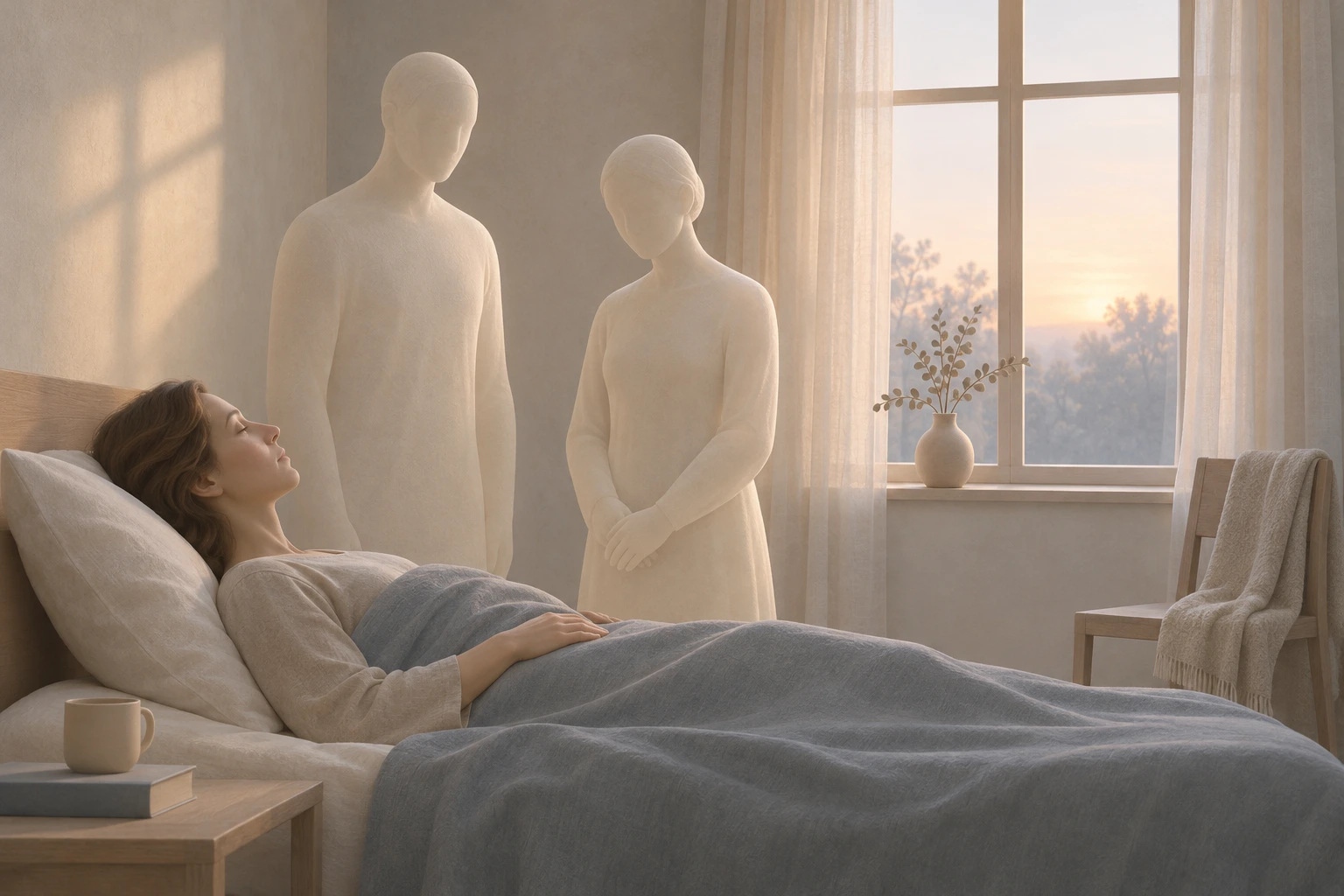
Figure 8. Silent accompaniment. Two light figures and increasing light in the bedroom based on a story by Sharon T. The setting is conveyed conventionally; she associates the external event with drowning at the pool. [16]
Silent accompaniment is also a social meeting. A person can feel accepted without words and perceive those present as helpers in their role. However, the role does not yet establish a biography. “I was helped,” “it was an acquaintance,” and “it was a certain deceased person” contain different statements, each of which requires its own verification. Careful reading preserves this difference even where the narrator himself combines them with one word.
Recognition and names
Recognizing a face and experiencing familiarity are different events. In the first case, you can name the features of appearance, compare a photograph, describe the changes. In the second, a person can be sure of intimacy without having either a name or an earthly history of relationships. Such recognition is especially important for the feeling of returning home: a place becomes one's own through one's relationship to it, even if it cannot be described as a previously seen address.
One must also distinguish between recognition during the experience and a name given later. Val C describes an unusual figure, tentatively comparing it to an alien. She allows the influence of a book read previously on the character's appearance. In the scene itself, Val is more interested in the interlocutor than in the proposed show of life, and asks permission to look into his eyes. Earthly friends and the school play remain accessible to her memory and influence her desire to return. She connects the explanation that everyone is shown images in accordance with expectations with the subsequent reading of other stories. [17]
Such a source is especially useful because it contains its own attempt to separate the event and its explanation. The assumption of personal appearance may be reasonable, but it does not become part of the original scene just because it explains it well. To compare stories, you need to preserve both layers: how the creature seemed then and what people began to think about it later.
This also applies to the word “God”. It can denote a character, an unseen source of guidance, a universal unity, or the meaning a person attaches to an experience. These uses cannot be completely reduced to one image. The statement about an encounter with God becomes clearer if we find out what exactly made this encounter divine in the eyes of the narrator: the spoken name, knowledge of intentions, a feeling of unconditional acceptance or absolute confidence.
Lisa R talks about a dark room with light outside its boundaries, a group of short creatures in colored clothes and the main interlocutor who interrupts communication several times, as if consulting with someone. For her, stern faces are combined with kind eyes. Another participant calls the invisible interlocutor God. Lisa herself does not see him. According to her description, the creatures understand her thoughts, but only partially allow her into their own thoughts. Curiosity turns to fear as she remembers the accident. She wants to stay, but returning turns out to be mandatory. [18]
In this story, membership in the hierarchy is established through the characters' messages and observation of their behavior. The experience does not provide equal access to all participants. This is already a meaningful limitation of the hypothesis about the universal transparency of consciousness: the very possibility of direct communication does not mean that everyone knows everything about everyone.
Meeting without guaranteed consolation
The conductor is interesting not only in appearance. He may have the right to direct, permit, refuse, wait for an answer, or make decisions for another. Therefore, emotional impression and power distribution should be considered separately. A friendly interlocutor may leave little freedom. A strict figure can be perceived as reliable. The feeling of love does not in itself answer the question of whether it is possible to refuse the proposed path.
It is here that the individual “I” manifests itself especially clearly. A question, an objection, an attempt to postpone a decision or hide a thought requires distinguishing between one's own desires and the intentions of another. If a person describes such a scene, his self is not completely dissolved, even when there is a sense of unity and common connection around him. It is important to find out whether unity and resistance belong to the same moment or to different parts of the memory.
Tina W, in a later account of childhood electrical trauma, describes calm observation of her own body and white light, but denies the tunnel, creatures, life review, omniscience, and time change. Her story ends with the return of bodily sensations. She does not report a separate world in which the meeting would take place. [19]
Sammy E, while describing the domestic crisis, also directly denies the presence of other beings and voices. In an unusual state, he remembers his own life and contemplates returning. There is no normal vision or hearing, and the body is felt distantly, like a memory. Several lines of thought are experienced simultaneously, but remain his own. The main content consists of reflections; light, tunnel and omniscience are absent. The medical duration of the dangerous condition has not been independently established. [20]
These accounts make room for an important thread: that an experience can be rich in self-awareness and contain little or no external world. The absence of a guide here does not seem like a missing character that needs to be restored. It changes the nature of the event. The person is left alone with his understanding of the situation, and the decision is not formalized as a conversation.
The encounter thus represents a possible extension of experience beyond the self. Sometimes the other is only present, sometimes he gets to know each other, sometimes he explains the rules. In the following scenes, a more complex organization appears: space for communication, access to the past, activities and restrictions. It is there that a single meeting turns into a representation of the whole world.
Chapter 6
Life Review and the Surrounding World
The past becomes accessible
An ordinary memory highlights a part of the past. It leaves other events and other people's experiences outside of attention. Therefore, the story of a complete overview of life is striking primarily in its supposed completeness of access. A person reports that he can simultaneously see his own action, understand its motive, and feel the consequences for another. If we accept such a description as an accurate statement of the subjective state, the very position of the observer changes: he turns out to be both a participant in the event and a witness to it from several sides.
Katherine L describes the pavilion and the screen as if placed on a table. While reviewing, she could pause the show, zoom in on episodes, and look at different perspectives, including the people affected by her actions. The conversation with the creatures also concerned missed opportunities to act. She attributes the experience to complications from the surgery, but does not know whether she suffered cardiac arrest. [21]
In this description, the screen gives access to events, and moral meaning arises from a change in point of view. These functions can be separated. Even if you remove the visual device, the idea of joint perception of the action and its consequences will remain. If you remove someone else's perspective, you are left with a sequence of scenes similar to viewing your own biography. The two review options may have very different meanings to the storyteller.
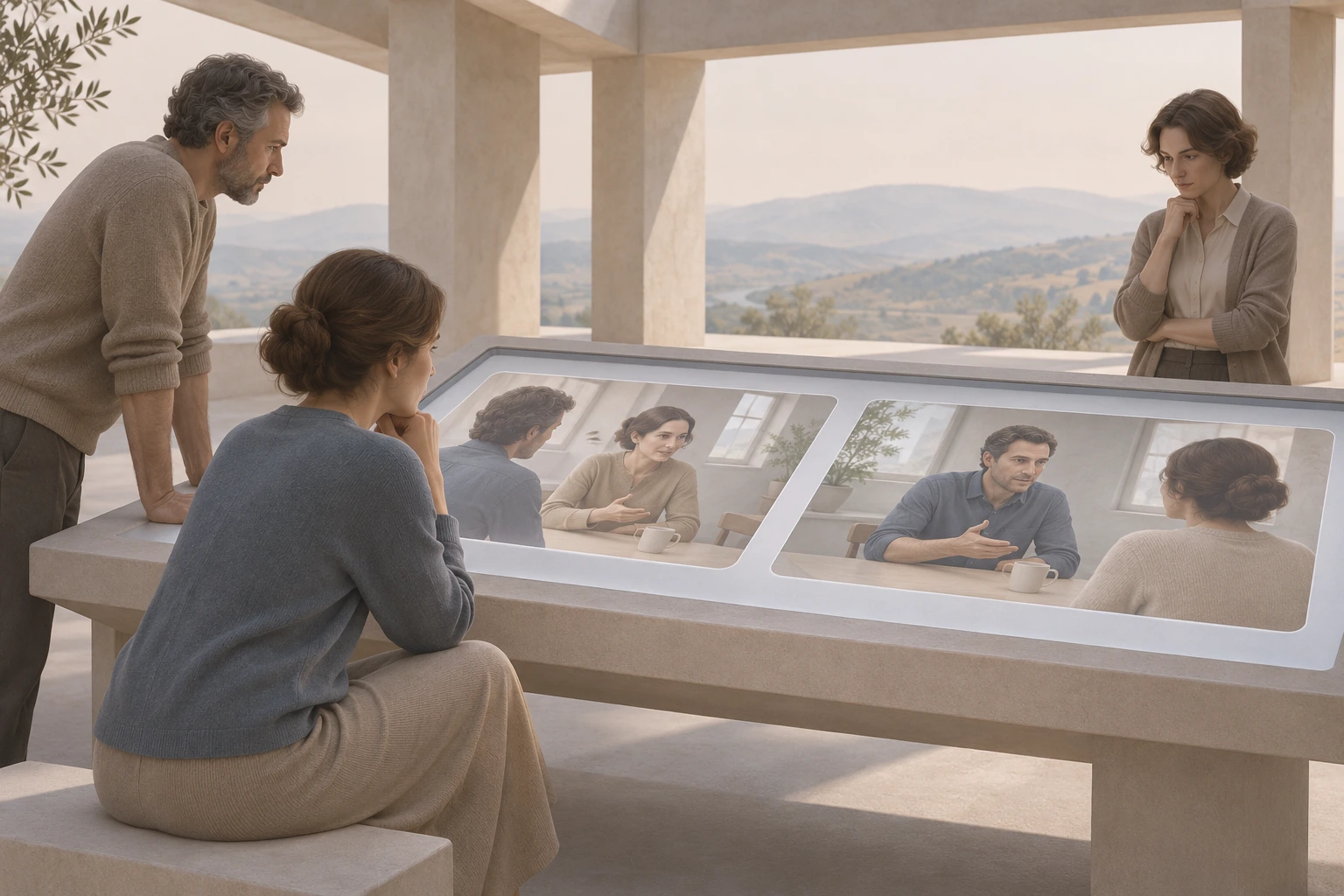
Figure 9. Review of life and change of perspective. Artistic reconstruction based on a story by Catherine L: the screen is positioned as if on a table. The episode on the screen and the details of the pavilion are depicted conventionally. [21]
Nor can the review be considered a court in advance. What is important to the court is the charge, the rule, the assessor and the decision. A change in understanding is sufficient for self-esteem. Both processes can be present in a conversation: a person himself experiences regret and at the same time hears the assessment of another. The study must show this configuration without replacing it with a familiar religious or psychological term.
Odell H recalls a large screen with several scenes, one of which was enlarged for discussion. The rest remained on the edges. He calls his interlocutor Jesus. The story contains fear of condemnation, comments about actions and shared laughter. An attempt to embellish the motive for the offense, according to Odell, was immediately detected; good actions were also discussed. The tunnel appears after viewing. The page features two versions of the same near-drowning story; this is one witness, not two confirmations of the order of events. [22]
This order is useful precisely because of its specificity. If you place any tunnel at the beginning of a universal route, the original sequence will disappear. A comparison in meaning must leave open the possibility that similar elements are connected differently. While the order is not stable, the map represents a network of possible transitions between scenes.
The screen as a subject and as a comparison
The screen image requires particularly careful reading. The words “life passed like a movie” can indicate the rapid emergence of memories. Mention of the surface, frame, position relative to the person and method of control makes the description more specific. Another case is a modern comparison chosen years later to convey an unusual experience. These options are different even when the narrator uses the same word.
Riette W describes a white room, a man in white clothes, and several flat touch screens. One shows life options, the other gives additional information. She feels she has to choose, even though she doesn't like either option. As a result, preference is given to the family for whom she feels sympathy. After the decision, a passage through the door follows, and the continuation is not remembered. She dates the recalled episode to around the age of four; its interpretation as pre-birth is contained in an adult publication. White clothing is not called a medical gown. [23]
Here an exact substantive similarity appears with some of the review stories: information can be viewed through a separate surface. But the content is directed in the opposite direction of time. In one case the past is shown, in the other a possible future. The way in which choice or knowledge is represented appears to be common, but its intended purpose varies.
Shelley P also describes a room and several screens, but emphasizes in detail the simultaneous display of three lives. One option disappears after the refusal gesture, the other continues to play. The escort convinces her to accept a life for which she does not at first desire. Later on the same page an amphitheater with many souls appears, but this is a separate adult vision. Combining the selection room and the amphitheater into one continuous scene would distort the source. [24]
This distinction is important for a spatial map. Two situations described by one person are not necessarily adjacent and do not even necessarily belong to the same class of conditions. To consider them parts of a single place, a connection indicated by the narrator himself is needed. The richness of the overall text can give the impression of detailed geography, whereas the source material consists of discrete episodes.
The similarity becomes more meaningful if several features coincide: the position of the screen, the method of selecting an image, the ability to stop, a separate accompanying person. However, even this combination does not determine the origin of the experience. She asks a comparative question. To answer, one would have to take into account the time the record appeared, the cultural images available to the person, and the circumstances of the memory. The mere convenience of a device for explaining complex information does not confirm the existence of a common external technology.
Human artifacts have an important property: they immediately suggest a method of action. A door allows passage, a book invites reading, a queue implies waiting for access. In interpreting the story, this clue may be too strong. Having seen the similarity of a device, the researcher runs the risk of attributing to it a function that the witness did not mention at all.
Rooms and books in the environment description
George C reports a long white hallway and rooms to the right. He is accompanied by a tall, light creature. There are other creatures in the rooms and a starry darkness that contrasts with the corridor. When he asks if the others will go with him, the attendant replies that they are not ready yet. George feels small, and compares his companion’s attitude to his father’s. He does not remember the end of the journey and birth. Does not describe any treatment in the rooms. [25]
Such a space can easily be called a hospital, educational institution or distribution center. But each name will add information. For a hospital, signs of treatment are needed, for a school - for training, for distribution - for assigning a place. The corridor and waiting alone do not choose between these versions. Sometimes the most accurate formulation remains descriptive: a room in which others are present while the person being followed moves on.
Brian D talks about the desks, books and index cards that accompany learning. His guide appears as an almost faceless golden creature, communicates mentally and maintains a connection even when he ceases to be visible. There is a sense of familiarity about him, although there is no recognizable face; communication allows for humor. Brian experiences himself as a broader being for whom the earthly personality represents one of the forms. He asks questions and directs attention, and at the end other light assistants appear. This is a self-report with anecdotal medical and temporal assessments. [26]
In such a scene, knowledge receives its usual organization. The desk separates the student's place, the book stores the contents, the card index promises search. Together they create the impression of working with information. To understand the subjective world, it is important to find out whether one was actually required to read, search and remember, or whether the meaning became immediately available. In the first case, consistent activity is maintained. In the second, surrounding objects rather provide access, the mechanism of which is not described.
This raises the question of causality within a scene. If a person receives an answer because he opened the book, the object participates in the action. If he already knows the answer and notices the book at the same time, the connection is weaker. If the book is added later as an explanation, we are talking about the language of memory. All three options may be sincere, but they provide different information about the structure of the experienced world.
White coats and earthly professions
One of the most literal accounts of men in white coats is published by Stephen I. He directly calls the event the dream of an adult and reports that he worked as a nurse for many years. The dream contains a gurney, figures taken for doctors, photographs and screen images associated with the supposed past personality. The publication does not contain independent confirmation of this identity. [27]
This example shows why subject similarity should be preserved along with context. Robes are indeed present. But their detection in a dream does not create another medically determined near-death event. Professional familiarity with the hospital environment is also included in the source description, although it does not in itself explain every detail of the dream.
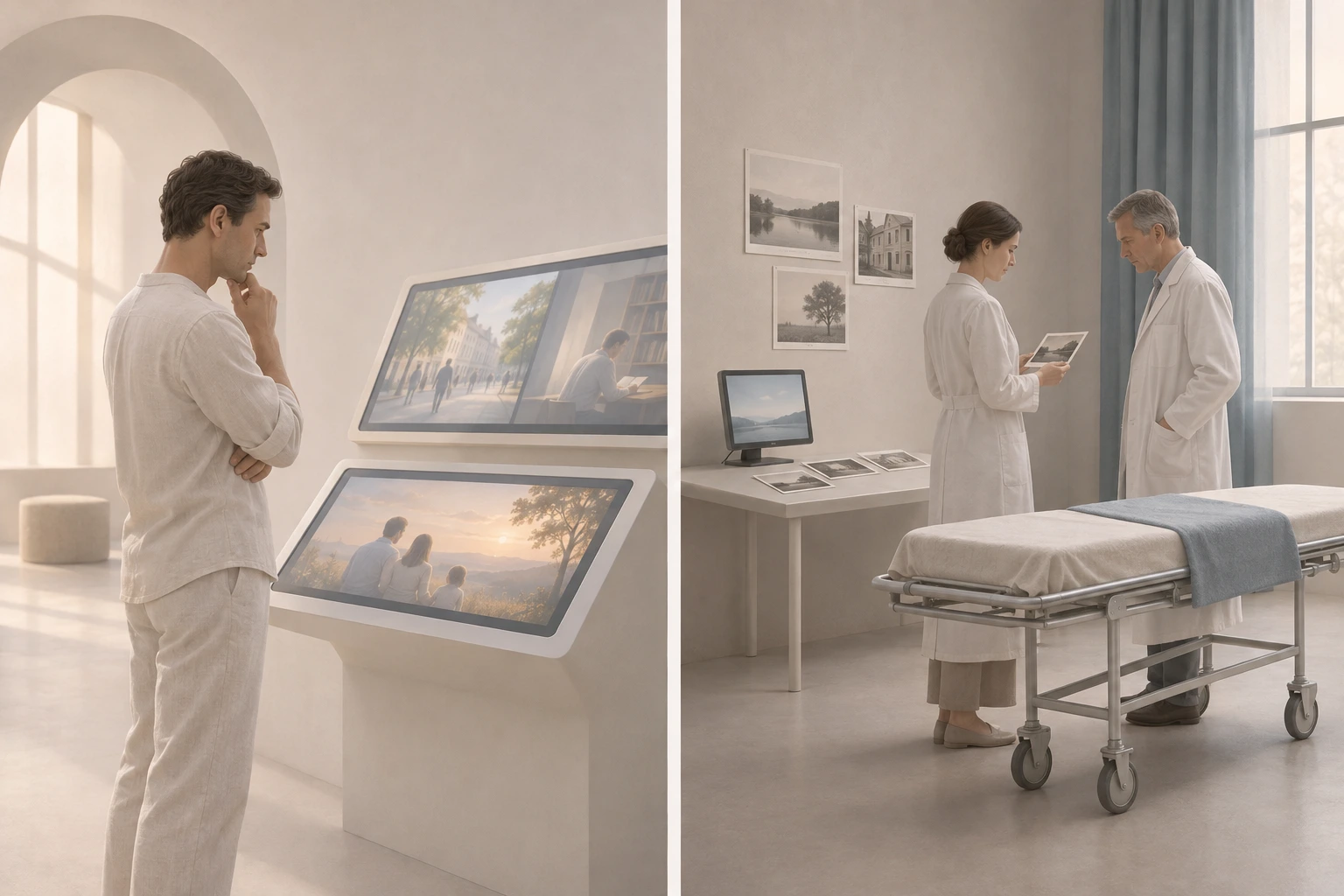
Figure 10. White clothes and medical gowns. On the left is Rietta W's stated prenatal memory of wearing white clothing; on the right are medical images in Stephen I's adult dream. The diptych reconstructs two different messages. [23] [27]
Different relationships between experience and habitual image are possible. A person can perceive familiar things as real objects in another world. He can understand them as a specially selected representation. Finally, the image can only become understandable with subsequent retelling. To choose between these possibilities, it is necessary to know what exactly the witness is claiming. It is impossible for him to decide whether the room he saw was a literal room or a form of communication.
A world that depends on attention
Catherine L adds that the shape of the buildings became more defined when she paid attention to them; similarly the human form of her own presence could appear. In her presentation, the degree of objectivity depended on concentration. Later she remained in the gardens, but could not go deeper into the city. She decided to call one interlocutor Jesus, although she then described him more as a representative of divine intention. The communication itself gave her strength; The content of the acquired knowledge turned out to be inaccessible after returning. [21]
Such a world is difficult to map in the usual way. The map assumes that the object persists while the observer is looking in a different direction. If the story itself links form to attention, another question arises: what exactly remains stable when it changes? Perhaps a place, a function, a connection to another being, or just a feeling of recognition. The answer determines what can be considered a repeating unit.
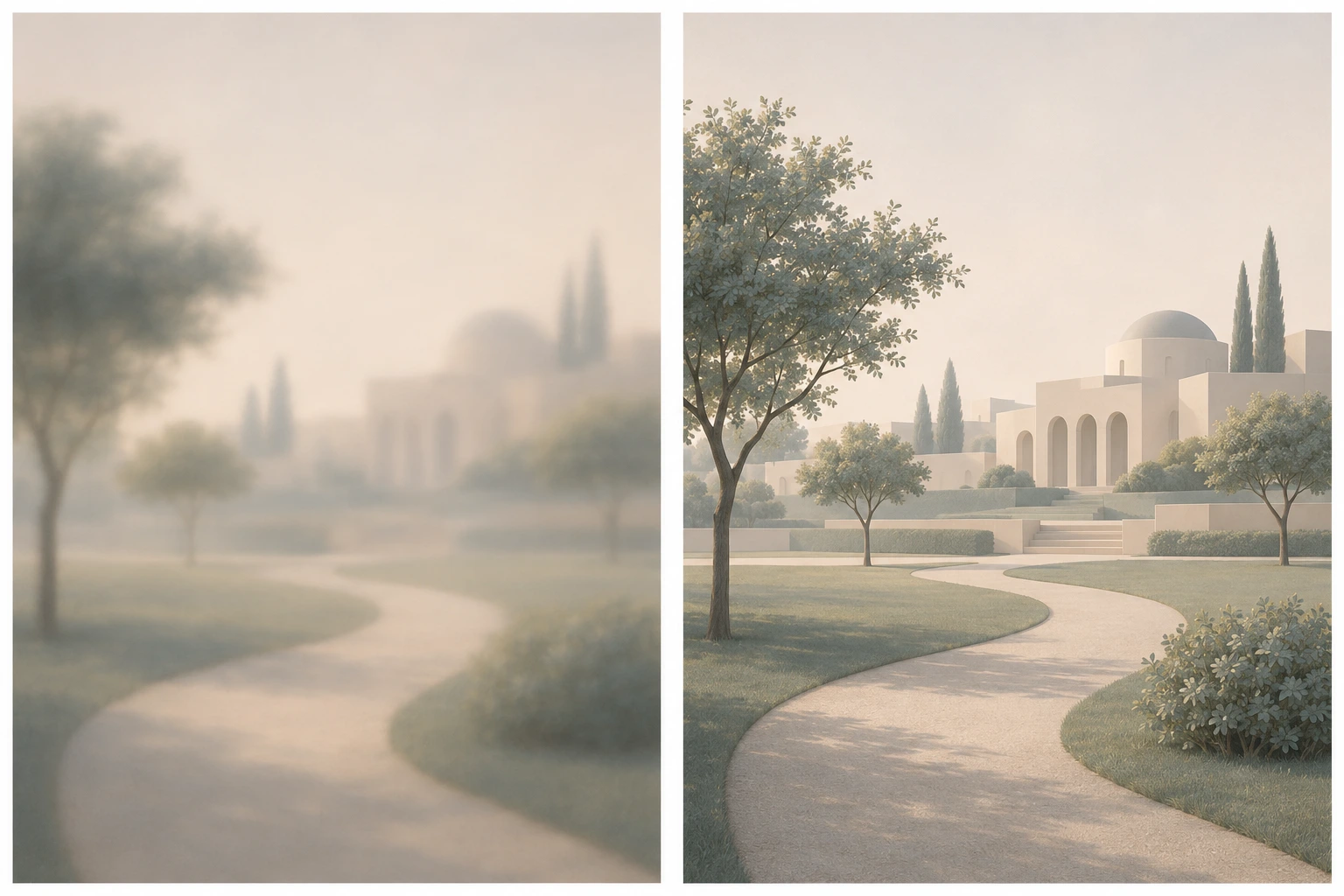
Figure 11. Objectivity and attention. Conditional visualization of Katherine L's message that shapes became more defined with concentration. The change in detail conveys the described experience. [21]
Kami R reports presences without clear visible figures, a sense of a common whole, and a joint decision to continue living in the same body. It does not directly assign a specific order and place to all experience. Her story includes several hospital and subsequent conditions that cannot be combined into one medical minute. [28]
Considering the subject and almost non-subject stories together shows the range of possible descriptions. At one edge are buildings, surfaces and activities. On the other are relationships, meanings and decisions that do not require a detailed setting. The general function may still be preserved, but the familiar geography becomes less defined.
Further comparison should maintain this difference. Experiencing an organized world does not always mean describing an unchanging environment. For a storyteller, the most sustainable things can be connections with others, a sense of belonging, and an understanding of what is happening. It is these properties that become especially noticeable when movement stops and abiding occurs.
Chapter 7
Staying, Resting, and Recovering
After arrival
The word "stay" denotes an important change in the story. The transition is completed, the initial position is understood, and the next event has not yet occurred. Between these points, it becomes possible to live within the experienced space: talk, observe, choose an activity, or simply remain calm. It is here that the question arises whether there is a gap in the stories that cannot be reduced to the preparation of a new birth.
Maureen K describes, after the initial meeting, a separate group of helpers engaged in her restoration. She remembers soft warm blankets, music with no apparent source, and understanding needs without question. The assistants work in silence. First she asks if she really died and if what is happening is real; fear gives way to calm. Maureen doesn't sense anyone else nearby. She directly says that she had no reference point for determining the past tense. Then other attendants appear. The story was published as a self-report of a dangerous condition, without accompanying medical documentation. [29]
In this case, the restoration is highlighted by the content of the scene itself. It differs from instant relief: there is the experience of a state that requires care, there is help and its completion. Even if there is no calendar duration, the sequence remains. At first help is needed, then the situation changes. Such a transition can be described without calculating how many Earth minutes it corresponds to.
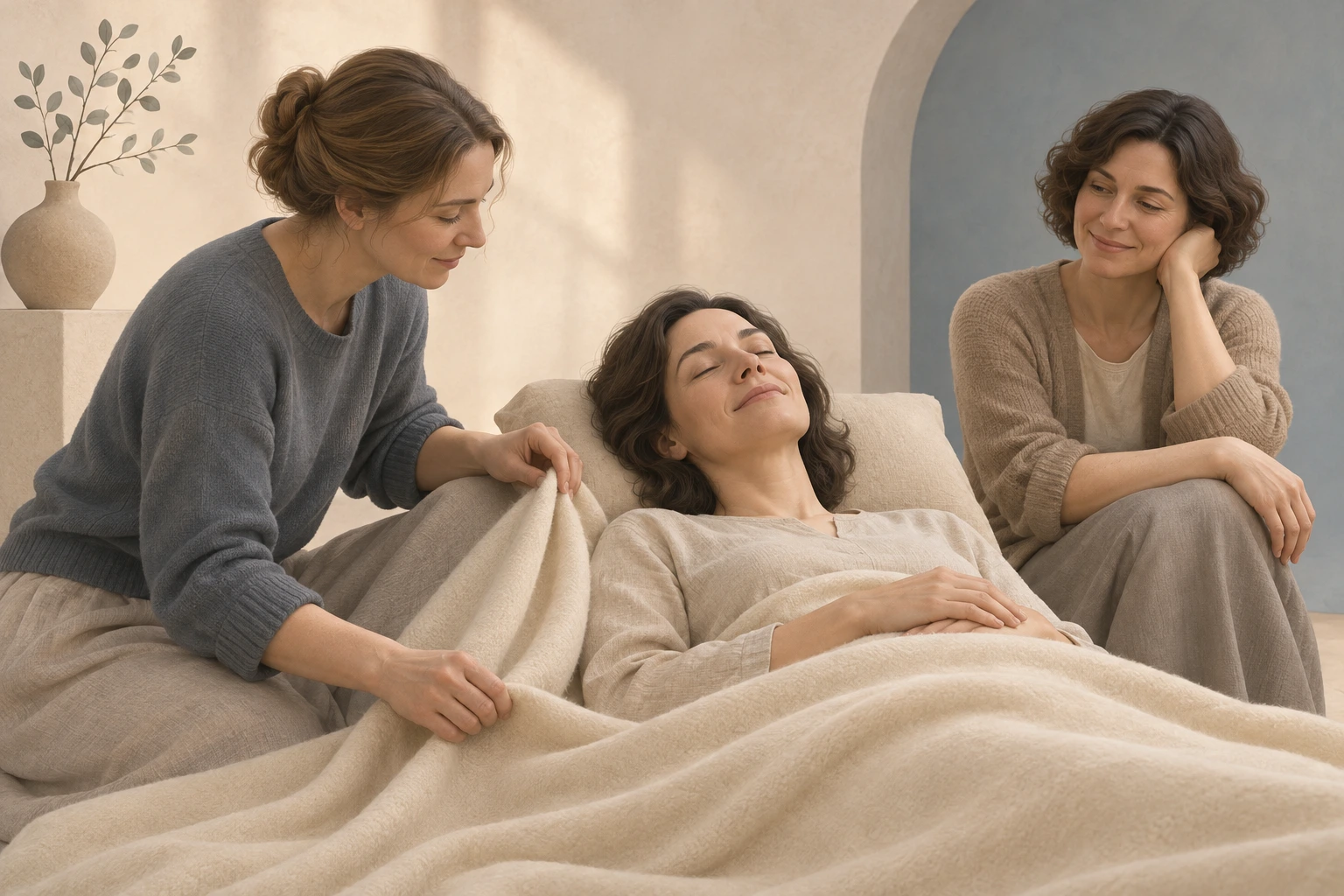
Figure 12. Care after arrival. Soft blankets and silent help from a story by Maureen K. Artistic reconstruction conveys restoration and calm; The duration is not specified in the source. [29]
Relief, rest and recovery are not entirely the same. Relief means that the painful sensation has decreased. Rest implies the absence of the need to act. Restoration implies the return of some ability or state. The story may contain all this, but may be limited to one sign. A feeling of warmth does not indicate treatment, and the absence of fatigue does not prove that there was a period of rest before it.
Opportunity to stay
James in the OBERF archive outlines the supposed previous death, white area of recovery and subsequent training. In the grove, he is offered to return to Earth to the teacher or stay with the mentor; he chooses to stay. Long conversations, a bench overlooking the valley and a teacher with a white beard remain in my memory. James feels like the place was made just for him; the mentor confirms this with a reservation. The readiness to be born arises gradually. It is preceded by resistance, then farewell to a loved one and the meeting of a future brother. James emphasizes that he is unable to measure the duration of the recovery: the expression “minutes or years” conveys uncertainty. He explains the mention of God through existence and the Universe. This is an adult publication with a stated memory from childhood, with no established previous biography or early documentation. [30]
Within such a story, the gap has its own content. It involves a relationship and interest that cannot be described as an instant sorting of the arrival. Moreover, the choice to remain in a specific situation does not determine the right to remain indefinitely. The text shows one decision and a subsequent change of heart. Turning this episode into a universal rule of freedom would add information that the story itself does not provide.
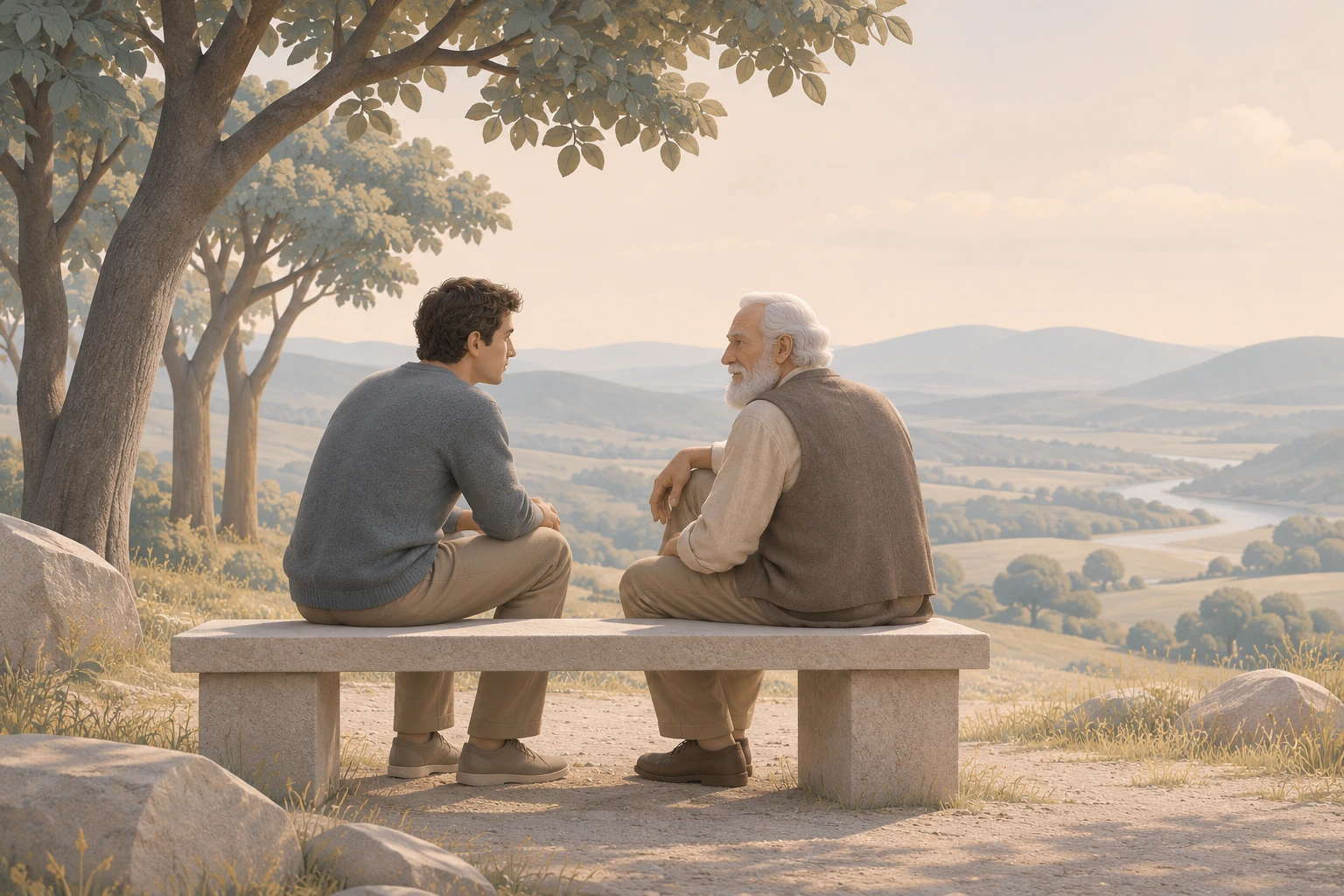
Figure 13. Opportunity to stay. A bench overlooking the valley and a conversation with a mentor based on James' story. Artistic reconstruction conveys a separate episode of stay, the duration of which is unknown. [30]
For comparison purposes, it is particularly useful to distinguish between opportunity and preference. A person may want to stay and find it impossible. May be able to stay but want to continue. May change desire as communication progresses. Then the reason for the transition lies in a change in the state of the individual, and not in the expiration of a set period. These options create different patterns of return, although at the level of a short retelling they all sound like “he was sent back.”
The gap has another property: it can be valued in itself. If it is interesting in conversations, relationships or exploration of the environment, its meaning is not limited to the future life. This must be taken into account when discussing the learning hypothesis. You can learn for the sake of preparing for a task, for the sake of understanding, or for the sake of participating in communication itself. To choose a specific meaning, you need to know the content of the message, and not just the presence of a mentor.
Peace that you want to preserve
Angela E describes, after a supposed previous death, fatigue, comfort from familiar beings, and a desire to withdraw from communication. Resentment towards her former family and interest in her fate remain, but those accompanying her do not allow continued observation, so as not to cause pain. She is allowed additional rest. Later, she refuses to choose her parents, and the choice, according to her, is made for her. The sensory environment of this interval is almost not described. The focus is on safety, delay and changing the degree of participation in the decision. There is no early independent record of the hypothesized childhood memory. [31]
This example allows us to see that the absence of a detailed landscape does not make the story psychologically empty. The internal state can be described better than space. It is known what a person avoids, what he asks for when he begins to interact. For a stay map, this is sometimes more useful than the number of doors and rooms. Restoration of personality can be depicted through the return of readiness to enter into relationships.
However, care and management are not mutually exclusive here. The assistant can respect the request for a delay and later make a decision for the mentee. To a person, this may appear reasonable, forced, or unfair. To understand the role of the accompanying people, it is necessary to reconstruct the narrator's attitude towards their actions. One word “loving” does not describe the entire order of interaction.
Jennifer B remembers a dark but safe and familiar state that seemed very lasting to her. I don't want to leave. In the free story there is an opportunity to stay, while the questionnaire responses speak of the need to leave. Favorite presence is associated with this decision. Sounds and smells are not described, and a sense of urgency appears around the moment of leaving. [32]
It is better to preserve this discrepancy. Possible explanations include a change of desire, different meanings of “can,” an imprecise question, or later organization of the memory. Choosing one explanation requires further grounds. Until those are available, the source shows a tension between experienced freedom and experienced necessity. This tension is an element in its own right that would disappear in an overly smooth edit.
Activities and relationships
Diana G describes a light landscape, crystalline buildings and a library. There is no separate sun, the light seems to come from the surroundings. The creatures she encounters, in her impression, are engaged in art and creation. A familiar presence shows her around and discusses returning. Diana initially resists, then agrees. The story involves a near-drowning; she herself does not claim that her clinical death was established. [33]
Such a scene is important as a question of activity. If the other life is described only as the absence of earthly pain, it is difficult to understand what fills its positive content. Creating, communicating, exploring, and helping introduce goals that go beyond ending suffering. They also assume differences between the participants: some know how, some learn, some want to see the result.
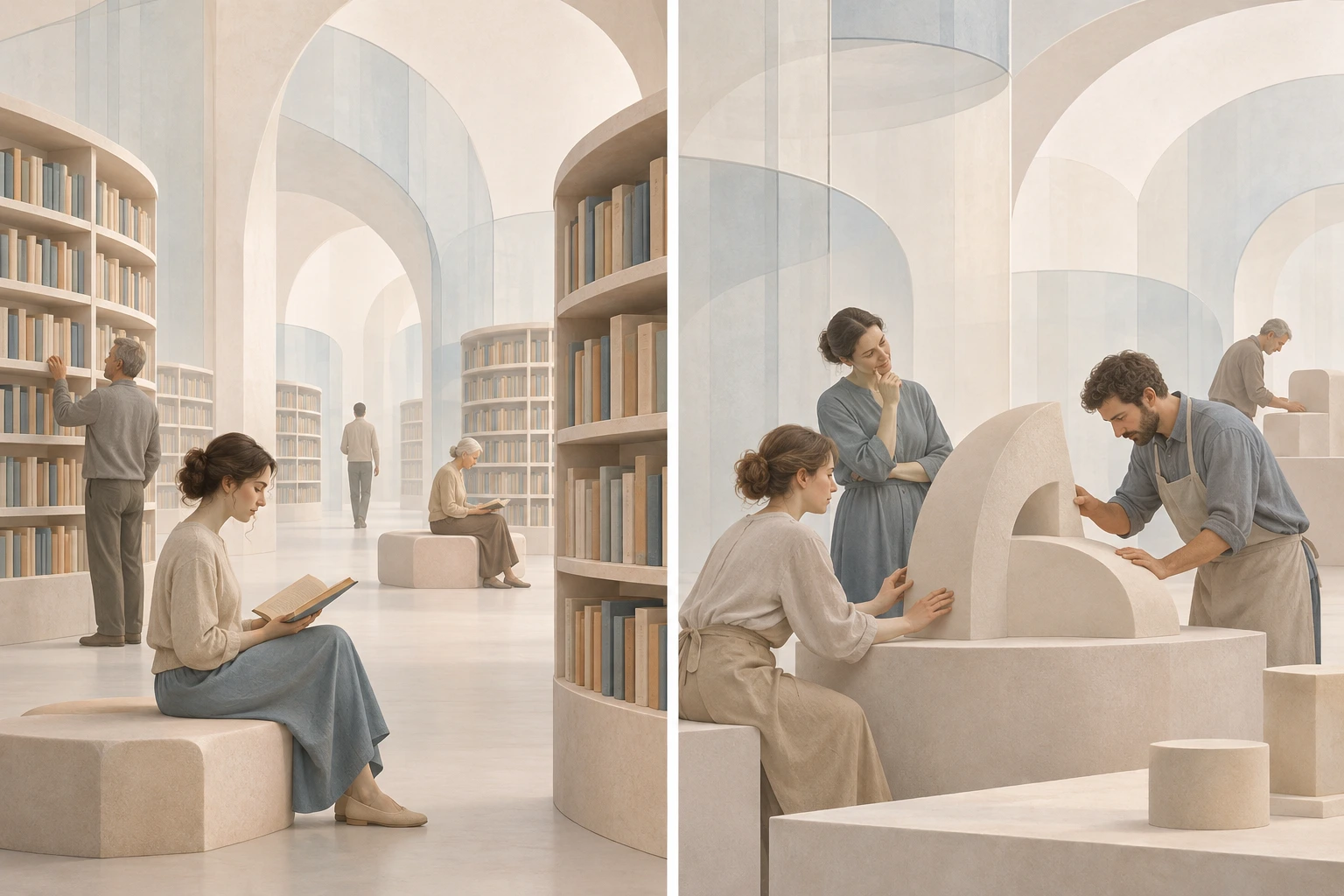
Figure 14. Activities and creativity. Two separate scenes based on the story by Diana G: on the left is the library, on the right is creative activity. Architecture and specific activities are depicted conventionally. [33]
This raises an internal question about the world model itself. If all knowledge is immediately available, in what sense is learning required? If every desire is immediately fulfilled, what does long-term work mean? These questions do not refute the story. They help clarify whether the claimed completeness of knowledge relates to a specific topic, a summary state, or a general later interpretation.
Several logically different options can be imagined. Knowledge of the result is available, but the process itself has not yet been experienced. The idea is clear, but you need to master the method of action. The feelings of others are known, but the freedom to enter into relationships with them is maintained. These are possible distinctions for analysis, not information about an existing post-mortem arrangement. A specific story should provide a reason to choose one of them.
Communication also requires some variability. A conversation in which nothing new can be learned and attitudes cannot be changed has little resemblance to learning in the usual sense. Therefore, it is important to clarify whether a person is surprised, asks questions, or does not understand everything at first. It is details like these that show the internal dynamics of being, even if the narrator himself talks about the absence of time.
Staying without items
Carey T, in an adult recording, recalls a childhood dream of emptiness, where ordinary objects, a body, thoughts and emotions were absent. Curiosity then set in, followed by a scene of early infancy with a cat and the pain of a scratch. The memory itself is framed as a dream of a four-year-old child, ending with awakening. He develops the connection between emptiness and pre-existence in the following explanation. The birth transition and accompanying persons are not described in this fragment. [34]
This story is far from the image of a populated vacation spot. But he also poses the question of abiding: is it possible to describe a state of no activity and still consider it as one’s past? It is especially important here not to confuse the initial lack of thought with later curiosity. There is already a boundary between them, beyond which a direction towards something else appears.
A comparison of such options makes it possible to distinguish between the richness of content and the preservation of selfhood. For one narrator, the “I” is supported by the memory of loved ones, for another - by the ability to choose, for a third - by a simple sense of presence. If defining a person in advance requires a rich biography, the latter option will fall out of consideration. If we consider any experience of presence as a person, the connection with a specific earthly life will remain unclear.
Thus, the stay is described in several independent directions: pleasantness of the state, availability of activities, relationships with others, degree of freedom and readiness for change. None of them replace the others. You can be safe and not want communication; one can experience joy and at the same time obey the decision; you can safely remain without a busy external scene.
The question of a new life appears when maintaining the current state is no longer enough or when another participant reports the need for a transition. The next chapter is devoted specifically to this border. It especially shows the difference between offer, agreement, concession, assignment and what the narrator later calls his own choice.
Chapter 8
Choosing to Return
What exactly do they choose?
The choice of rebirth seems a natural conclusion to the story of being between lives. However, the word "choice" hides several different actions. You can agree to continue existing in the body, choose a family, prefer some circumstances over others, or just make a decision that can no longer be changed. In each case, some degree of participation is retained, but the amount of freedom is different.
Adam K recalls being offered two options: being tall and having a possible sports career without his twin, or living with his twin brother and having a close bond with him. He chooses a relationship with his brother. The scene does not describe in detail the place, body or appearance of the interlocutor. The preceding death and the actual birth are also not shown. A story about attempts to explain this to his mother in early childhood was published later. [35]
In such a story, one can confidently identify an object of preference: the relationship outweighs the other possibility. But the ability to choose between two lives does not mean the opportunity not to be born. The right to refuse the entire offer is a separate feature. If it is not described, it should be left unknown and not automatically assumed to be present or absent.
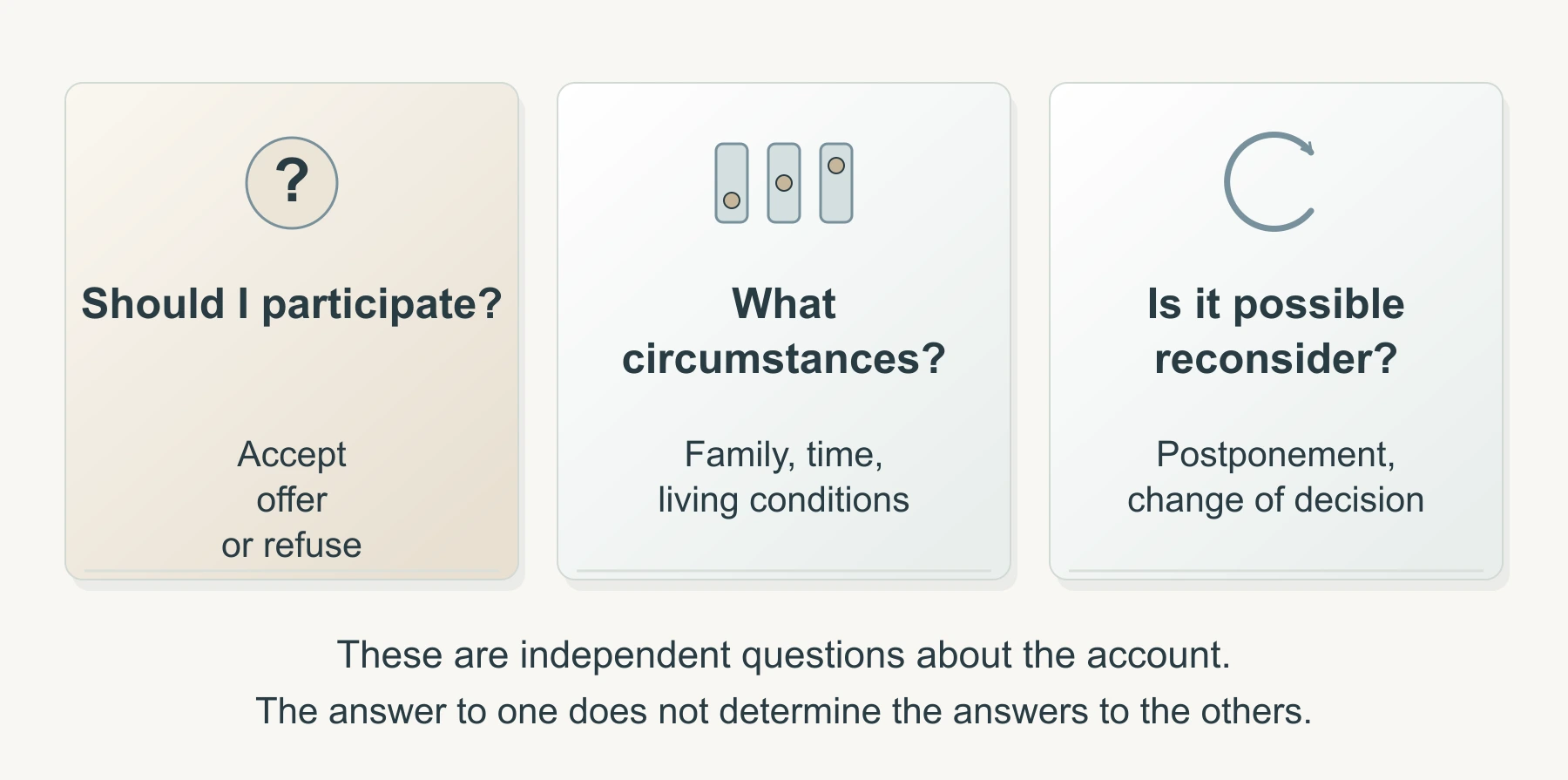
Figure 15. What exactly does choice mean? The analytical framework distinguishes between participation in a decision, choice of circumstances and possibility of revision. The freedom to choose one parameter does not determine the scope of other freedoms.
Michelle N, in an adult entry, describes dreams and flashes of memories that she says have accompanied her since childhood and dated back to before birth. She talks about a quiet dark space, another little girl and an invisible interlocutor who asks about wishes for the next life. The initial desire for wealth and popularity is replaced by a choice of life lessons. Then both find themselves in something like an ancient boat without water; white light completes the memory. There is no scene of birth or previous death. [36]
Here, the learning motive is present within the recalled conversation. Moreover, from one such choice it is impossible to establish the purpose of all incarnations. It is only possible to compare what is considered desirable: position in society, relationships, experience, help or the acquisition of a certain quality. Even if the external organization of the scenes differs, the objects of preference provide material for meaningful comparison.
Consent may vary
Christian Sandberg describes the long delay after a painful life, the handler's repeated questions about readiness and subsequent consent. In another episode, he recalls training for accepting limitations, loosely calling it a simulation. The guide first assures that there is no rush, but before a specific entrance there is an urgency given earthly time. Beings, which Sandberg conventionally calls technicians, participate in the preparation of forgetting and ask for final consent. Their medical gowns are not described. He also offers a bar graph of internal states as a rough comparison, rather than a literally observed device. Memories, he said, returned in adulthood through meditation. [37]
At first glance, freedom from time and the requirement to hurry contradict each other. But the story may refer to them as different solutions. One can choose to participate indefinitely, whereas the chosen opportunity has a limited window. These are logically compatible provisions. The verification question begins next: what allows us to establish the existence of such a window and tie it to an earthly event?
This distinction helps to understand consent as a process. Initial curiosity is not the final decision. Fear can lead to procrastination. Familiarity with perceived limitations may change intention. Therefore, not only the last remark and the birth that took place are significant, but also the path along which the person came to agreement.
Consent has conditions. Did the person understand the consequences clearly enough? Could you stop the preparation? Have alternatives been proposed? These questions do not require the transfer of earthly law to a supposed other world. They make it possible to clarify the meaning of the word “voluntarily” in the evidence itself. Without specification, it is easy to call any event that was preceded by at least one positive feeling voluntary.
Obligation and limits of refusal
In another prenatal story, Jennifer describes loving guides and the belief that she must return until the task is completed. She asks to keep the memory so she can cope better. Then a separate force appears, which she attributes to erasing memories, and resistance begins. Jennifer herself considers the words about the “last time” ambiguous: it could be the last chance or something else. She does not report a meeting with God. [38]
Here, support and coercion refer to different participants. Neither a coherent system of government nor a conflict of independent authorities can be immediately deduced from this. Such a conclusion would require the described interaction between them. So far, the story gives, first of all, the difference in the experienced roles: some help, others hinder, and still others allow passage.
Something else is more significant. The idea of a mandatory task can be combined with uncertainty about its content. Then the person experiences responsibility, but does not have a clear condition for completion. This is a difficult question for the learning hypothesis: what is the measure of success when memory for a task is limited? The story may offer a moral answer, but the mechanism for verifying the result itself requires a separate description.
Alex P remembers a painful previous death and the inability to choose the next circumstance due to fear of repetition. The time for choice, he feels, is ending, and he enters the body without a final preference. He does not remember specific past biographies, does not know the future, and cannot name the purpose of his current life. Family information about his birth is given as a subsequent comparison. [39]
This story changes the emotional center of the intended choice. Instead of a calm comparison of possibilities, a decision appears under pressure. It is impossible to explain anxiety in advance by insufficient development of the soul, a special lesson or erroneous perception: the source does not establish such information. Fear is part of the story and should remain visible alongside the more comforting versions.
Return to your old life
A separate branch is formed by decisions to return to the same body. They have a different subject. A person does not choose an unknown family or biography, but correlates his own desire with existing relationships. The mere fact of returning to consciousness does not allow us to determine whether the decision caused physiological recovery or whether the decision became part of the experience of this recovery.
Ursula K, in a later account of a child's dangerous condition, describes the hospital's observation and mother's sympathy. She decides to return after considering the consequences of leaving for her. The tunnel, another world, the dead and the review of life directly denies. Medical circumstances and hospital observation have not been independently verified. [40]
The relationship motive here is comparable to the choice of intimacy in prenatal stories. However, the coincidence of motive does not combine two events into one physiological or metaphysical procedure. Continuing the same biography and starting another biography require different evidence. The only thing that can be called common is the experience of a reason to stay connected with people.
This distinction is also important for the words “it’s too early.” They may mean that the present life is not completed. It does not follow from them that after its completion the next one will necessarily be chosen. A story that ends with a return after resuscitation leaves the further cycle beyond observation. It can only be filled with another source, clearly noting the change of source.
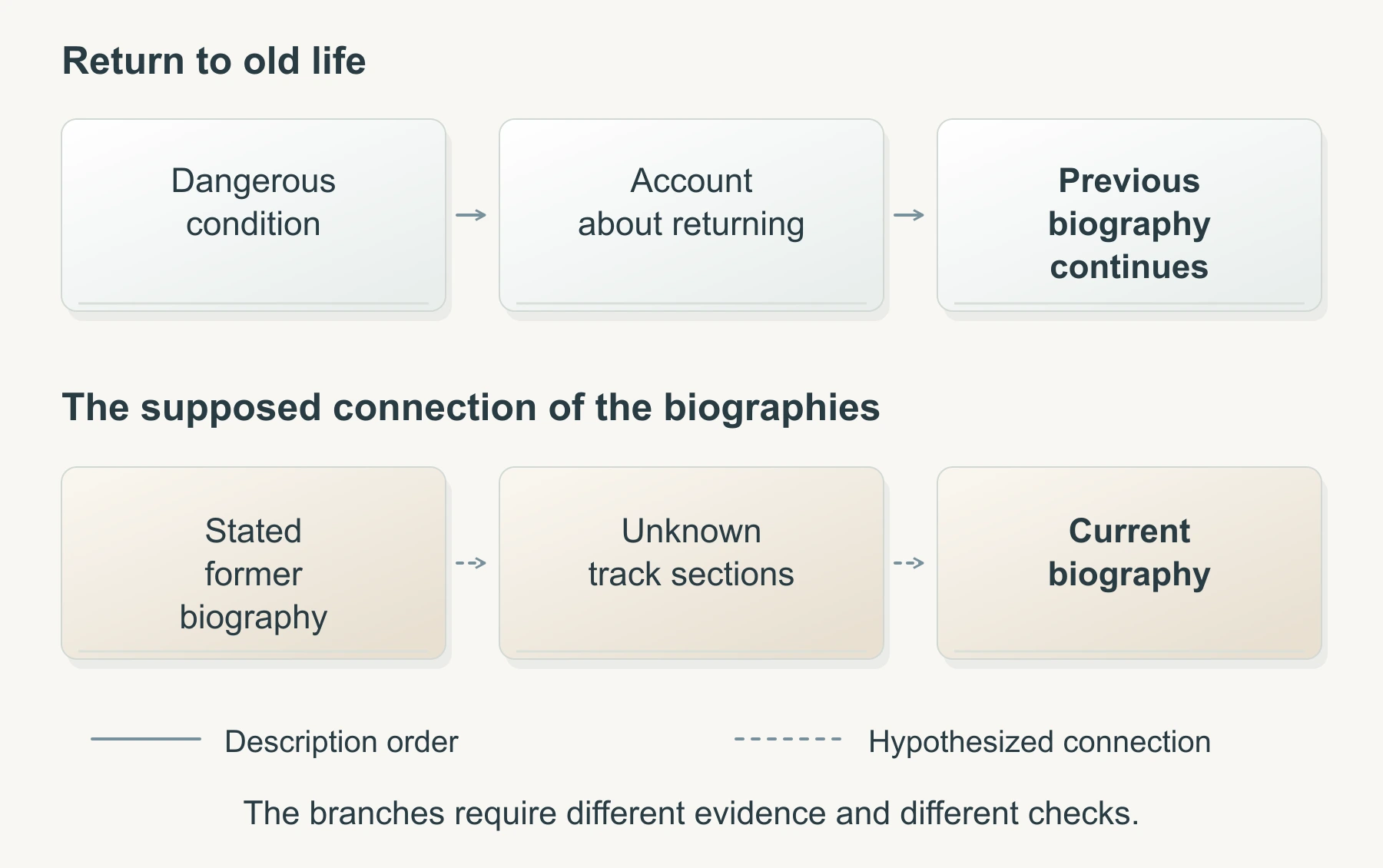
Figure 16. Two branches of return. The scheme separates the continuation of the previous biography and the intended connection with the new biography. Each branch requires its own evidence and methods of verification.
Plan and open future
The expected choice of circumstances raises the question of freedom in subsequent life. Several models are possible here. In one, only the initial conditions are defined. In the other, probable difficulties are selected, but the answers to them remain open. In the third, everything that happens is recorded in advance. These models cannot be discreetly changed depending on explanatory convenience: they make different demands on prediction and memory.
If we are talking about probable branches, a discrepancy with a specific event may be acceptable, but then the prediction becomes more difficult to test. If an immutable scenario is asserted, the prediction error becomes more important. The more freely a hypothesis adapts to any outcome, the less that outcome communicates about its correctness.
The moment of recording must also be taken into account. The explanation of the present difficulty in terms of an allegedly previous choice appears after the difficulty is already known. It can be a meaningful way of thinking about life. But the evidentiary task of prediction requires a text that existed before the event and contained fairly definite information. Late recognition of fate does not replace such a text.
Particularly careful handling requires the assumption that suffering has been chosen in advance. Sharing your own consent does not give you access to another person's consent. Moreover, it does not establish that the disease, violence or disaster was necessary for the victim. Even in a hypothetical model of pre-choice, there remains earthly responsibility for harm caused and the opportunity to reduce suffering.
The learning motive also does not automatically make every challenge rewarding. To talk about learning, we need to identify what has changed and how that change is maintained. If the result is completely forgotten, another carrier of the acquired quality is assumed. If a tendency or way of relating to others persists, it is necessary to show how to distinguish it from the characteristics of present life. This is already a question of the continuity of personality, to which we have to return.
Thus, stories make it possible to highlight desire, offer, constraint, consent and purpose as different elements. In some cases, they form a clear solution. In others, conflict or unfinished choices remain. The subsequent birth completes the narrative, but does not remove its ambiguities. To understand what exactly crossed this border, one should turn to the memory of the beginning of life.
Chapter 9
Memory Before Birth
Where does present life begin?
A memory of a state before birth need not include another earthly biography. A person may describe choosing a mother, waiting, cramped conditions in the womb, or their first sensations after birth, without saying anything about a preceding death. For that person, this begins their own account. For the researcher, it leaves open whether another life existed in the proposed sequence.
It makes sense to distinguish four subjects of memory: the previous biography, the interval between biographies, the intrauterine state and birth. They can connect, but the presence of one does not establish the others. The mention of a mother's voice, for example, does not yet contain a statement about family choice. The family selection scene may be completed long before any remembered bodily sensation.
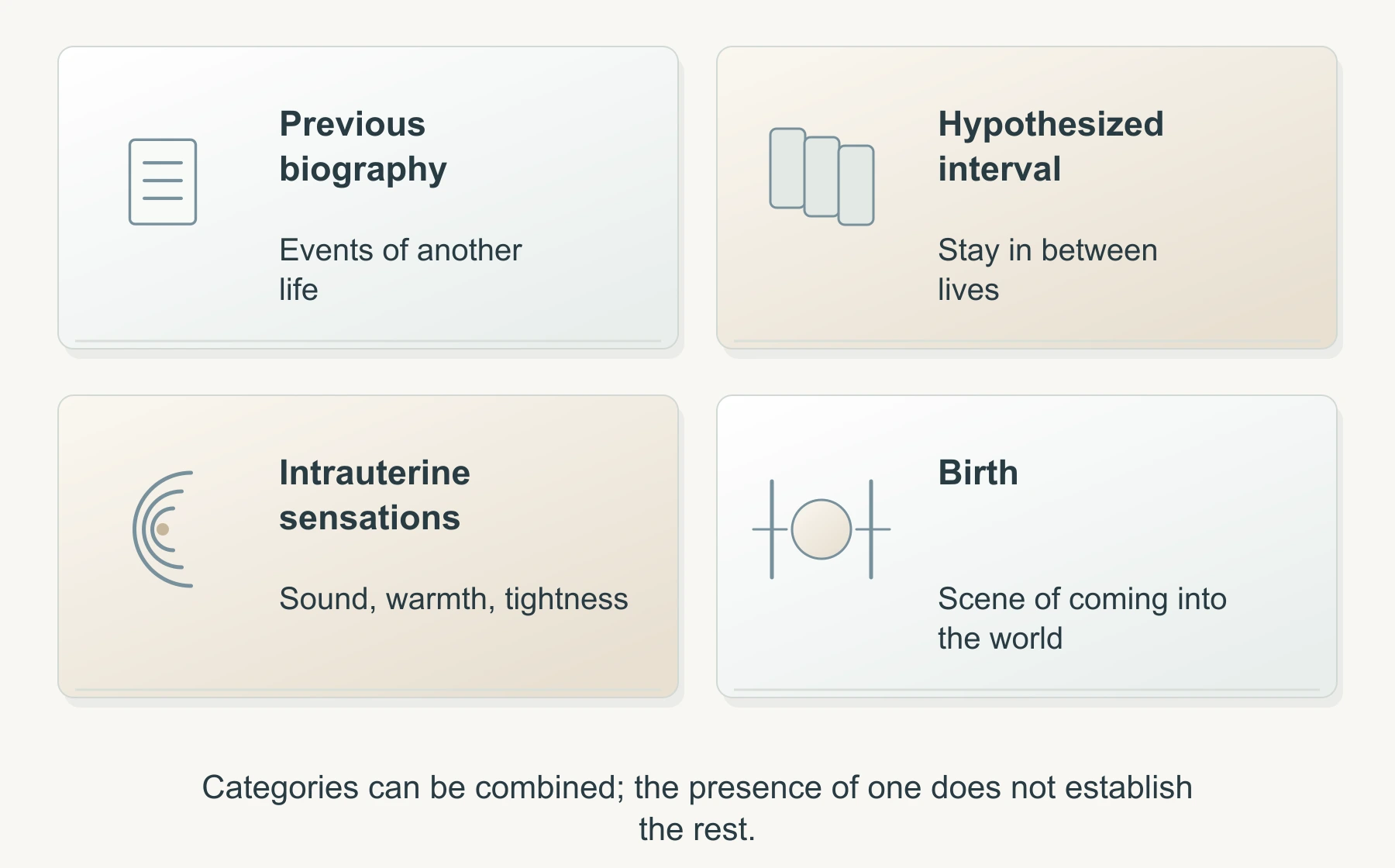
Figure 17. Four items of memories. Previous biography, estimated interval, intrauterine state and birth are presented separately. These categories can be combined, but the presence of one does not establish the others.
Okado and Ikegawa's work examines 21 a child who reported a supposed between-life state. Interviews were conducted for 13, and maternal questionnaires were used for eight. Many did not talk about their past lives. One mother's report concerns a girl who said she saw her mother in a wedding dress with a dog. The comparison is given through the memory of the mother, who claimed that the child did not see the photograph of the event; an independent recording of the child's words before matching is not presented. [41]
Such a scene has an external support - an event in the parent's biography - but the assumed position of the observer remains a separate statement. Even if the dress and the dog are confirmed, it is necessary to find out what the child might have seen in the photograph or heard in the family. Confirmation of object detail and confirmation of perception before birth require different tests.
The physical world returns
May describes choosing to live with the support of a presence whose face is not retained in memory. The future life is shown through a kind of hole, which it does not directly call a screen. White light is perceived as almost tangible and sensual. This is followed by warmth, density and closeness, harsh light at birth and the mother's voice. In her later story, the thinking subject experiences himself as wiser than the infant body allows him to express, and is irritated by the lack of language. She strives for her mother, whose connection she already considers familiar. There is no early recording of this memory. [42]
This description connects two scales of selfhood. One is related to the body and its limitations: it is difficult to move, you cannot speak, the sensations are unusual. The other is represented as the already existing ability to understand and evaluate. If we take the story at the level of its internal structure, the birth becomes a limitation of the means of expression with the supposed preservation of the observer.

Figure 18. Return of bodily sensations. Warmth and closeness, harsh light and the closeness of the mother in May's late story. An artistic composition conveys a sequence of sensations; the details of the scene are relative. [42]
But there remains a distance between the experienced sensation and its adult name. The words "womb", "choice", "consent", "inhalation" may be late concepts for an early image. This does not change the image, but it changes the question. It is necessary to find out what exactly a person remembers as immediate content, and what he infers from sequence, family explanations and current knowledge.
Descriptions of misunderstandings are especially useful. If the narrator claims that at a certain moment he did not know where he was, one cannot at the same time attribute to him full knowledge of what was happening. Later scene recognition must retain its timestamp. Otherwise, the incomplete early fragment will quietly turn into a detailed record of the entire birth process.
Bill D remembers the wait, the line, and the strong formless presence gathering those ready for the body. There is no normal sight or sound; the position and feelings of others are perceived directly. He tries to preserve his memory and describes his own strategic plan. Next to a powerful figure, he feels his own smallness, although he continues to reason and act. Then there are tremors, a difficult first breath and cold scales. However, he says that he did not understand the intrauterine position and does not know the earlier past. Even the author himself does not consider rebirth to be the only necessary conclusion. [43]
In such a case, the preservation of intention is more important than the assumed completeness of knowledge. Personality is recognized through the goal: to continue to remember. But the memory erasure claim goes one step further. A memory may contain a gap, but the gap itself does not indicate why the memory became unavailable. Additional information is needed to draw conclusions about the external erasure mechanism. You cannot automatically explain to them every missing part of the route.
Transition, stay and return in children's stories
Sharma and Tucker identified three groups of reports in their analysis of 35 Burmese cases: transition after death, relatively stable stay, and return associated with parental choice or conception. The sources included earthly places, responsibilities, comfort and discomfort, self-direction to family, and help from an elder being. In one description, other creatures threw objects at the narrator; in another, the person's needs were provided for and the stay felt pleasant. The authors specifically cautioned that the Burmese portion of the database was incompletely coded and was partly selected for the presence of interlife memories; it cannot be considered representative for prevalence calculations. [44]
The significance of this scheme is that it extracts a sequence from a particular class of records. But the three wide nodes do not yet tell us which states are required in each case. “Stay” can combine a detailed description of a place and a short phrase about being near a tree. With the same code, the completeness of information differs.
The same applies to external and internal signs. A known place does not give duration. A message about an elder being does not establish a method of communication. The reference to the next family does not explain whether it was chosen freely. If the original researcher did not ask these questions, missing information cannot be recovered from similarities to other stories alone.
Matlock and Giesler-Petersen compared 85 of published cases and noted that few covered more than three of the five stages considered. Their material contains differences between terrestrial and nonterrestrial environments in Asian and Western descriptions. At the same time, the authors accept in advance the reincarnation explanation for some cases; this premise is not the result of the comparison itself. [45]
The combined sequence may appear continuous even when no source traverses it completely. In this case, the map shows the compatibility of individual fragments with the general hypothesis. To move to a statement about a single route, you need to additionally confirm that the same states are actually connected, and the gaps between them are not filled with assumptions.
Child's voice and recording history
Tomo, in Ocado's study, distinguishes between his current self and his former British boy. He describes the transition through an image likened to a slide or escalator, and talks about choosing a strong body. A significant part of the information is preserved in the mother’s diary; by the research interviews, many details had already disappeared. The hypothesized former identity could not be found. The image of my former mother and the desire to meet her persisted longer than some of the details. Therefore, the decrease in available information did not coincide with the immediate disappearance of the emotional connection. [46]
In this case, the diary allows you to see the story over time. It shows which questions were asked and which answers came first. Even in the absence of an established biography, such a document is useful for studying changes in memory. It also limits the possibilities of later reconstruction: a known earlier statement cannot be quietly replaced by a more convenient version.
The age of the child in itself does not make the story free from influences, but it does not explain its content either. A specific history of access to information is required: family conversations, trips, images, questions from adults. At the same time, the researcher must maintain the possibility of error in both directions. Acknowledging a match too quickly leaves regular channels unchecked; explaining too quickly by fantasy stops the search for a possible source of knowledge.
Stevenson and Samararatne's publication on Thusit Silva includes a report that before his birth he observed his present father at a place of pilgrimage. There were early lists for biographical statements, but it is not entirely clear which stage of the record the interlife phrase specifically belongs to. The article also retains erroneous information. [47]
This example shows why the document date is important at the individual statement level. Having an early record of an entire case does not mean that every detail later published was there from the beginning. History can reinforce some conclusions and leave others without independent support. The general reputation of the case should not replace the examination of a specific fragment.
What should pass through the border
If we assume the continuation of personality, it is necessary to determine what exactly continues. Possibly biographical information, characteristic preferences, attitudes, skills, a sense of familiarity, or the ability to experience. These signs differ in the way they are checked. The name of the former place can be compared with the document. The feeling of a former home requires first describing how it differs from the current confidence in the origin of the memory.
Continuity of self-awareness also has several meanings. One is the absence of an experienced break. The other is the belief that the same subject existed before the break. The third is saving certain information after it. The presence of the third does not automatically imply the first: a person can know information about the past without remembering the transition at all. Therefore, “remembering a past life” and “remembering the whole path” should remain different categories.
The birth itself in this part of the book serves as the boundary of the story, and not a predetermined point of attachment of consciousness. Some sources place the choice earlier than conception, others describe the entry into the body later, and still others begin with the bodily scene. It is possible to bring them to one date only at the cost of additional assumptions. Each case should have its own sequence.
After birth, another story begins - the story of the story of the experience. A language appears, questions arise, and accessible concepts change. At some point, information is recorded for the first time. There may be years between the hypothesized event and the document. The next part of the book is devoted to what can be restored through this distance: earthly time, personal stability and the testimonies of other people.