Part IV Possible Explanations
Chapter 13
Consciousness, the Brain, and the Limits of Explanation
What is required from the mechanism
After becoming acquainted with unusual stories, there is a natural desire to get one explanation. It must combine leaving the body, clarity of thought, meeting, light, changing time and confidence in the reality of what is happening. However, we must first determine whether we are explaining each of these characteristics separately, their combination in a particular individual, or the origin of a common narrative route. Answering one question does not automatically complete the others.
In consciousness research, neural correlates are strictly understood to be the minimal neural mechanisms that are jointly sufficient for a particular conscious experience. A single EEG measure may be a candidate marker of these mechanisms; its statistical connection with the report does not yet establish the entire mechanism. [84] For a causal explanation, more is required: to show how a change in conditions affects the desired property of experience. Another step is to understand why this particular content occurs. A change in state, the appearance of a particular image, and the subsequent belief in its meaning may require different levels of analysis.
Let's imagine a hypothetical research situation. It is known that when given certain exposures, people are more likely to report an unusual bodily perspective. This is already a meaningful result. But he doesn't tell you why one person sees a hospital room, another describes movement in the dark, and a third doesn't remember anything. To move from a general possibility to a specific story, data about additional conditions, sequence of events, and memory formation will be needed.
An explanation in terms of an external world or the continuation of consciousness should be treated in the same way. Merely assuming another level of reality does not explain why one person has access to one scene and another person to a different scene, or why information is retained in this particular form. Any substantive model must describe the conditions under which experience arises and identify observations that would contradict its expectations. Otherwise, it merely retells the account in more general terms.
Brain recording without story
A paper by Vicente et al. 2022 analyzed the EEG of a 87 year-old patient with severe brain damage and seizures. Absolute gamma power increased before cardiac arrest at a certain recording site, and decreased after it; the relative proportion of gamma activity had a different dynamics. The patient died. The assumption of a possible review of life arose during the interpretation of physiology, since he could not communicate the content of the experience. [68]
In 2023, Xu and colleagues studied recordings from four dying patients. Two showed increased gamma activity and changes in connectivity after ventilatory support was withdrawn. No patient survived to provide an account of that period. The authors themselves noted that the findings do not establish the presence of conscious processing and are also compatible with pathological processes. [69]
When reading such works, it is especially important not to turn electrical activity into a translation of a particular scene. The name of the frequency range does not indicate a memory, a feeling of love, or a meeting with a relative. Meaningful correspondence requires data about one person's physiology and experience within an agreed-upon time frame. If one of the parties is missing, there remains a hypothesis about the relationship that has yet to be tested.
In AWARE II this problem manifests itself differently. EEG was available for only two of the subsequently interviewed participants, and they reported no explicit memories. Rhythms recorded in other patients cannot be transferred to narrators. The presence of both physiological recordings and unusual stories in one article does not in itself mean that they are individually synchronized. [4]
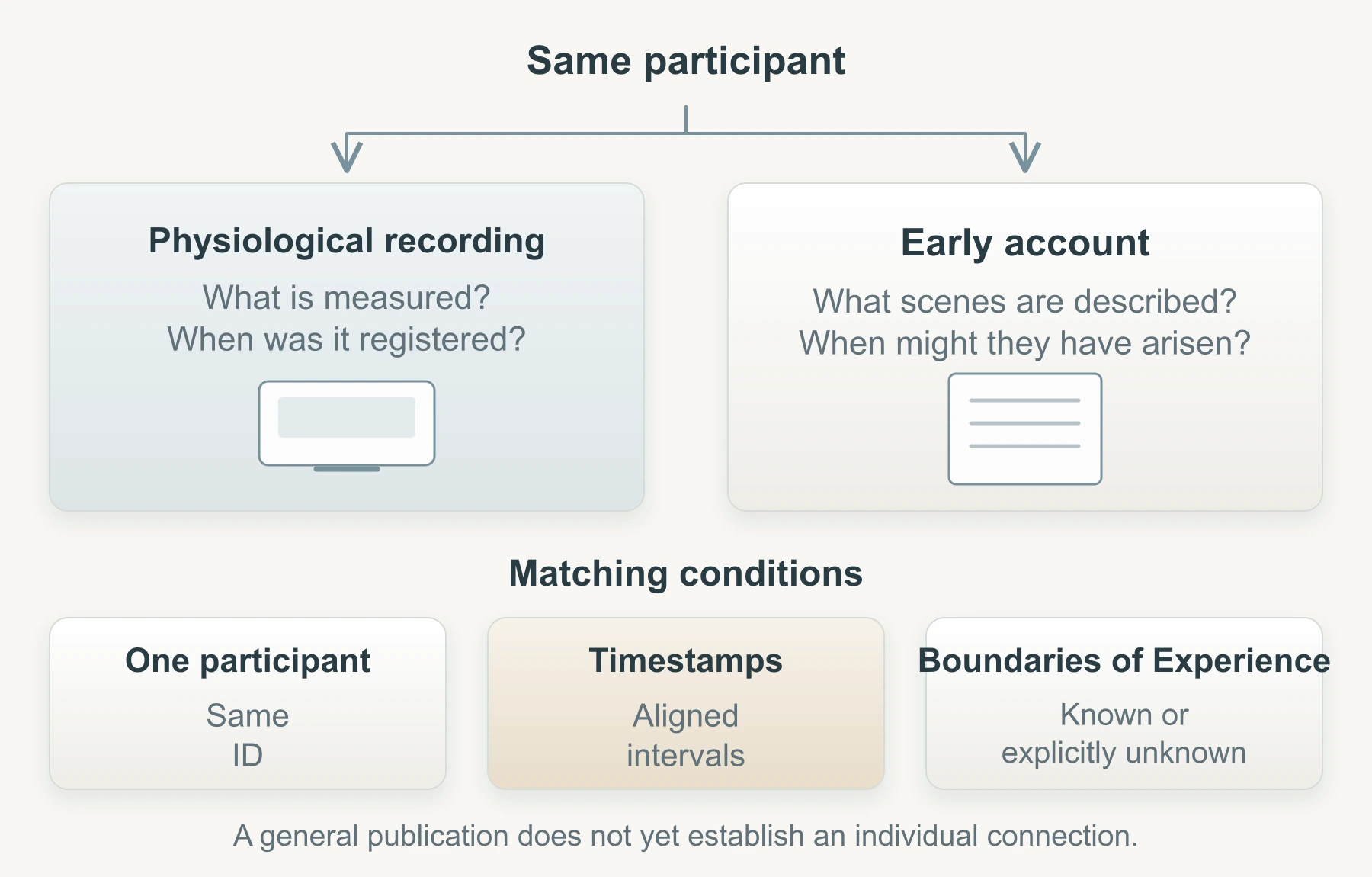
Figure 25. Comparison of physiology and story. The author's diagram shows the conditions for individual comparison: one participant, agreed intervals and known limits of recall time. The presence of both types of material in one publication does not yet establish their connection.
There is also a simple arithmetic difficulty that can change the meaning of the title. The relative contribution of a certain signal may increase when the total quantity decreases faster than the signal itself. For example, in a conditional data set, five units out of ten constitute a larger proportion than ten units out of a hundred, although the absolute number has decreased. Therefore, the words “increased activity” need to clarify the indicator, the starting point of comparison and the recording area. This principle applies to measurements in general and is especially useful where the conclusion about consciousness depends on a small terminological error.
What can be compared in the laboratory
Laboratory analogue is useful when it allows precise changes in conditions and comparison of results. Its value does not require complete coincidence with the original phenomenon. At the same time, the list of matches should be kept next to the list of differences. The model of an individual component becomes much more informative if it is clear in advance which part of the story is being tested and which questions the experiment does not yet address.
In Martial et al.'s study 2024 a year after controlled syncope, eight of 22 participants with eligible data achieved story content threshold on the Greyson scale. The change in the experience of time was noted by 20 people. Encounters with deceased or religious figures and boundaries of no return were not reported in this sample. The work compared narratives and EEG, demonstrating partial overlap with the phenomenology of near-death experiences. This is not a study of the experience after permanent death. [70]
Another way to compare is to ask people who have experienced both conditions of interest. In the work of Martial, Carhart-Harris and Timmermann 31, a participant contrasted his own near-death experiences with psychedelic experiences. There was overlap in a number of characteristics, with differences in bodily separation and visual images. The study was retrospective and relied on self-selection; The circumstances of the experience varied. The coincidence of features did not establish either complete identity of the mechanisms or a common external location. [71]
To assess similarity, it is important to separate frequency and intensity. One symptom may occur in both groups almost equally frequently, but be experienced with different intensity. The overall score can also hide different sets of components: two people arrive at the same number through different answers. Therefore, the similarity statement must be read in conjunction with the scale questions. Without this, comparison turns into a comparison of names, behind which different experiences remain.
Clinical circumstances add another layer of complexity. In a case published by Fritz et al in 2025, a woman described an unusual experience following severe respiratory failure and emergency administration of ketamine along with other drugs. Cardiac arrest is not specified in the description. It was not possible to accurately position the experience in relation to the drug and other disturbances of the condition. To attribute all content to a single substance would be to exceed the possibilities of this case. [72]
Therefore, the comparison must maintain context. Retrospective survey, experimental intervention, and single clinical observation answer different questions. They can be combined into a research program, but the status of the result cannot be imperceptibly changed when moving from one category to another. A possible mechanism remains possible until its necessary conditions are established in the event in question.
Trying to put together an explanation
The NEPTUNE model, proposed by Martial et al in 2025, integrates the proposed influences of physiological stress, blood flow, neurochemical changes, bodily signal processing and psychological processes. She looks at near-death experiences up to brain death. The authors directly indicate the theoretical status of the model and unknown necessary and sufficient combinations of mechanisms. Its goal is to link disparate findings into a testable neuroscientific explanation; The review itself does not constitute a new single sample of patients. [73]
Combining mechanisms makes it possible to meaningfully describe complex experiences without requiring a single cause for all its details. But the complexity of the model comes at a cost. If any combination of observations can be explained by the selection of additional processes, the model loses certainty. Therefore, after unification, restrictions are especially needed: what properties should occur together, what conditions should weaken a particular effect, and where the absence of a result is expected.
A simple example of such a requirement can be formulated without choosing a final theory. If it is assumed that a change in bodily perspective depends on the mismatch of certain signals, the researcher must describe in advance how this sign will change when the mismatch is eliminated. If the influence of biographical expectations on the image of the greeter is expected, expectations must be recorded before the experience or at least independently of its subsequent interpretation. In both cases, the usefulness of an explanation is determined by its relation to new data.
The transition from a possible condition to an established cause deserves special attention. The formulation “such a mechanism is capable of causing a similar characteristic” leaves open the question of a specific episode. It requires information about the presence of a mechanism, the time of its action and its connection with the content. This intermediate level may seem less complete than a universal solution, but it is precisely this level that allows you to gradually refine the explanation instead of endlessly repeating the general idea.
The limit of explanation and the limit of question
Brain research and the philosophical question about the nature of consciousness are related, but not completely coincidental. Even a detailed description of the conditions under which a certain experience occurs may leave open the question of why it has a subjective side. Conversely, recognizing this philosophical quandary does not establish a concrete story about another world, family choice, or the transition of personality between bodies. Each such story has its own information requirements.
The neuroscientific explanation also does not negate the human significance of the experience. The reasons for the occurrence of the experience and the place it took in life can be studied separately. If a person considers an encounter to be a source of reconciliation or new understanding, it is a statement of consequences and meaning. To discuss the literal reality of the encounter requires a different set of arguments. One research direction does not have to absorb the second.
When comparing hypotheses, reverse substitution must also be avoided. The insufficiency of a particular model does not serve as ready proof of its alternative. A positive basis occurs when an alternative model describes the observation being tested better, limits the expected result in advance, and withstands attempts to find conventional ways of obtaining it. This is especially true for the intended transmission of information: the content being verified must be stored until confirmation, and possible channels must be studied separately.
At this point, the conversation about the brain returns to the structure of evidence. Even if all the events of an experience can ever be accurately dated, the content will remain accessible through memory and story. It is already possible to explore how they are influenced by confidence, questioning and cultural language. The next chapter is devoted to this gap between the event and its explanation, in which most of the material available to the researcher is formed.
Chapter 14
Memory, Suggestion, and Culture
The persuasiveness of memory
A person can doubt someone else's story and have little doubt about his own experience. It is especially difficult to question an event that is remembered with unusual clarity and has changed one's attitude towards life. Therefore, an explanation through memory is often perceived as an accusation of invention. For research, this is a false convergence. Sincerity refers to the narrator's intention; accuracy - to the correspondence of individual statements to events. One can faithfully report what is experienced as a memory and still need external verification of its content.
Moore and Grayson asked 122 participants to compare memories of their near-death experiences with real and imagined events. Memories of NDE were generally rated as particularly rich. The average interval after the experiment was about 34 years. This is evidence of the characteristics of the memory at the time of the study. A single examination does not show that the content of each memory remained unchanged throughout the previous years. [74]
In Schmidt et al.'s experiment with 24 highly suggestible adults, a posthypnotic cue increased confidence and speeded word recognition compared to a neutral cue. No statistically significant change in accuracy was found. The work shows the individual variability of certainty, but does not reproduce the emergence of a false biography or posthumous journey. [75]
It is therefore useful to consider memory according to several characteristics. How bright is it? How confident is the person? How consistently do the details repeat? Is there external verification? When did the first entry appear? These features may be consistent, but they cannot be replaced by a single overall impression of credibility. A detailed story without external reference points remains a detailed story. A short early message with a verifiable rare detail may be more valuable for a particular issue, although it makes less of an emotional impact.
Sustainability also needs definition. The repetition of a general meaning is one thing, the coincidence of specific words, sequences and circumstances is another. If a person says for years that he has been surrounded by love, this does not establish the immutability of each episode. If the later version contains a new figure, you should find out whether it was in the earlier entry. This analysis allows changes to be noticed without the assumption that any change is a deliberate deception.
Error and source of knowledge
In Meyersburg et al.'s study, 15 adults with reports of past life memories were compared with 15 control participants. In tasks with semantically related words, false recall and recognition of the missing word could occur. In the first group, some erroneous answers were more common, although the statistical power depended on the test. Specific backgrounds have not been verified; spontaneous pediatric cases have not been studied. Therefore, the result relates to the characteristics of the laboratory task performed by this small sample. [76]
The significance of such work is the ability to study a single mechanism under known conditions. The researcher knows which word was presented and which was not. In stories about supposed existence before birth, such a reference list is absent. Because of this, transferring a laboratory result requires caution. It shows that conclusive recognition can be erroneous, but does not automatically determine the origin of any particular memory obtained outside the laboratory.
The explanation through reconstruction must also be specific. What information was available? When could they get to a person? Which part of the story matches them? What details remain unexplained? The presumption of having read a book becomes stronger if the book is found and familiarity is established. The general possibility of narrative influence remains a weaker claim. Research rigor is equally necessary when searching for an unusual source as when explaining it in the usual way.
A mental example allows us to distinguish between an error of content and an error of origin. The person accurately reproduces the address, but believes that he saw it in a dream, although he once read it in a letter. The address may be correct, but the idea of where it is known from may be incorrect. If you check only the address, you will get the impression of a confirmed unusual transmission. If you reject an address due to a possible memory error, truly accurate information will be lost. Two checks are needed because the statements are different.
This leads to a useful reading rule. Each statement about knowledge can be decomposed into content and the stated source. “The house was red” is one statement. “I learned this while out of body” is another. They may receive varying degrees of confirmation. This separation does not artificially sever human experience; it allows us to understand which part of the story poses a problem for the existing explanation.
Order asked by the question
Procedures designed to obtain memories require special attention. In Helen Wambach's book, a sequence is published that guides a person to an imaginary exit from the body, the state before birth, the choice of birth, helpers and the purpose of life. The first answer is sometimes given five seconds. There is no control group free from such a scenario in the described material. Therefore, the overlap of routes should be considered together with the overlap of issues. [77]
The difference between an open-ended question and a guiding question can be small in form and large in impact. The question “What happened next?” allows for a wide range of answers. The question “Who met you after leaving?” already presupposes an exit and a greeter. The question “Why did you choose this family?” additionally assumes that the choice has taken place. Even if a person answers sincerely, these answers cannot be processed as independent occurrence of all the listed elements.
In a survey of 26 therapists, Wambach attributed the rare mention of the tunnel to the fact that many specialists did not ask about the transition after death. Her very way of working included leading to the light, reviewing life and discussing subsequent incarnations. The material shows why a missed question and a negative answer should have different symbols. [78]
The Newton Institute Guide 2022 recommends open-ended questions and allows for different orderings of experiences. At the same time, certain areas are required for certification; a council or place of supreme wisdom is indicated by a mandatory stop. Expected locations include training, recovery, and body selection. This is a modern educational document. It helps analyze the procedure, but does not establish that each of Newton's early sessions followed exactly the same rules. [79]
To compare stories, it is useful to save the question next to the answer. Then you can see whether the room appeared on its own, appeared after an offer to inspect the room, or was named by the researcher first. The same applies to the guide, the screen, advice and preparation of a new life. The similarity of words ceases to be the only criterion; The history of the appearance of each element becomes visible. It is this that determines how independent the repetitions are.
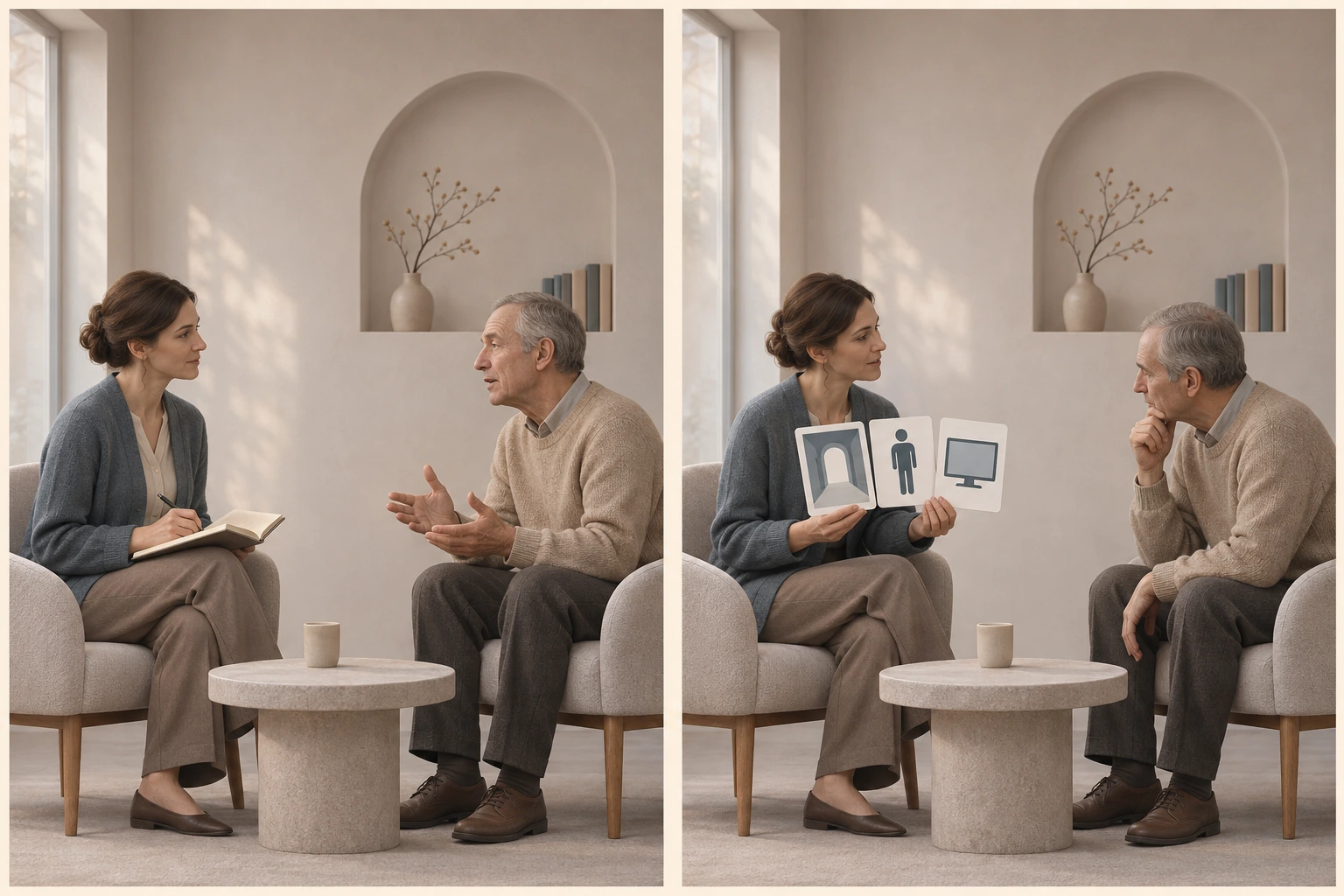
Figure 26. How the question guides the story. On the left is the open-ended question “What happened next?”, on the right is the pre-meeting question “Who met you?” The author's model shows different conditions for the appearance of the answer.
Expectations and boundaries of the scenario
The publisher's abstract of Robert Baker's study reports on 60 students who received supportive, neutral, or skeptical training in regression. The number of past lives reported depended on the setting. The annotation does not allow us to reconstruct all the details of the group distribution and effect sizes. The work indicates the value of preliminary expectation, but does not determine the historical truth of individual stories by this result. [80]
The influence of anticipation does not necessarily mean passive repetition of the prompt. The person may be surprised by his own images, resist the intended story, or report something that the interviewer did not expect. In Brian Weiss's book, one patient's material includes rest, waiting, and the obligation to return; in one session the expected meeting with the “masters” did not take place. Such an episode shows the variability of the story itself, but does not provide an independent verification of the described structure of the world. [81]
Therefore, a simple division into “completely inspired” and “completely independent” is too crude for analysis. Various contributions are possible: an initial impression, a given topic, a random image, clarification after a question, a later interpretation. In a particular record, you should look for their sequence. The more detailed the protocol is preserved, the less you have to guess which part of the content belonged to the original experience and which arose during its discussion.
Independence of repetitions is especially important. One hundred similar responses following the same instruction may reflect the robustness of that instruction. One hundred similar early reports with no known common source pose a different question. In both cases, a pattern is found, but the patterns relate to different objects. The first may describe the interaction of procedure and imagination, the second - the broader mechanism of the emergence of stories. The number of answers without information about their origin does not choose between explanations.
Culture before and after the experience
The personalization hypothesis suggests that familiar images serve as a way to convey shared meaning. It can be formulated precisely enough for discussion. But first we need to separate three possible moments of cultural influence: the content of the experience itself, the words when first telling it, and the later interpretation. The same image can receive a religious name only after its return. If this occurs, the name cannot be automatically assigned to the original state.
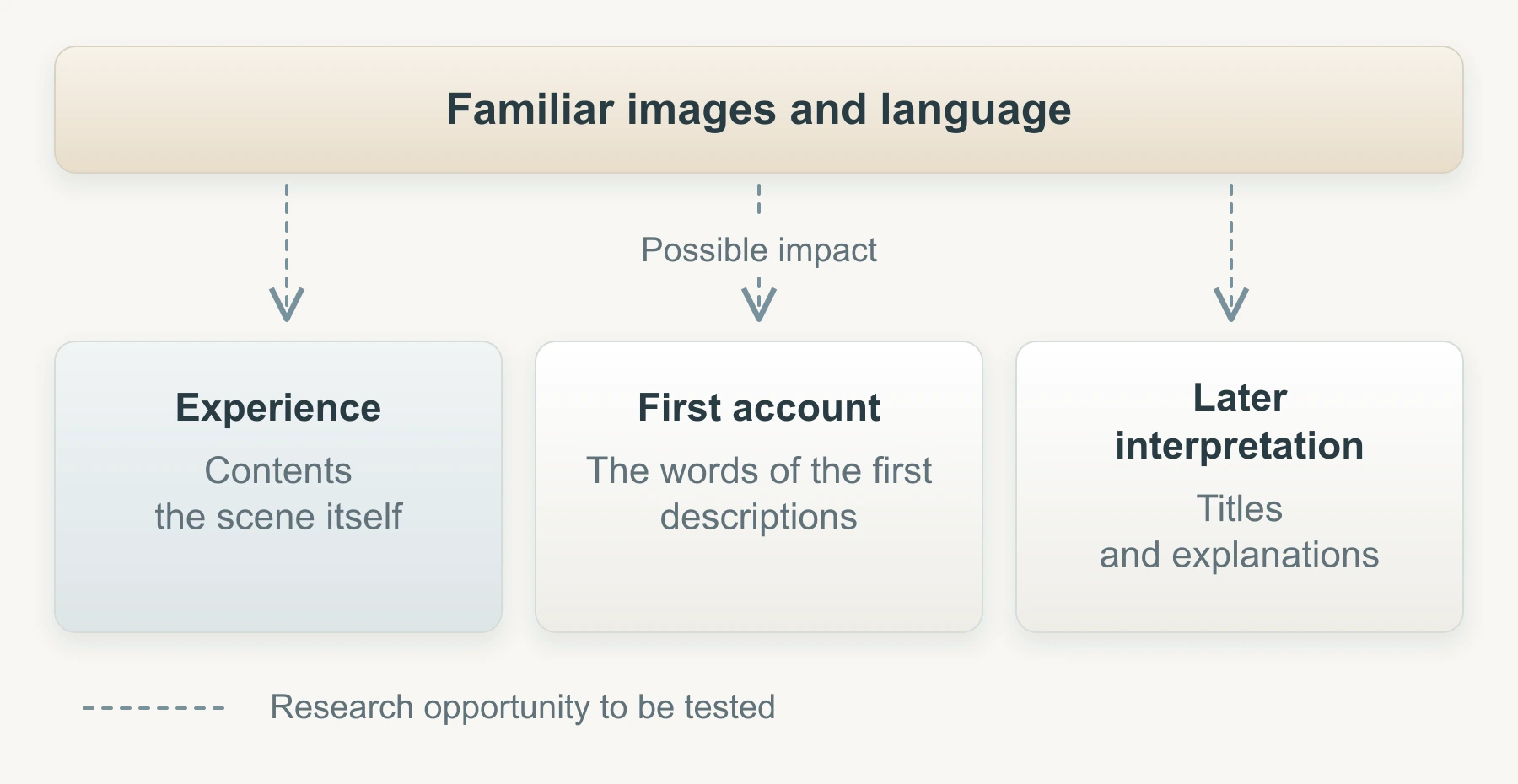
Figure 27. Cultural framing of experience. The analytical framework distinguishes three possible levels of influence of habitual images and language: the experience itself, the first story, and later interpretation.
In a Japanese study by Morita et al., near-death visions were reported by relatives. The likelihood of reporting was related to the religiosity and beliefs of the responding relative. This connection does not establish the cause of the patient's experience, but it does show another place of possible selection: the observer decides what to notice, remember and call a vision. [82]
The title of the Iranian study by Rashidi et al uses the word rebirth. In content, it denotes personal renewal after returning to life, and not a new incarnation in another body. Such differences are important when comparing publications in different languages: the literal coincidence of a word does not guarantee the coincidence of the phenomenon under study. [83]
The personal design model should also set the limits of variability. If the common path is preserved, what features must be present regardless of religion? Accompaniment may have different images, but the obligatory nature of accompaniment is a separate prediction. The choice room and direct decision can perform a similar function, but coercion and free refusal differ in the rule of action. All contradictions cannot be considered a change of scenery if the hypothesis claims to describe a general process.
Memory, questions and culture therefore form an important part of the explanation of recurring plots. Their participation can be explored without first solving the entire problem of the origin of consciousness. Precise work begins with distinguishing what originated, what survived, what was proposed, and what was named later. After such an analysis, it is no longer equally weighty stories that return to the general map, but evidence with different histories. It is from them that we must build a circuit that will withstand its own exceptions.