Part I Experience and Evidence
Chapter 1
What Does It Mean to Experience Your Own Death?
Experience and event
The phrase “I experienced my own death” connects two different statements. One relates to what happened to the person. The other is how what was happening was given to him. To understand the story, it is necessary to untangle this connection. The medical description may indicate circulatory arrest. A personal testimony may contain a feeling of finally leaving the body. You need to find a relationship between them, and not just put an equal sign.
Experience is directly accessible to a person. He feels pain, sees light, recognizes a face, hears a voice, or senses a presence without a visible image. The question of external cause belongs to another level of analysis. This distinction does not imply that perception and its interpretation necessarily follow each other in time. If there is a cup on the table, the question of the difference between the cup and its perception rarely becomes a practical problem. Unusual experience forces this difference to be taken into account.
A simple mental example is helpful. A man sees a familiar room in a dream. Inside the dream there is the color of the walls, the distance to the door, the expectation of a meeting. The experience of a room exists as an event of its experience. Moreover, the mere presence of such an experience does not establish that at the corresponding moment he was in the physical room. This example does not explain near-death experiences as dreams. It shows the logical difference between having an experience and inferring its external object.
The same difference holds under the opposite assumption. If the experience is truly connected to external reality, the strength of subjective certainty does not yet explain how this connection works. For research, additional features are needed: accurate information, independent observations, limitations of conventional channels for obtaining information. The question is not just how convincing the condition was from the inside.
What does the word qualia mean?
The word “qualia” here refers to how an experience feels to the person experiencing it. One can know the wavelength of light and still ask another question: what the corresponding color looks like to a person. You can describe the bodily signs of fear and separately ask how the fear itself is experienced. Such a distinction does not resolve the question of the origin of consciousness. It helps define the subject of conversation.
When exploring non-ordinary states, it is easy to focus on the content of the scene and miss the way it is experienced. Several stories may mention light, but in one it is perceived as an external object, in another as a glow that fills the entire space, in the third as knowledge without a distinct visual form. If you write down only the word “light”, the differences disappear.
Describing experience therefore requires questions about form. Was there a direction of view? Was there a distance to the objects? Was it possible to shift attention? Were the sounds similar to speech or did the meaning emerge immediately? Was the body felt? These questions clarify the experience without imposing a physical interpretation on it. They are especially useful where familiar words are used by analogy.
The expression “everything became clear to me” also needs clarification. It can mean a feeling of completeness, the emergence of a specific thought, an understanding of a relationship, or the ability to answer a certain question. If after returning only confidence in the previous omniscience remains, the researcher has information about this confidence. Verification of the volume of acquired knowledge is possible only where the content being verified has been preserved.
Several meanings of self
The concept of “I” should not be turned into one indivisible indicator. A person may remember his name and biography, but have a different sense of location. He can perceive himself as an observer and at the same time not think about the years he has lived. In mental analysis, one can distinguish between a sense of presence, ownership of the body, authorship of an action, memory of oneself, and the ability to reflect on one’s condition.
The phrase “I understood that I continued to exist” refers primarily to reflection. The experiencer notices his own experience and draws a conclusion about it. However, the absence of such a phrase does not mean the absence of consciousness. In ordinary concentrated action, a person does not have to constantly formulate the thought that he exists. Similarly, in a story one must distinguish between the absence of reflective commentary and the direct message of a loss of self-awareness.
Preserving an autobiography raises a different question. Let's say the narrator confidently calls himself the same person he was before the event. It is important to find out what provided this confidence. Did he remember his family? Did you recognize your own body? Felt continuity without memories? Did you come to a conclusion after waking up? These variants may be accompanied by the same phrase, “it was me,” but describe different bases of personal identity.
In the following, the word “personality” will be used for the relatively stable biographical and psychological organization of a person, and “subject of experience” for the supposed experiencer. This is a working distinction. It allows the possibility of a change in memory or character to be discussed without immediately deciding whether a different subject has appeared. This question arises especially acutely in stories about memories of a former life.
Empty memory and lack of experience
There may be a gap between the last memory before loss of response and the first memory after recovery. By itself, it reports no memory available. To conclude that there is no experience, other grounds are needed. The converse is also true: the presence of a memory upon awakening does not automatically establish at what second it occurred.
In a mental example, a person remembers the beginning of a procedure and then finds himself in another room. For him, the gap seemed to disappear. According to the clock, a significant amount of time could have passed. But the subjective absence of a gap does not prove that time has “accelerated” for an individual consciousness. It may be that there is no available event record. This example is needed to distinguish between measured duration and memory structure.
Therefore, the book will consistently distinguish between the observed state of the organism, the experienced content, the available memory, and the explanation of the narrator. These four descriptions refer to the same person, but do not necessarily have the same time frame. Their comparison is the first step towards research.

Figure 1. Four levels of one case. From left to right, from top to bottom, the state of the body, experience, memory and explanation are shown. The author's composition separates the sides of one case without specifying the sequence of their occurrence.
Why the question remains meaningful
Careful discrimination does not eliminate the main interest. The possibility of continuation of personal experience after death affects what a person usually accepts as his own existence. If the body, memory, character and sense of presence can be considered separately, it becomes clearer which properties are intended to be preserved.
For mental comparison, three options for continuation can be distinguished. In one the biography is preserved, in the other there is only a minimal sense of presence. The third allows for the transfer of information without preserving the experiencer. These options cannot be combined with one word “immortality”: they answer different questions about what will remain of a particular person.
The following chapters will begin with the available evidence. Before discussing the entire proposed cycle, it will be necessary to understand how much weight a single story has and what happens when multiple stories come to be understood as describing a single system.
Chapter 2
How an Account Becomes Data
First entry
History takes on a research form when it becomes possible to reconstruct the origin of its details. Who was the first to report an unusual experience? What words were used? What was known at that moment? Who did they tell next? Without such consistency, even detailed publication may leave the most important fact unknown.
Early recording is useful because it limits the room for possible change. If the message is recorded before the hypothesized former family is known, some subsequent influences can be excluded from the origin of the details already recorded. This does not exclude earlier channels of information or guarantee the accuracy of the recording. But a certain limit appears that can be checked.
A later story may also contain valuable information. Its limitation is that the researcher is more often forced to reconstruct the previous path of information from the memory of the participants. The desire to be precise is no substitute for documentation. Therefore, the quality of evidence is determined not by sincerity alone, but by a combination of sincerity, conditions of recording and available verification.
In the book, the date of the supposed event will differ from the date of first documentation. In the case of a child, it is useful to further distinguish between the beginning of utterances, the first in-depth interview, and the first contact between families. For a clinical case, the first conversation after recovery and the narrator’s access to the explanations of others are important. For sleep - the time of recording and the moment of receiving news related to it.
Unit of observation
The calculation begins with the definition of the unit. One person is able to report several experiences. One case may appear in an article, book, interview, or documentary. Multiple researchers may reanalyze the same sample. If you count each publication as a new confirmation, the number of evidence will increase without new observations.
Independence also has several meanings. Two people may not know each other but answer the same guiding questions. Two witnesses may be present to discuss the event prior to the first interview. Two authors may share an early story. In all of these situations, there is a coincidence, but its origin varies.
Let's imagine a conditional archive of twenty stories. It later turns out that eight of the texts are retellings of one incident, and four more were received from members of the same family after joint discussions. The arithmetic number of texts remains the same. The possibility of using it as a number of independent observations disappears. The example shows why bibliography and case corpus require different registers.
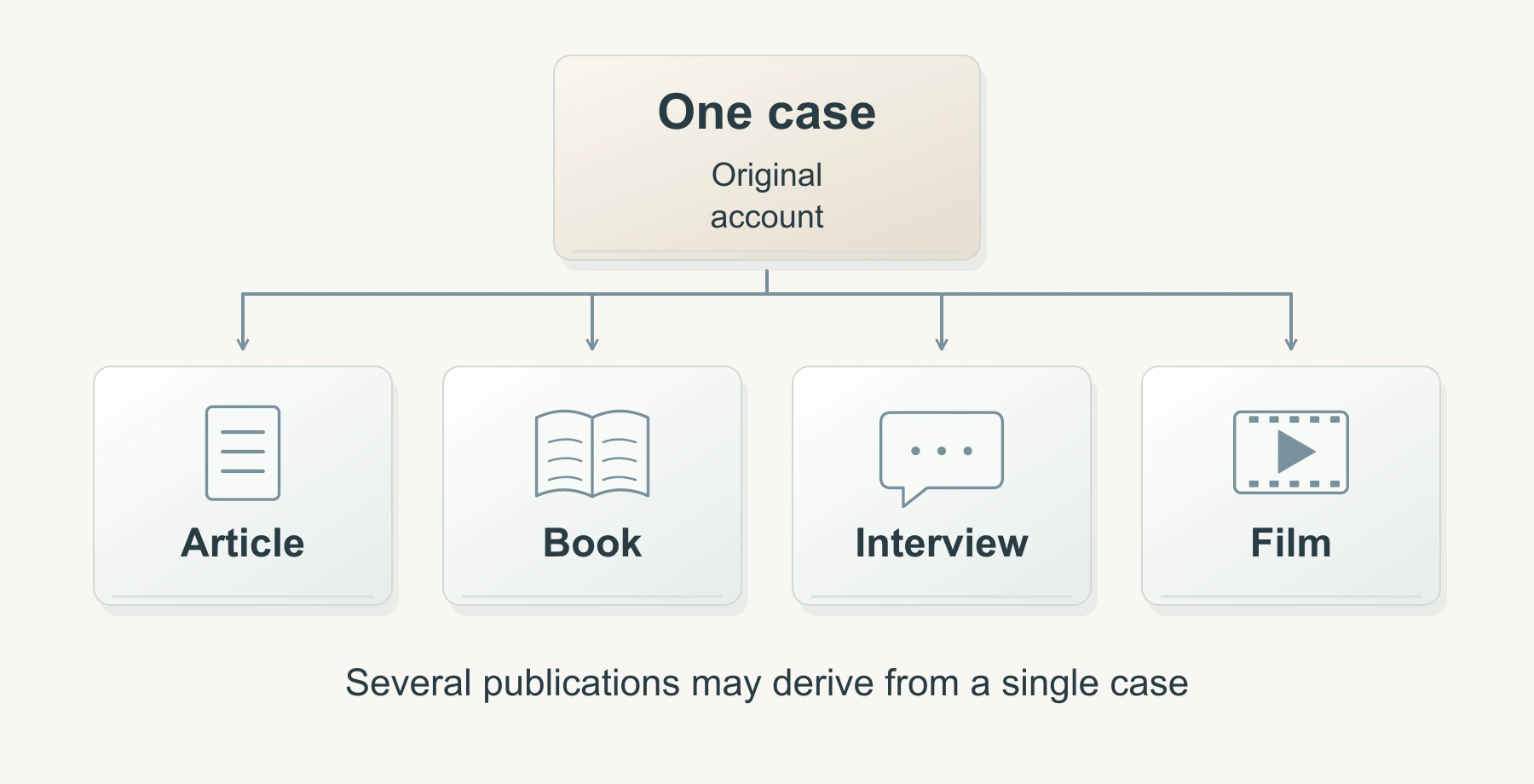
Figure 2. One case and several publications. The schematic diagram shows how an article, book, interview, and film can all be traced back to the same piece of evidence. The number of publications differs from the number of independent cases.
Group percentages need the same attention. If only a portion of the participants answered a question, the response rate among those who responded does not coincide with the rate among all invitees. It is essential for the book to indicate whether it is a group of survivors, a group who agreed to be interviewed, a group with an available recording, or a group that passed a certain threshold of the questionnaire.
Similarity of description and similarity of function
Stories can be compared on several levels. The first one stores a specific image: screen, bridge, room, person, light. The second one highlights the action: viewing, transition, waiting, accompaniment. On the third, the intended function appears: obtaining information, changing state, restoring, preparing a solution.
This classification is useful as long as the transition between levels remains visible. The screen and voice may function as a message, but it does not follow that they are two faces of the same device. The differences in material, space, modes of interaction and authorship of the message can be significant.
A comparison that is too narrow risks missing semantic similarities. Too wide will reveal it almost everywhere. The category “person going through change” will easily combine sleep, travel, learning and illness. Therefore, the categorization rule must explain both the inclusion of a case and its exclusion. Such a rule is further called an analysis code; We are talking about marking up the material, not about a computer program.
The work map of the book keeps the description and interpretation side by side. If the narrator talks about waiting in a room, it remains a description. Attribution to the preparation phase is a research decision that can be reconsidered. In the absence of information about the purpose of the expectation, such a purpose cannot be quietly added to the original story.
Silence of the source
The unmentioned event allows for several explanations. It might not happen, be forgotten, seem unimportant to the narrator, or not be included in the shortened publication. Perhaps the relevant question was not asked at all. Therefore, an empty field on the card should mean unknown, as long as there is no basis for a more definite conclusion.
Direct denial has a different status. If a person independently emphasizes that he has not met anyone, the researcher receives positive information about the absence of a meeting in his memory. But even then, the question of the completeness of memory remains. Careful recording allows you to see how far the denial extends.
Matching requires at least four field states: the element is described; the element is directly negated; it was not asked or reported; the description is ambiguous. They cannot be reduced without loss to two meanings: “is” and “is not.” It is especially dangerous to build a universal sequence based on a table where all the gaps have imperceptibly turned into negations.
How to Preserve Uncertainty in a Record
Let's look at the author's mental example. The first story says, “I didn’t see anyone.” In the second: “I found myself in a bright space,” after which the recording ends. Both texts do not describe the meeting, but the information differs. For the first, we note a direct negation of the visually perceived encounter; nothing is yet known about presence without a visible image. For the second, we maintain uncertainty: the absence of a continuation does not indicate whether someone was nearby.
If the interviewer then asks the second person about the guide and receives a positive answer, two entries are needed. In a free story, the element is not stated, but after the question it is described. This is not a judgment on the reliability of the answer. This recording allows us to explore how the mode of conversation changes the composition of the available material. When comparing cases, the initial silence can no longer be imperceptibly replaced by an independent mention of the meeting.
The negative case is not useful as a rhetorical counterbalance to the colorful story. It clarifies the boundaries of the model. If a certain stage is considered obligatory, the reliably described absence of this stage requires explanation. If a stage is considered possible, absence is not a refutation. What is important is the pre-established meaning of the statement.
Questions change the accessible narrative.
An interview helps a person to reconstruct the experience, but at the same time sets the form of the answer. The question “what happened next” leaves more possible continuations than the question “who took you to your resting place.” In the second case, a guide, a direction and a place with a specific function are already proposed.
This does not mean that answers to substantive questions are always false. The problem lies in the origin of the element. When it appears only after a prompt, its repetition cannot be used as completely independent evidence that many people themselves identify just such a stage.
That's why a good research dossier keeps the story loose until further clarification. Then the questions and answers themselves are recorded. This order allows you to later evaluate which details arose independently, which were clarified, and which could have been introduced by the procedure.
Completed routes require especially careful analysis. Their appeal lies in the sequence: arrival, meeting, explanation, preparation, return. However, the sequence may belong to experience, interviews or editing. To verify, it is necessary to compare the early recording, the protocol of questions and the published text.
How to read degree of confirmation
Evidence may be well established in one part and remain open in another. The medical record can confirm the circulatory arrest, but not the content of the experience. Another witness can confirm that the story was told before the news of the death, but not the exact time of the experience itself. The coincidence of a biographical detail may require an explanation without establishing the identity of the two individuals.
It is more convenient to evaluate individual statements than to assign one label to the entire case. For example, the timing of the event, the early recording, the accuracy of the details, possible channels of information and the independence of witnesses are separately checked. Then the strong side does not hide the weak, and the weak does not automatically destroy everything else.
Distinguishing between explanations requires asking what outcome each would expect to see. If every possible answer fits the hypothesis equally, it does little to help you choose between options. A statement becomes more meaningful when it admits the concrete possibility of being wrong.
The following chapters use this method of reading. First it is established what is being reported. Then - what has been tested and with what restrictions. Possible explanations are then discussed. Consistency allows you to explore unusual stories without prematurely turning them into a proven picture of the world.
Chapter 3
A Boundary That Can Be Measured
The price of one word
The medical record allows you to clarify the part of the story that other people observed. The specific state, the method of establishing it, and the time limits are important here. It depends on them which question gets the answer. Evidence of consciousness during a life-threatening condition and evidence of existence after the final cessation of life would require different tests.
A medical description begins with a specific condition. In the 2023 guideline by Greer et al., death by neurological criteria involves an established permanent loss of function of the brain as a whole, including the brain stem. The diagnosis requires a specific procedure. It cannot be inferred from coma alone, the absence of a pulse, or a single equipment reading. Successful resuscitation after circulatory arrest does not, by itself, constitute a return after established brain death. [1]
This difference does not lessen the severity of the experience. A person could be in extreme danger and experience a life-changing event. Precision is needed for the next step of reasoning. If the researcher claims that the experience arose in the complete absence of conditions for the functioning of consciousness, he must show what conditions were measured specifically in this patient. The word “death” itself, even pronounced by an eyewitness, does not replace such data.
It is useful here to preserve the distinction between a name and a measurement. A name compresses many details into a short expression. Measurement returns to those details. The period without spontaneous circulation, the period without a response to being addressed, and the period without an accessible memory may refer to different intervals. Combining them creates a simple picture of a single empty interval. That apparent simplicity must be tested before an entire journey is placed inside the interval.
Time line resuscitation
The clinical history has more than one beginning. You can count the time from the last meaningful response, from the detection of a person, from the expected circulatory arrest, from the call for help, or from the start of resuscitation efforts. These points are convenient for different tasks and are not interchangeable. Even a conscientious retelling can shift the boundaries of an event if one of them is later called simply the moment of death.
The Utstein International Template for Out-of-Hospital Cardiac Arrest, revision 2024, distinguishes between event and care time stamps and requires that the start and end of the calculated interval be clearly indicated. Unknown time should also retain its status. A similar discipline is also useful in the study of stories: duration becomes meaningful only when it is determined what exactly lasted. [2]
Let's imagine a hypothetical example that does not relate to a published patient. The person is found without reaction, after some time help begins, then blood circulation is restored, and the first conversation becomes possible later. In a memory, he hears a voice and then sees an unusual space. Even an impeccable treatment protocol does not yet tell where the voice and space were located on the external line. First, you need to associate at least one element of the story with an event that has an independent label.
This connection can be stronger or weaker. A recognizable phrase spoken several times limits the interval worse than a single pre-registered message. The memory of a beep becomes more useful if you know the times when the beep actually sounded. However, one matching detail does not automatically date everything the narrator places before and after it. The order within the story and the external chronology still need to be connected.
Therefore, for each scene a separate answer is required: whether its external time is known, whether it is limited to a few possible intervals, or not established at all. The uncertainty here can be kept literally by leaving a blank field. Attributing the entire story to the dramatic moment itself creates a more complete picture, but adds information that no one observed.
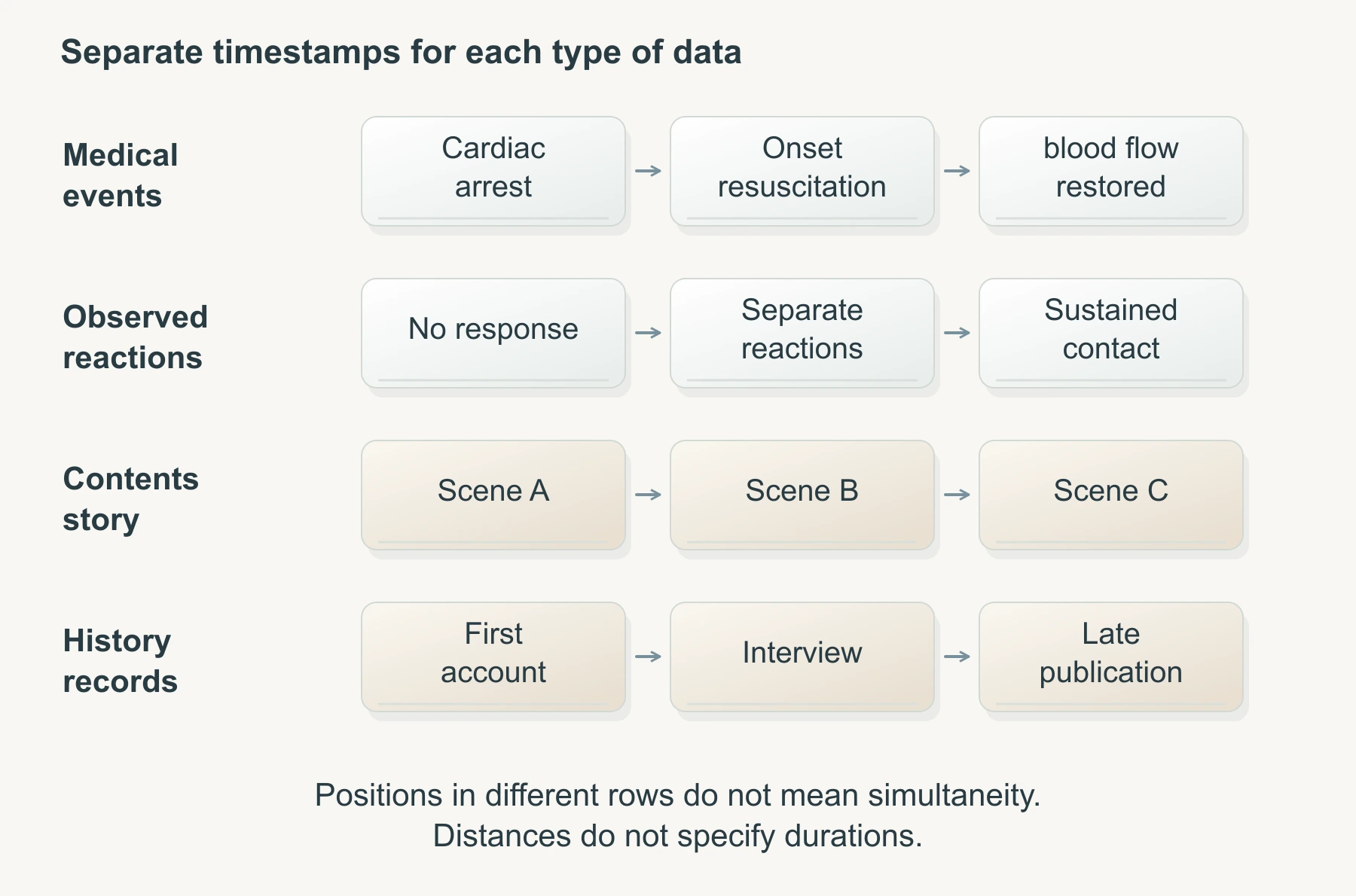
Figure 3. Four timelines. Medical events, human reactions, narrated scenes, and recording history require separate time references. The scheme is conditional; numerical durations are not specified.
What do prospective studies provide?
A prospective study is set up before the stories of interest are available. It allows you to pre-define participants, questions, and screening methods. Its advantage is that the future outcome does not decide who should be included in the sample. But the word “prospective” does not by itself guarantee that every story is recorded immediately, every physiological measure is preserved, and every participant passes the prescribed test.
In the first AWARE project, 2060 cases of cardiac arrest were reported. The initial interview was completed by 140 survivors, the next stage was completed by 101. These are different denominators: the number of medical events cannot be used as the number of people who reported the experience in detail. The article also describes one case, the information of which was able to be compared with resuscitation events; the content of this test will have to be returned to when discussing out-of-body perception. [3]
In AWARE II, of the 567 cases of in-hospital cardiac arrest, 53 individuals survived, 28 completed the interview, and 11 reported memories or perceptions that the authors associated with possible consciousness. Various categories are identified among the descriptions, including six reports of transcendental death experiences. The categories partially overlapped. These numbers cannot be added together as if each represents a separate person. No one identified the hidden image; the article also reports one auditory stimulus recognition among 28 interviewees. Such an answer does not in itself establish an out-of-body method of receiving information. [4]
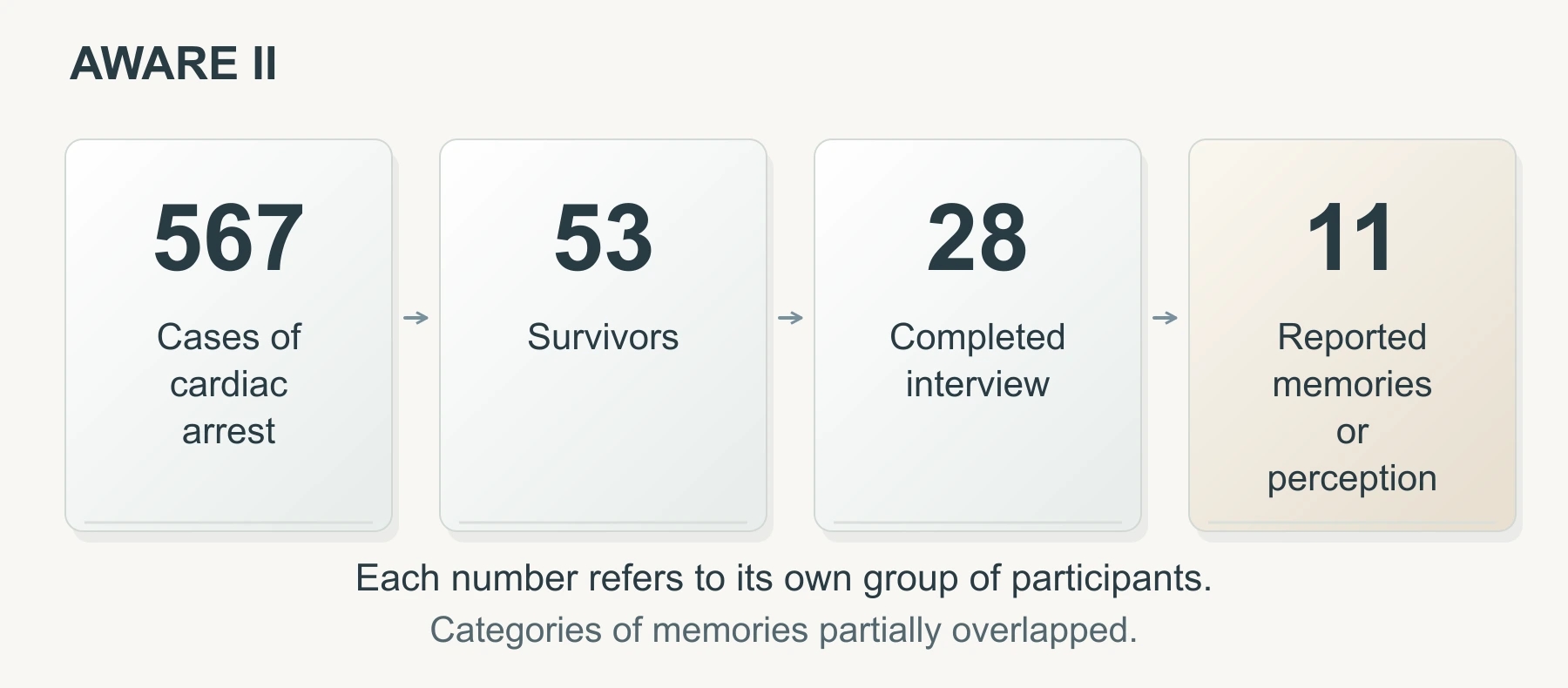
Figure 4. AWARE II Member Groups. The original cases, survivors, interviewees and those reporting memories form different groups. There was some overlap between the categories of experiences in the study. [4]
Every reduction in the sample changes the information available. If a person has died, an interview is impossible. If they survive but cannot participate, their subjective experience remains unknown. If they agree to an interview but remember nothing, the researcher obtains a particular survey result. The proportion of accounts among interviewees therefore characterizes this accessible group. Extending that figure to everyone who was dying introduces additional assumptions that must be stated.
This is especially important for the phase map. A long story is easier to divide into stages than a fragment of one feeling. But a preference for detailed stories can make transitions more natural at the selection level. Research benefits from both short messages and stories without light, meetings or life reviews. They show where the intended sequence ends, changes direction, or doesn't begin at all.
Experiencing and accessing memories
The person's state at the time of the event and his ability to later talk about it represent two research questions. A positive response in an interview proves the presence of a story at the time of the conversation. More work is required to determine when its contents originated. A negative response indicates that no available story could be obtained. There remains a space between these results that cannot be filled by mere assumptions about how memory works.
In a study by Sanders and colleagues, 12 of 260 patients undergoing general anesthesia followed a command by moving a specially isolated hand. Yet none of the 253 postoperative interviews revealed explicit memories of events during the operation. The abstract does not allow each patient who responded during the procedure to be confidently linked to a subsequent interview. Nevertheless, it clearly distinguishes a behavioral response at the time of the event from a later report of memory. [5]
A different result was obtained in a study by Mauduit et al after aortic surgery: none of the 101 patients reported memories of a period of non-response. In 67, the operation included hypothermic circulatory arrest. This is data on the specific conditions of the operation and the subsequent survey. They do not allow the absence of memory to be equated with a measured zero subjective duration. [6]
What limits a null result?
The null result allows us to ask a more precise question: How often would the procedure identify available memory under these conditions? Let's look at a separate mathematical example based on the size of a group of 101 people. Assuming the observations are independent and the probability of a positive report is the same, the absence of such reports gives a one-sided exact binomial upper bound of about 2.9 percent with a confidence level of 95 percent. The calculation has the form pₘₐₓ = 1 − 0.05^(1/101). This is an additional calculation of this book, and not a statistical estimate stated by the authors of the study. [6]
The margin refers to the probability of obtaining a report from a given procedure. This probability depends on the occurrence of the experience, the retention of available memory, and the ability to report it during questioning. Without a separate assessment of these links, the number 2.9 percent cannot be used as a limit on the frequency of any experience. The distinction is suggested by the following experience: simultaneously examine the quality of subsequent memory access and the recording of subjective content, while keeping medical conditions comparable.
There is an important consequence here for the study of personality continuation. Emptiness in a story is not the same as a story about emptiness. In the first case, the person cannot communicate anything. In the second, he describes the experience of the absence of objects, darkness, or a feeling of non-existence. The second option already contains a certain phenomenology, that is, a characteristic of how the state was experienced. Combining these options would eliminate the distinction between missing data and the distinctive content of experience.
Prolonged hospitalization should be treated with equal caution. In a prospective study by Rousseau et al, among 126 long-stay intensive care unit survivors, 19 reached the accepted threshold for near-death experience. The authors were unable to determine at what point in treatment the experience occurred. The time spent in the department therefore does not determine the duration of the described scenes. [7]
What remains measurable
A clinical trial does not have to immediately address the issue of postmortem existence to be meaningful. It can establish how often stories are received under certain conditions, what features are combined in them, and what external events can be compared with memories. It can also detect its own boundary: an area for which there is no record, answer, or reliable time stamp.
For subsequent analysis, it is more convenient to save several parallel lines. The first one contains medical events. The second shows observable human reactions. On the third is the sequence he talks about. The fourth is the interviews themselves and subsequent changes to the story. Matches between lines become the result of verification. They cannot be obtained in advance by placing everything unknown into one convenient interval.
This way of reading leaves room for the unexpected. If a detail is truly established in an early story and independently coincides with an event, it should be explored even when there is no ready explanation. But missing data must also remain missing. Research integrity applies in both cases: maintaining an inconvenient observation and rejecting a convenient addition require the same discipline.
The proposed path begins here at the observable border. There is a body, a medical situation and a later testimony. Further, the story can take the observer to the ceiling, to the light, or to an unfamiliar space. To move with him, you must first understand what the feeling of moving itself means and what kind of object, according to the person, has changed its location.