Part III Time and the Continuity of Personal Identity
Chapter 10
Two Kinds of Time
Event calendar
The question of time arises almost immediately after the story of the return. If a person says that he left the body and ended up in another place, I want to know how long he stayed there. If the child considers himself to be a deceased person, another question arises: how much time separated the two lives. Both questions are understandable, but they refer to different quantities. The first concerns the experienced duration, the second concerns the interval between events in the earthly calendar. Additional information is needed to connect these quantities. The persuasiveness of the story alone is not enough to automatically make the two scales comparable.
The difference between the date of death of one person and the date of birth of another is calculated in the usual way. However, the meaning of the result depends on the assumptions. It must be accepted that it is the previous life that is established, that no other supposed existence is missing between the two biographies, and that the birth corresponds to the moment of transition that the narrator describes. If at least one condition is unknown, the resulting number retains its calendar meaning, but its interpretation as the duration of stay between lives remains conditional.
Even simple arithmetic has to be checked. Krishna Rawat's article on Shanti Devi lists the death of Lugdi 4 October 1925 and the birth of Shanti 11 December 1926. The author calls the period one year ten months and seven days. Based on the given dates, it turns out to be one year, two months and seven days, or 433 days. This is an internal publishing error. The corrected subtraction does not turn the dates themselves into independently verified documents: the article retells the story, and the original death and birth certificates are not presented here. [48]
Such a discrepancy may seem minor compared to the unusualness of the whole story. But it is precisely from such numbers that ideas about the timing of return are then built. An accidental typo, a translation error, or the wrong month can change the expected pattern. Checking the time therefore begins with the mundane work: where each date comes from, in which document it appears, how accurately the day is known, and whether the table and the main text are consistent. Metaphysical interpretation does not cancel the requirements of the calendar.
Duration and order
Subjective time has several sides. A person may remember a sequence of events, feel a long wait, know within the experience that many years have passed, or retain only the impression of timelessness. These descriptions cannot be written in one column. Sequence answers the question of what happened before and after. The sense of duration tells how drawn out the event seemed to be. A statement about the number of years may be part of the content of the experience, although the sequential experience of these years is not remembered.
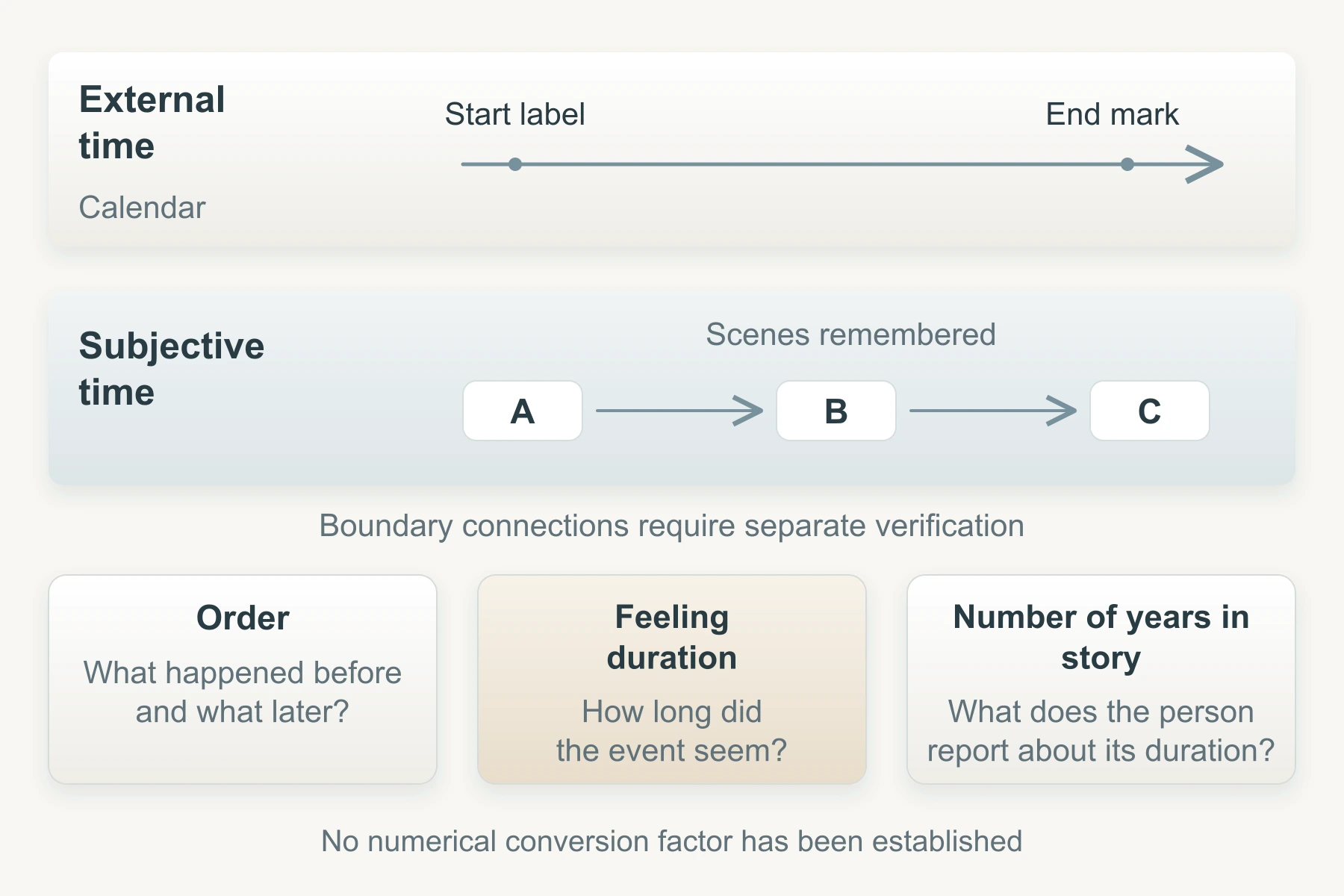
Figure 19. Calendar and subjective time. The schema maps external cues to scene order and a sense of duration. A subjective line has no set numerical scale.
In the publication of Rawat and Rivas, Shanti Devi, when asked about time, answers that there was no sensation of it and she cannot estimate the duration. Another passage calls the wait long. These formulations are compatible: the experience could have consistency and the emotional quality of expectation without numerical evaluation. However, the article combines materials from different years, including descriptions of hypnotic interviews, so they cannot be considered one recording made immediately after the event. [49]
The phrase about lack of time requires especially careful reading. It may indicate the absence of a clock, a loss of interest in duration, an inability to appreciate the interval after returning, or an experience of simultaneity. Each opportunity poses its own question. If a story contains a conversation, a decision, and a subsequent transition, there is already a distinction between states, even if the narrator considers the place timeless. This does not refute the experience. It's just that the word "time" is used here in several senses, and they should be separated before building a physical model.
A mental example helps you see the difference. One person reports waiting at the door for a long time, but doesn't know how long. Another says that he immediately became aware of the past hundred years. The third recalls many individual days. In all three cases, a strong feeling of prolonged stay is possible. But only the third story contains the stated expanded sequence. Even there, the question remains how memory represents many days and whether their number can be established. To give all three the same length would be to lose the main difference between the stories.
External landmarks
In the descriptions of the supposed interval, earthly events are found: funerals, conversations of relatives, movement of people near the body. Such details can serve as temporary references if their provenance is verified. However, the landmark connects a specific fragment with the calendar. It does not automatically measure the entire subsequent scene. A recognizable funeral allows discussion of the position of the episode in relation to the funeral, but does not indicate the duration of further stay in the garden, darkness or unfamiliar room.
Purnima Ekanayake's study mentions a few days near the deceased body, followed by a transition. There is an obstacle to the calendar check: the table dates the death of 9 to April 1985, but the main text dates it to September of the same year. Birth is indicated as 24 on August 1987. The researcher also notes the lack of initial recording of utterances prior to the families' contact. Until the discrepancy is resolved, the exact interval is unsuitable for inferring the speed of subjective time. [50]
There is another possibility of error: a person could find out the time of the earthly event later. If, after returning, he read how long the resuscitation lasted, this knowledge could be included in the subsequent story. Then the phrase "I was there for seven minutes" could mean "the doctors reported that seven minutes had passed." In this case, there is no subjective assessment. The researcher must preserve both formulations and their origins so that the medical interval does not begin to impersonate the internal clock.
It is useful to ask how exactly a person came to his assessment. Did he see a clock, count repeated actions, observe the cycle of day and night, hear a number from a character, or draw a conclusion after waking up? The answer does not determine the truth of the entire story, but it allows us to understand what value is generally proposed for comparison. Sometimes the most accurate result is to admit that the duration is unknown. Such a recording leaves room for further research and does not create false precision.
Missing links
Particularly difficult are cases in which a person reports several previous existences. Stevenson's description of Swarnlata includes Biya, who died in the year 1939, and Swarnlata, born 2 in March 1948. But the story includes another supposed life between them, Kamlesh, who could not be identified. The interval between two known dates cannot therefore be confidently considered as one stay between lives. [51]
In the same book, Jasbir's case is arranged differently: the supposed predecessor died approximately three and a half years after the birth of the child. The story connects the transition with the illness of the already living Jasbir, and the exact date of the illness has not been established. The date of birth of the body and the supposed change of identity here denote different events. A negative difference between birth and death does not become evidence of reverse time. [51]
There are also specially selected short intervals. Matlock reviewed 36 published cases in which the reported death preceded the birth by less than nine months. This sample allows for discussion of the relationships between the intended transition, pregnancy, and birth. It does not characterize the frequency of short intervals among all messages and does not itself establish the moment of attachment to the body. [52]
From these examples follows an important amendment to the scheme itself. It may have several possible ending markers: conception, a certain point in pregnancy, birth, or a late change in self-identity. If a researcher pre-selects one label for all stories, he or she runs the risk of ending up with a pattern created by his or her own definition. You should first find out what event is being discussed in each case, and then compare only comparable intervals. The age of the first utterance and the date of its recording refer to the history of the message; without the narrator's specific approval, they cannot be considered the moment of the intended transition.
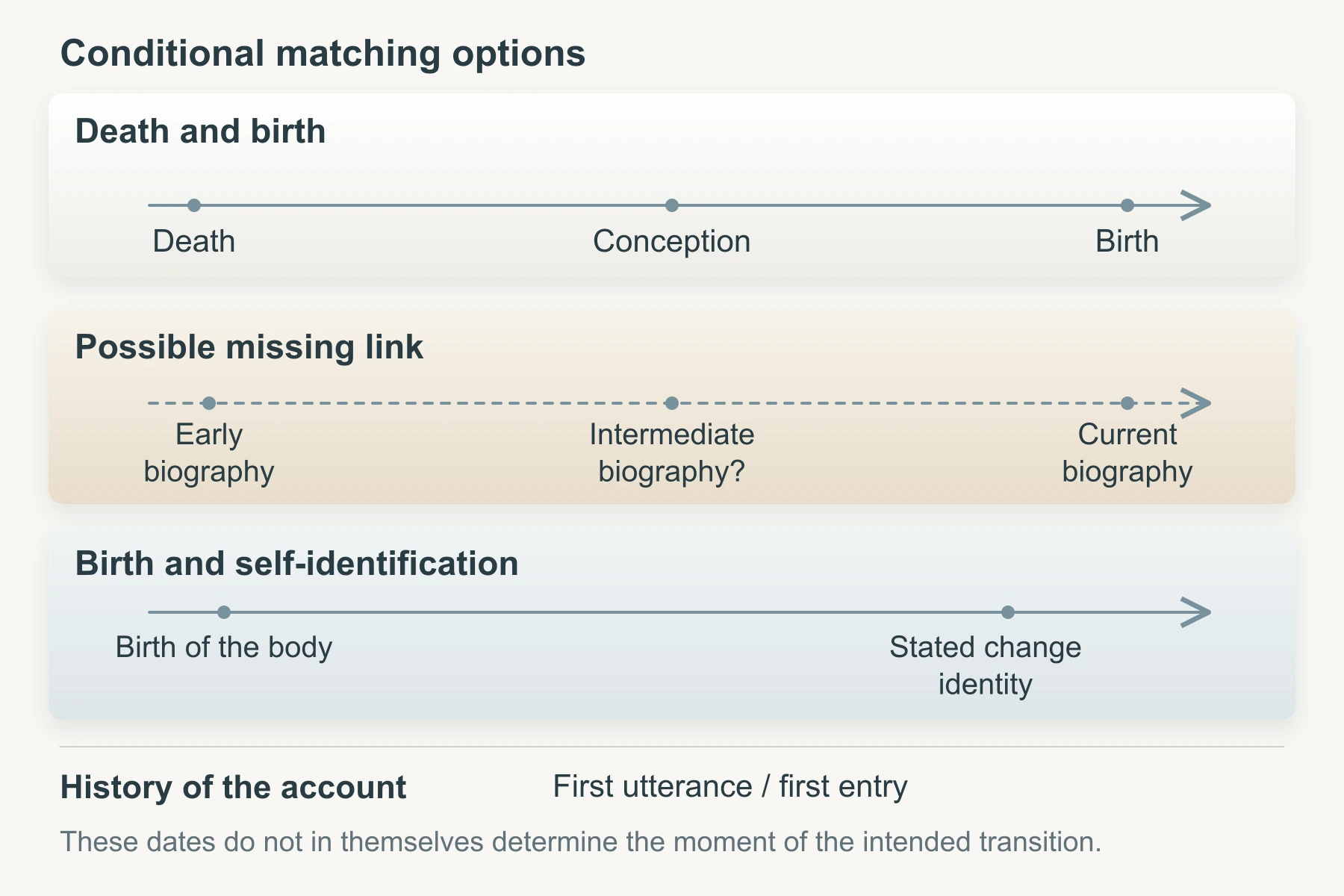
Figure 20. Interval boundaries. The conventional scheme separates conception, birth and the declared change of identity. The first entry relates to the message history; its date does not determine the moment of the supposed incarnation.
Comparison of two scales
For a full comparison, two intervals with the same boundaries are needed. The external interval must be tied to documented events. Internal - described by the survivor himself before he was told the external result. In addition, you need to know that the memory refers specifically to this period, and not to the state before or after it. These conditions are difficult, but they explain why individual medical minutes and stories about years cannot yet be added into a universal ratio.
As a mental example, let's say that two people independently described a long stay and the medical records show the same duration of non-response. Even such a coincidence leaves several options: they could estimate the same duration differently, form experiences in different parts of the observed period, or later give the experience a greater length. Sequence details and early records are needed to distinguish between variants. Simply dividing one number by another hides these forks.
One should also distinguish between the moment of experience and the moment of its restoration in memory. It may take years for a person to talk about a scene for the first time. This in itself does not establish either its later creation or its preservation in an unchanged form. A separate story arises: when the first certainty appeared, what exactly was remembered first, what information came later. Experience, biography, and narrative each have their own chronologies. Their connection constitutes the research problem.
Acknowledgment of these limitations does not render the issue of time contentless. On the contrary, it makes possible concrete results: a corrected date, the separation of a long wait from the knowledge of years, the identification of a missed life, the establishment of an early message. The heterogeneous evidence considered here does not allow us to derive a reliable general relationship between earthly and subjective duration. The next problem therefore concerns whose watches are being compared. If time connects two biographies, it is necessary to understand on what basis they are considered biographies of the same being.
Chapter 11
Who Continues to Live?
Body and perceived identity
The question of the continuation of life is often formulated as if the meaning of the word “continuation” is obvious. But a story about a cardiac arrest experience, a childhood memory of another family, and a sudden change in adult identity make different demands on the concept of personhood. In the first case, the person returns to his biography. In the second, a statement about another biography appears. In the third, the previous life of the body continues, but the story of who owns this body changes. A general theory should explain differences, not eliminate them with a single name.
Sumitra's case makes the problem particularly clear. According to the initial report, she was born around the year 1968. Shiva Tripathi died in May 1985. In July of the same year, after an unusual state, Sumitra began to identify herself with Shiva. There is no medical confirmation of Sumitra's death. The researchers began work after introducing the families; newspaper information about the death was previously available. The authors recognized the clue in one recognition and errors with photographs, although some of the other information was considered difficult to explain. [53]
The transition here cannot be described in one sentence about the new birth. According to the story, the attitude of a living person towards his own name, loved ones and past has changed. If we imagine a literal continuation of Shiva, the question arises about the fate of the former Sumitra. If we assume a psychological change in self-identification, it is necessary to explain its content and the knowledge associated with it. Both productions are meaningful, but each requires its own set of observations. The uncertainty does not disappear because an expressive term is chosen.
Even the word “death” in such a case requires separate verification. Relatives may describe immobility, a lack of noticeable breathing, or a belief that the person is dead. These reports reveal the perceptions of witnesses. Medical approval requires other data. Therefore, the chain “a person died, another soul took over his body” includes at least two hypotheses: about the state of the body and about the source of the new identity. The strong impression from the second part does not confirm the first.
Conviction, knowledge and identity
Three independent statements can be distinguished. A person perceives himself as a certain person. He provides information about the life of this person. There is an identity between him and the deceased, that is, we are talking about one continuing subject. The first statement relates to self-awareness, the second to information, and the third to the nature of personality. They are connected, but the transition from one to the next requires justification.
The story of Iris Farzadi shows why the stability of self-identity does not complete the test. The Hungarian girl began to imagine herself as the Spanish Lucia. Upon later research, the claimed Spanish family could not be found. The authors of the detailed publication differed in explanations: they considered possession, dissociation with cryptomnesia, and the possibility of leaving the issue unresolved. The durability of the unusual identity appeared to be compatible with the lack of a verified hypothesized biography. [54]
Cryptomnesia is a situation where previously learned content appears without recognition of its origin and can be perceived as its own new thought. Brown and Murphy examined this effect in tasks where participants inadvertently assigned the answers of others. [55] The term itself does not replace the establishment of a specific channel of information in a specific case. If the explanation involves a book read, a conversation overheard, or a previous acquaintance, it is advisable to provide reasons for such an assumption. The link to a potential opportunity should remain a possibility, and the information path found should remain a verified circumstance.
The reverse error occurs when an unknown source of information is immediately declared evidence of personal continuation. Mental example: a person, without explicable access, accurately lists the facts of someone else's biography. Even if this condition is met, there remains a difference between receiving information and preserving the subject itself. The memory transfer hypothesis, the alternate mode of knowledge hypothesis, and the reincarnation hypothesis may all coincide in one prediction. They will have to be distinguished by additional consequences, and not by repeated presentation of the same facts.
This reasoning does not discount unusual information. It clarifies what issue it can solve. Testing knowledge can significantly narrow the range of explanations. Establishing identity also requires showing why the coincidence of information indicates the continuation of the experiencing “I”, and not just the coincidence of the contents of two minds. In a book about the possible path of the soul, this boundary is especially important: otherwise, biographical information begins to quietly carry out the work of an entire theory of consciousness.
New speech and old biography
Another strong motive is the appearance of speech that a person supposedly never studied. This communication is called xenoglossy. Before discussing its origins, it is necessary to determine what exactly is being demonstrated: a few words, memorized expressions, comprehension of questions, fluent speaking, or native-level proficiency in the language. Changing pronunciation and the ability to construct new sentences have different testing requirements. A listener who does not know the language can evaluate only part of these properties.
In a linguistic analysis of the case of Uttara and Sharada, Sarah Thomason showed discrepancies between assessments of Bengali speech. Possibilities of previous exposure to the language were considered; one specialist assessed the speech as modern and non-native. Such material requires caution in moving from impressive linguistic behavior to inferences about a particular historical figure. Thomason analyzed primarily the linguistic strength of the evidence, and it is within this framework that her conclusions should be read. [56]
Even a well-done language test addresses a limited issue. He is able to determine how freely a person understands and produces speech. The history of language acquisition is checked separately. The historical figure one considers oneself to be is another separate task. If you mix these levels, any unusual phrase begins to serve as evidence at once of language, memory, and a new carrier of consciousness. In contrast, sequential division allows us to notice at what stage the evidence actually becomes stronger.
The method of communication during the inspection also matters. If the evaluator knows the intended background, he can ask appropriate questions and interpret vague answers in her favor. Reverse bias is also possible, when an unusual answer is rejected because of a pre-accepted explanation. Separate recording of questions, answers, and evaluation criteria protects the study from both directions of error. What is important here is not the emotional state of the researcher, but the ability of another specialist to restore the progress of the test.
Several possible sequels
A simple model assumes a match between one deceased person and one new person. Stevenson discussed reports among the Igbo where one deceased person was believed to have incarnated several children. He noted the unequal strength of evidence and the familial interest in such attribution. In the same book, the claimed intermediate existence of Ma Tan Tan Aye in the body of an ox remained unverifiable. Such stories expand the set of hypotheses, but do not establish either the division of personality or the transition between biological species. [57]
Logically, the hypothesis of several continuations is much more demanding than the hypothesis of one. You need to decide what exactly is being shared: memory, ability to experience, character traits, or all of the above. If two people have the same perceived past, do they maintain a common center of experience? Could their decisions diverge? At what point do they become separate entities? Without answers, the word "separation" denotes an image rather than a mechanism that can be compared with observations.
A mental example makes the difficulty clearer. Let's imagine two exact copies of one autobiographical memory. Each copy is confident in its past and recognizes itself as a continuation of the previous person. If they are in different places and have different new experiences, their current points of view will diverge. The presence of the same memory does not determine which of them is the former subject and whether a single answer is even applicable here. This is a philosophical problem that arises even before discussing specific stories of rebirth.

Figure 21. Same memory and different points of view. Mental example: two figures have the same autobiographical memory, but receive different new experiences. The coincidence of memories leaves the question of the identity of the subject open.
On the other hand, the absence of memories does not resolve the issue negatively. It is possible to define personal continuity through memory, but then cases of its loss will require additional conditions. You can lean on the body, but such a model will read stories about another body differently. One can assume a stable bearer of experience who does not depend on the available biography. Then you will have to explain by what observable signs he is recognized. Each definition has consequences and should be chosen openly.
How to make a difference explorable
Here a problem arises for future theory. Let the first model involve the transfer of information without the continuation of the previous subject, and the second - the continuation of the same subject. If both predict the same responses under any available conditions, additional biographical matches will make it impossible to choose between them. This refers to the observational discernibility of models and does not mean that the philosophical question has already been resolved.
To take this further, each model needs its own law of connection between the intended host, memory, and behavior. It should specify different consequences: for example, restrictions on multiple simultaneous continuations or on the joint saving of a skill and a specific intention. Constraints cannot be chosen after experiencing an opportunity. First, a testable consequence is derived from the model device, then suitable data are searched for or collected. The book offers this path as a research challenge; There is no established way to directly measure the numerical identity of a subject.
Persistent Self
To analyze stories, it is useful to temporarily hold several personality components side by side. Is there still a sense of existence? Does a person recognize his earthly life? Does he remember relationships and obligations? Can he reflect on his own condition? Is there a sense of authorship of decisions? It is not necessary for all components to be changed at the same time. Therefore, the statement about the preservation of the “I” makes sense only in conjunction with an explanation of what exactly the narrator refers to this “I”.
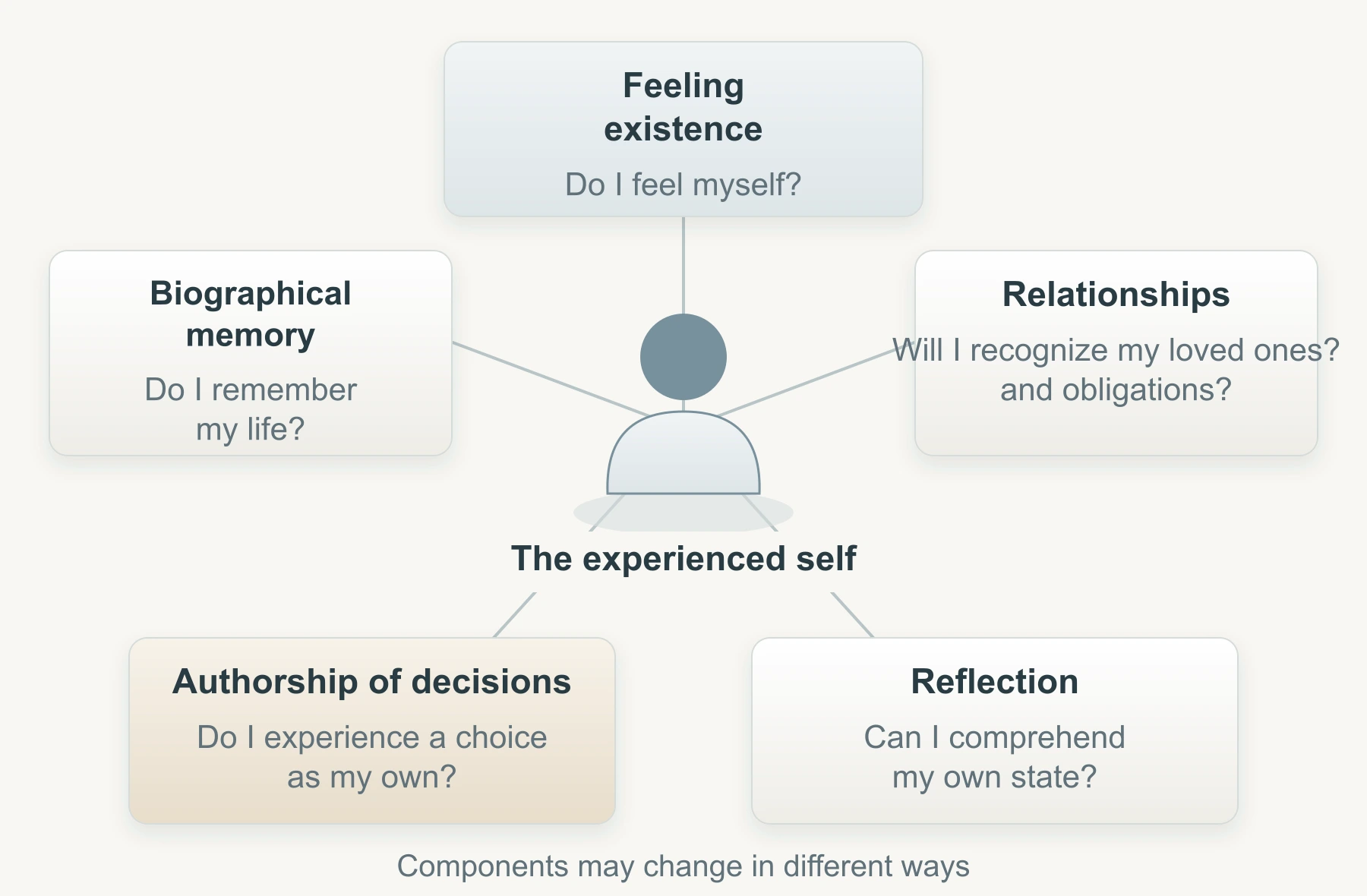
Figure 22. Components of the enduring self. The working framework distinguishes between sense of existence, biographical memory, relationships, authorship of decisions, and reflection. These signs can change in different ways.
Qualia, that is, the experienced quality of a state, give access to the other side of the question. A story about color, pain, peace, or touch reveals how an experience is remembered from within. It does not contain a ready answer about who is its bearer outside of the current biography. Self-awareness adds a relationship to experience: what is happening is recognized as one’s own. Reflection allows us to evaluate this attitude. These differences should be preserved in the analysis so that the vividness of sensations does not replace the establishment of personal continuity.
In Jasbir's case, a particularly pressing question remains: what happened to Jasbir's former self if the subsequent identity is considered to have come from outside? Stevenson himself did not have a definite answer. The unknown place in such a story must remain visible, even if other details attract the researcher. [51]
Therefore, the map of the continuation of life should show not only transitions between places, but also changes in the one who recognizes himself. At one point we can talk about a former person with full memory, at another - about a subject without a name, at a third - about a new biography with separate fragments of the past. It is impossible to silently draw a line of identity between such states. It is this line that requires explanation. The next group of evidence complicates the task even more: the deceased is recognized by another person who continues to live.
Chapter 12
Encounters in Dreams and Shared Experiences
Whose side of the meeting is available
The story of meeting the deceased seems especially close to direct observation: a familiar person looks a certain way, says words, touches a hand, or reports that he is fine. But the researcher receives the testimony of a living participant. The presumed side of the deceased is accessible only through the content of this experience. This simple distinction allows us to preserve the details of the meeting without turning each of them into an independent report about the structure of another world.
In a survey of bereaved hospice caregivers, Wright et al found dream themes to include health and peace of the deceased, messages, shared memories, and illness and death. Dreams could be pleasant, unpleasant or mixed. The study looked at the mourners' experiences without measuring the subjective duration of the dream character's existence. [58]
For a map of a possible post-mortem path, this means that images cannot be placed into phases based only on sleep time. If a person saw a relative many years after the funeral, the gap in the dreamer’s life is known. It does not follow from it that the relative subjectively waited the same number of years or was in one place all this time. A specific date may also be present in a dream, but then you need to separately establish how it is known and what exactly it means.
The question also arises about the compatibility of such meetings with rebirth. Let's say, in a mental example, that one deceased person is credited with being reborn, and another person later reports sleeping with him. The contradiction will appear only under the additional condition: the new birth completely excludes any previous manifestations. If this rule is not in the original hypothesis, the dream cannot be considered either a refutation or confirmation of rebirth. But you can see what new rule has to be added to connect the two stories.
The last days of a living man
Near-death dreams and visions of the patient himself represent a separate group. In the longitudinal study by Kerr et al, the analysis included 59 hospice patients; 52 have reported end-of-life dreams or visions. Among the images there were dead, living and everyday scenes. This number does not mean that all 52 saw the dead. Interviews were repeated and time was noted relative to the patient's subsequent death. [59]
In the home hospice study, Depner et al also found a variety of content: closeness and support, neutral or conflictual interactions, daily activities, transportation, and familiar images of popular culture. Messages from one participant may have been repeated. Therefore, the number of recorded experiences differs from the number of people, and the presence of an everyday scene does not automatically allocate it to a special posthumous category. [60]
In such observations, the ability to trace changes over time is especially valuable. But you need to understand what exactly is changing: the content of the dream, the frequency of messages, the patient’s condition, the ability to talk, or the researcher’s willingness to include the episode. If a person can no longer respond, his absence from new interviews does not equate to a lack of experience. Here the researcher faces a frontier of data availability that cannot be filled by guessing at what happened inside.
The same scene can also take on different emotional meanings. Seeing a deceased person you know does not mean experiencing relief. In Dam's Indian study, some participants were frightened by the very presence of a person they knew to be dead, even if his image seemed benevolent. This makes it difficult to consider comfort as a necessary feature of such experiences. Differences in circumstances and samples do not allow the result to be explained by national or religious affiliation alone. [61]
Therefore, it is useful to describe content and reactions to it separately. Who showed up? What was happening? How did you feel during the meeting? How did the person evaluate her after waking up or returning to normal communication? These answers can diverge without contradiction. The meeting could be intimidating at first, but later felt supportive. Both points are important for the reconstruction of experience, since the later consoling meaning does not have to coincide with the initial state.
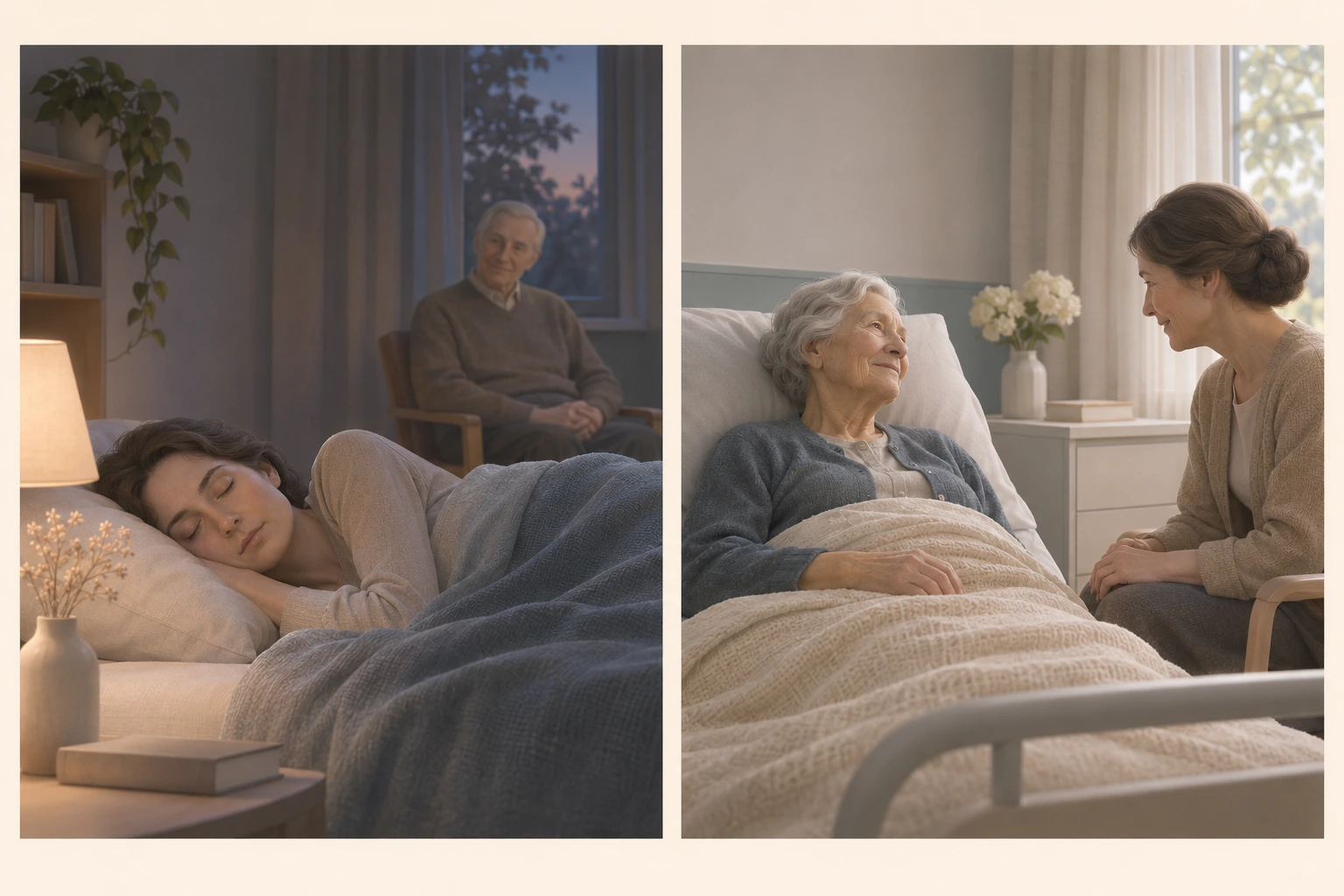
Figure 23. Who experiences the meeting. On the left is a dream after a loss, on the right is the patient's experience at the end of life. The author's composition separates the two contexts of the message and shows whose side of the experience is available for research.
News that hasn't arrived yet
Of greatest interest for verification are messages about a meeting before receiving news of death. Here an external fact appears that can potentially be compared with the earlier record. However, a distinction must be made between unknown death, unknown illness and unknown danger. If a person has long known about the serious condition of a relative, the coincidence has different conditions than in the absence of any preliminary information. Both stories can be meaningful to the person experiencing them, but their research framework is different.
The Historical Case of Doris is published by William Barrett. According to the letters, the family hid the death of Vida's sister from the dying woman. However, doctor Florence Barrett left before Vida's episode; this part is described by others present. Measures to conceal news were reported by relatives and are not controlled isolation of information. Web transcription allows for the reconstruction of differences in evidence but does not replace original manuscripts and medical records. [62]
In Haraldsson's study, another narrator associated Margret's appearance with a clock that read 03:30. His wife later confirmed that in the morning he spoke about the meeting before the news of his death. This sequence is more interesting than a single later memory, but the early written record and independent confirmation of an exact match are not presented until the minute. [63]
A strong test must hold four elements together: the content of the first message, the time it was recorded, the information available before it, and the independently identified external event. If one element is missing, the others do not disappear, but the range of acceptable output is narrowed. Confirmation of death proves death. Confirmation of the morning story establishes the existence of the story before a certain news event. The matching of parts requires its own verification. The word “confirmed” without specifying the confirmed element creates more confidence than the data allows.
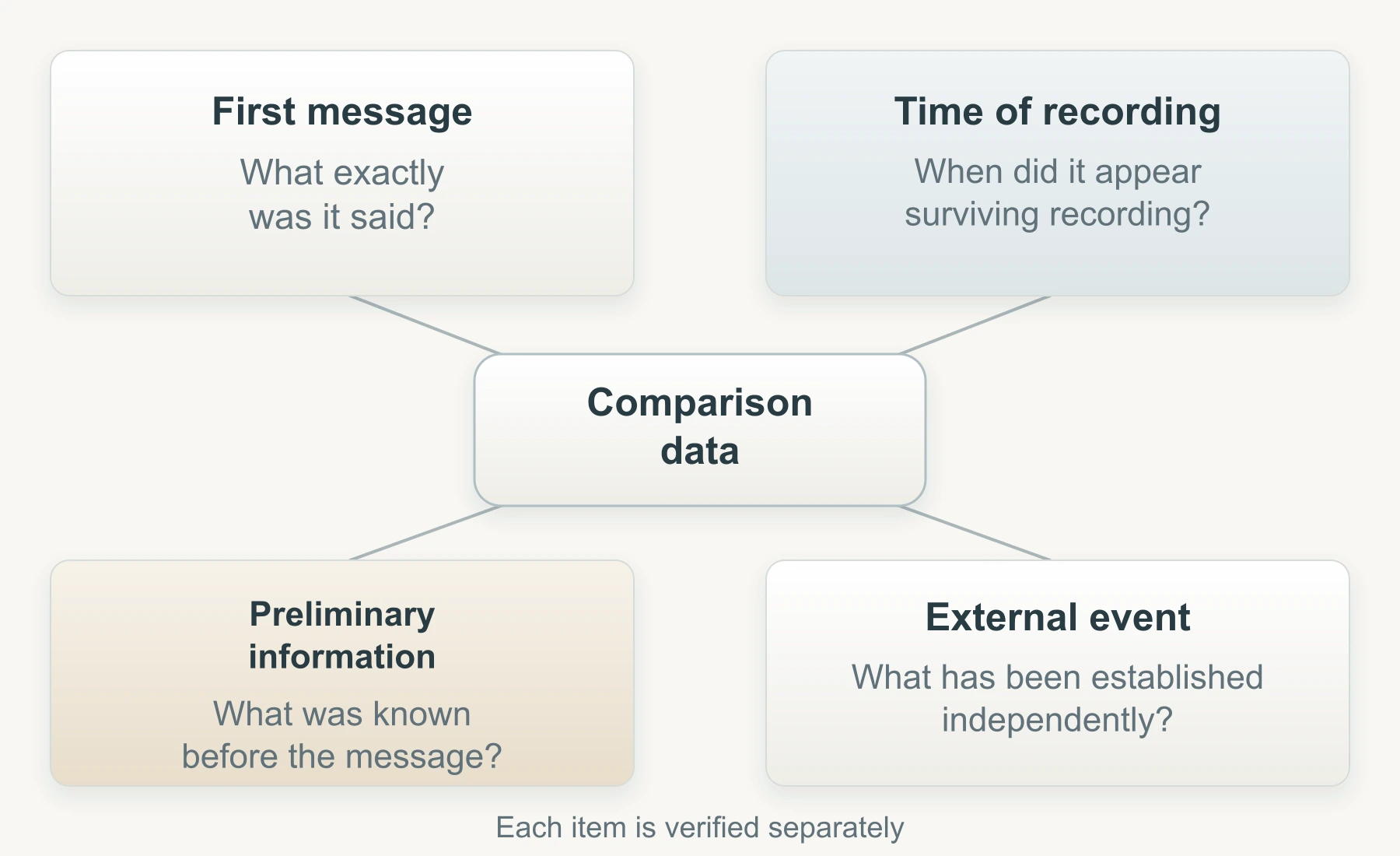
Figure 24. What exactly confirms the coincidence. The scheme combines four verification elements: first message, recording time, previously known information and an independently established event. Each element requires its own confirmation.
It is also necessary to take into account failed correspondences. Mental example: a person writes down many dreams about friends, but discusses only the one after which sad news comes. Even a very close match in such a story is evaluated differently than a single pre-formulated message. To compare observation with chance, you need to know the space of possibilities: how many dreams, people, suitable events and acceptable time intervals there were. This question is about the structure of the test, not the sincerity of the person.
Collaboration and independence
The name shared death experience may give the impression that two people were simultaneously observing the same world. In the Shared Crossing Research Initiative study 107, participants reported 164 experiences. The term included the feeling of being accompanied by one narrator to the dying person; two independently recorded witnesses were not required for each episode. The two publications in this project use the same original sample, so they cannot be stacked as independent corpora. [64]
Tressoldi et al.'s cross-cultural survey included 121 individuals who reported 146 cases. The definition included experiences before, during, and after the death of another. In the available author's preprint, when covering multiple moments with the same person, priority was given to the "before" category. Therefore, the time distribution also depends on the decision of the encoder. The study does not represent a prospective medical examination of all matches. [65]
There are at least four degrees of compatibility. One person may feel close to the dying person. Several people may talk about the same incident. Their later stories may coincide after discussion. Finally, you can obtain separate records before exchanging information. These situations cannot be placed on the same level just because the word “together” is present in all of them. For checking the general source of information, the last option is especially significant.
Haraldsson was checking reports of second witnesses. Of 39 reported joint observations, 21 received late confirmation, 6 remained unclear, 3 - without recall or participation in confirmation; 9 witnesses were unavailable. These results show the value of follow-up testing but do not establish the independence of the original descriptions. [63]
The important thing here is not to demand the impossible from old stories, but to accurately understand their capabilities. A later interview may reveal a discrepancy, confirm the existence of an earlier conversation, or clarify the situation. It usually cannot recover a lost recording until witnesses communicate. If people immediately discussed what they saw, their subsequent agreement should be analyzed in conjunction with this fact. The independence of a witness's personality and the independence of his information are different properties.
The meaning of the encounter
Cultural interpretation can change the meaning of a dream. In Hinton et al.'s study among traumatized Cambodian refugees, persistent dreams of the dead could be understood as a sign of difficulty with rebirth. This is a clinical group with experience of mass violence; its characteristics cannot be transferred to all Buddhists or all mourners. [66]
Even research categories require verification. In Black et al.'s work, coder agreement was weaker when attributing a dream to a pleasant visit from the dead than when coding more specific physical expressions of affection. This means that an outwardly clear spiritual name may hide different decisions of appraisers. The closer the category is to the intended nature of the event, the more important it is to establish on what grounds it is assigned. [67]
For a person, an encounter can retain meaning regardless of whether the origin of the image is established. The emotional outcome and the transmission of external information refer to different issues. Both can be seriously explored without requiring consolation to prove the objectivity of the dream world or for uncertainty of origin to destroy the value of the experience. This approach allows one to talk about evidence without pre-judging a person's entire experience.
For the general map, a significant result remains. Dreams, near-death visions and stories of those accompanying them provide additional forms of meetings, recognition and communication. They expand the material for comparison, but do not become a direct record of the chronology of the deceased. Their separate position should be preserved: this is information about what the living experience when meeting the image of the deceased, and sometimes statements about receiving unknown information. The test of the second statement begins where the mere description of the brightness of the meeting ends.