Why matter remained
The atoms that make up the Earth and stars contain protons, neutrons and electrons. These particles have antiparticles. In a hot environment, sufficiently energetic interactions can produce pairs, and the meeting of a particle with an antiparticle can convert their energy into other forms. The question then arises before the formation of stars: why was there so much ordinary matter left after the early hot epoch?
Explaining the appearance of particles and explaining their excess are different tasks. You can get huge amounts of matter and antimatter without changing the difference between them very much. Subsequent annihilation will destroy most of the pairs, maintaining a small initial advantage. It is this preponderance that needs to be associated with physical processes.
The problem does not require that antimatter not exist anywhere: antiparticles are being created today. We need to explain the observed cosmological baryon excess. Particles like protons and neutrons are called baryons; in early plasma the corresponding charge was distributed between quarks. Cosmological history should relate this charge to the present amount of ordinary matter without destroying successful predictions of the formation of light nuclei.
Small excess with big consequences
To compare different epochs, the excess of baryons over antibaryons is expressed relative to another quantity, which is rarefied during expansion. We can take the ratio of the numerical densities of the excess and photons. Another choice is the entropy density: the resulting ratio is called the baryon yield. It is especially convenient when the entropy in the comoving volume is conserved:
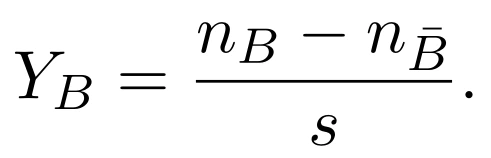
The numerator contains the numerical densities of baryons and antibaryons, and s denotes the entropy density. The Planck reference cosmology with standard late thermal history gives a baryon yield of about 8.7×10⁻¹¹; the ratio of the excess to the number of photons is about 6.1×10⁻¹⁰. This specifies the order of magnitude that the mechanism must reproduce. The transition between the two ratios depends on the thermal history; a constant number of photons cannot be transferred through any early particle transformations. [6]
Baryon excess should be distinguished from electric charge. A proton and an electron have opposite electrical charges, but an electron is not an antiproton. Therefore, an ordinary neutral atom is capable of containing a positive baryon number while remaining electrically neutral. Confusing these two accounts creates a false mystery about why excess matter does not make the entire Universe a giant charged body. Every physical interaction must be checked to ensure that the charge in question is maintained.
Creating a small advantage is only part of the task: it must survive further cooling. The number of pairs of particles and antiparticles varies, and some reactions can both create and erase asymmetry. Therefore, the calculation tracks the remaining charge. A rapid reaction that effectively produces an excess is sometimes just as effective in returning the system to equilibrium and destroying the result.
For the usual scenario, starting with a symmetric plasma, Sakharov's conditions bind three requirements. Changing the baryon number makes it possible to shift the initial balance altogether. The breaking of symmetries between particles and antiparticles makes it possible to prefer one sign of excess. Deviation from thermal equilibrium allows this preference to persist: under standard assumptions, reverse processes in equilibrium compensate for the directional accumulation of charge. Conditions specify the necessary properties of the mechanism; the amount of remaining substance is determined by the rates of specific reactions. [47]
C symmetry replaces particles with antiparticles; P changes spatial orientation, like a mirror image. For many mechanisms, their combination of CP is essential. The ability to distinguish a process from the corresponding process with antiparticles and reflected coordinates opens the way to different probabilities. However, measured CP violation in one interaction does not automatically determine all the necessary differences in another, early system.
Cosmological expansion creates a natural possibility of moving away from equilibrium. Particles have a characteristic time of interaction, and a changing Universe has a time of change in temperature and density. If reactions do not keep pace with changes in the environment, some equilibrium relationships cease to hold. For the researcher, this is a comparison of measurable or calculated speeds. It allows you to specify exactly when the desired charge can arise and which late reactions must turn off in order to maintain it.
Neutrinos as a connection between eras
One research line is adding heavy neutral leptons to known particles. They can mix weakly with ordinary neutrinos. This mixing links processes observed at low energies to possible early plasma dynamics. The minimal version considers two new states, their masses, and a single matrix of interactions with three types of ordinary leptons.
The interaction matrix is a table of coefficients relating each new state to ordinary leptonic species. The same table is involved in calculating the masses of light neutrinos, the birth and decay of a new particle in the installation, and the reactions of early plasma. Thanks to this, the laboratory can test the cosmological explanation. However, a single experiment usually measures only some combinations of coefficients, so the results of different channels have to be combined.
In oscillatory leptogenesis, asymmetry arises due to the quantum evolution of mixing neutral states and CP-violating interactions. During production in the plasma, their relative phases and the distribution of leptonic charges change. Interactions transfer the asymmetry to ordinary leptons, and electroweak processes link it to the baryon excess. This is how the mechanism proposed by Akhmedov, Rubakov and Smirnov works; For him, it is the evolution of mixing states in a hot medium that is essential. [48]
Quantum coherence means that for calculations it is sometimes not enough to know only the number of particles of each type. The relative phases of states are also important. Collisions with plasma can destroy this information, and free evolution can change the interference pattern. Therefore, the usual scheme of independent births and decays may miss a significant effect. Matrix kinetics equations allow you to take into account both the numbers of particles and the correlations stored between states, and then check how much the simplification changes the final charge.
The connection between the baryon and lepton excesses is ensured by sphaleron processes—collective transitions of electroweak fields. They change the baryon and lepton numbers, maintaining their difference. Therefore, the asymmetry that arises in ordinary leptons affects the final baryon charge. The transfer must take place while these processes are fast enough compared to cosmological evolution. When cooled they become ineffective. Their moment of switching off depends on the properties of the fields and the expansion history; a change in the scalar sector or cosmological background requires a new calculation. [49]
The laboratory picture can be quite visual. A new neutral particle is born during the decay of a meson or W-boson, flies for some distance and decays into visible products. The apex of its decay turns out to be displaced relative to the collision site. Based on geometry and energies, the mass and lifetime are reconstructed, and based on the composition of products, connections with various leptonic species are reconstructed. ATLAS searches of this type already constrain specific mass and mixing regions; the boundaries have the form of contours depending on the adopted scenario. [50]
Even after a particle is discovered, some complex interaction parameters will remain poorly determined by the available decays. The resulting asymmetry also depends on the initial population of new states and the late release of entropy. For our test, we fix a sufficiently high heating temperature, after which the expansion is controlled by radiation; the initial asymmetry and initial population of new states are equal to zero, there is no late dilution by entropy. These are the conditions of the chosen version of the mechanism: changing them after an unsuccessful result would mean testing a different version.
An independent search for double beta decay without neutrino emission is useful. Its observation would test for lepton number violation, but converting the signal into parameters requires taking into account possible exchange mechanisms and nuclear calculations. In the model with heavy neutrinos, the contributions can enhance or suppress each other. Collaborative studies show how such data, early nucleosynthesis limitations, and accelerator searches are narrowing the region in which the desired baryon yield is possible. [51]
Matter on a moving boundary
Another way connects asymmetry with an electroweak phase transition. During a first-order transition, new bubbles may appear in the old phase. Their boundaries move through the plasma, changing the properties of particles and the conditions of interactions. A spatially inhomogeneous, nonequilibrium environment arises in which the physical source of CP violation is capable of redistributing charges.
In the familiar Standard Model with the observed mass of the Higgs boson, the electroweak change of state is a smooth transition rather than the required bubble pattern. Therefore, such a mechanism requires additional physics. Lattice calculations help determine the conditions and speed of sphaleron processes in the standard case; When adding new fields, their results cannot be transferred without verification. [49]
As a specific hypothesis, one could add a single real scalar field and a separate CP-violating interaction between that field, the Higgs field, and the top quark. A scalar by itself is not enough: the source of the difference between particles and antiparticles must be stated explicitly. From one potential it is necessary to obtain the structure of the phases, the probability of bubble birth, the development of the transition, and plasma heating. Only then can the charge transfer at the moving wall be calculated.
The wall velocity is of particular interest. Slow and fast movement give particles different times to transport and react. At the same time, this speed affects the motion of the plasma and possible gravitational radiation. If you choose one speed for the formation of matter and another for a beautiful wave spectrum, you end up with a set of incompatible calculations. The model must use a single physical wall, with general uncertainty about its speed and thickness.
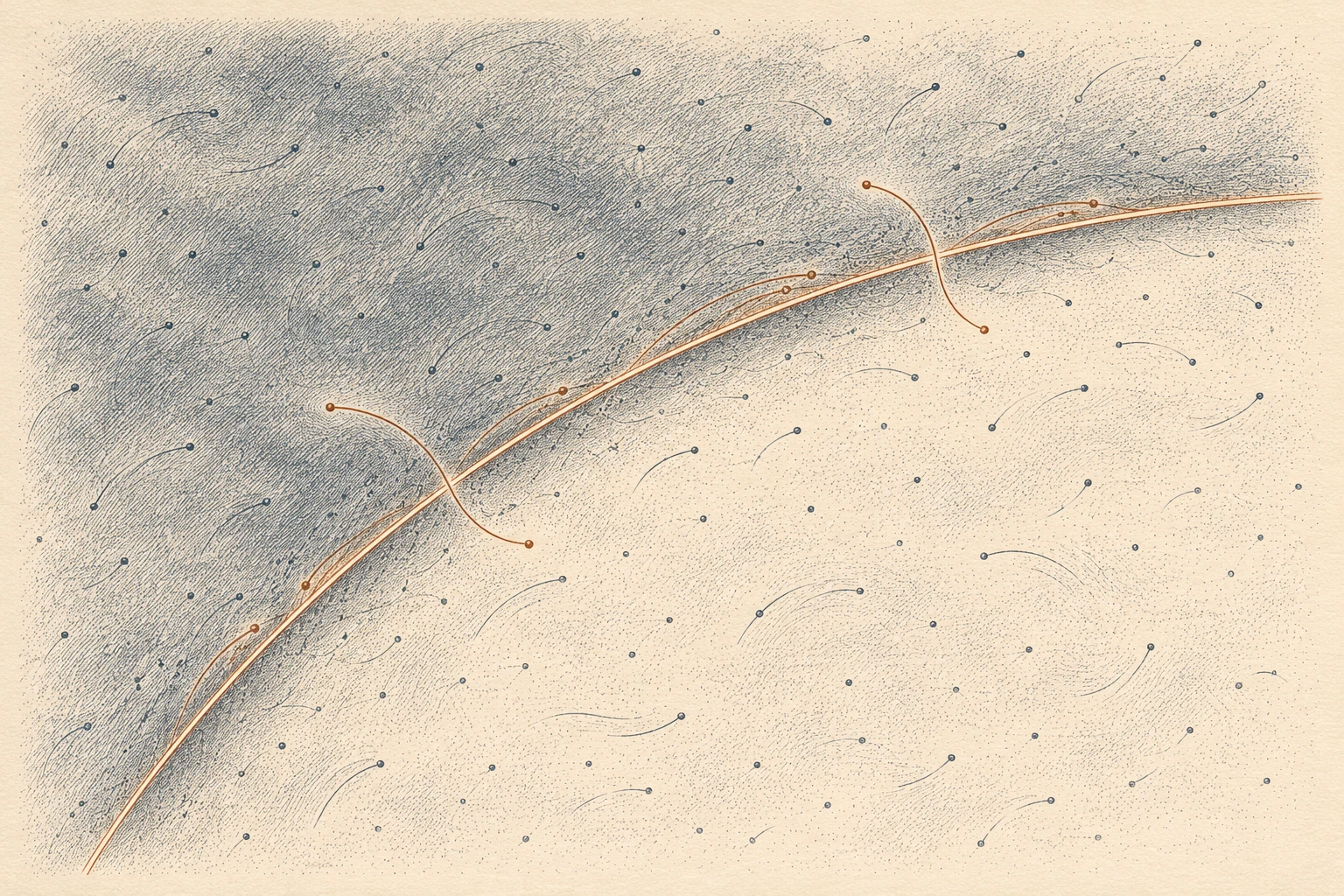
Engraving 10. A moving boundary between two phases. In the considered extension of the model, the boundary of the bubble of the new phase passes through the plasma and changes the conditions of interactions. The same wall is involved in the transfer of charges and the movement of the medium. This is an illustration of the hypothesis: the bubble transition requires additional physics, and the speed, wall thickness and amount of asymmetry are subject to general calculation.
This expansion also predicts laboratory effects. An additional scalar state can change the properties of the Higgs or appear in decays. The source of CP violation is capable of influencing electric dipole moments. In the singlet model studied by Ellis et al., there are regions with sufficient baryon yield, but with gravitational waves that are not available in their prediction. Therefore, the absence of waves does not exclude the entire mechanism of electroweak asymmetry formation. [52]
A permanent electric dipole moment along the spin would manifest itself in a certain dependence of the particle energy on the electric field. In molecular spectroscopy, the corresponding frequency shift is sought under controlled reversal of fields and other setup parameters. However, the molecular response may depend on several CP-violating interactions. The limit derived under the assumption of one contribution cannot be automatically transferred to their arbitrary combination. Comparing multiple measurements helps separate these contributions and test for a common source of asymmetry. [53]
What can you learn from a gravitational wave?
The movement of boundaries and excited plasma during a phase transition can generate a stochastic gravitational wave background. Its spectrum carries information about the characteristic size of the sources, duration and energy of the process. Unlike light from stars, such a signal could reveal the state of matter long before the appearance of atoms. But it is possible to reconstruct a single history from it only with a sufficiently definite physical model.
A simple calculation shows the problem. According to the published calibration of the sound source, the transition at a temperature of about 100 GeV and the transition at a temperature of about 1000 GeV could have the same peak frequency today - about 1.50 millihertz, if the duration of the process relative to the expansion time differs. Here, specially selected parameters are used, rather than found solutions to a specific scalar potential. The calculation illustrates the dependence of frequency on several quantities; amplitude and detectability were not determined. [54]
Even a convincing detection of such a background will require finding out which sector created it. A latent matter transition may produce a similar spectrum and not be involved in baryon production at all. To establish a connection, one must find consistent laboratory signatures and derive the correct charge from the overall dynamics. The very position of the peak in the sensitive range of the future device does not yet answer either the question of the source or the question of the possibility of detection.
The similar order of densities of ordinary and dark matter also motivates general models. In theories of asymmetric dark matter, interactions can bind the charges of two sectors, and then their history leads to different residual densities. However, the ratio of mass densities depends on masses, and on numerical asymmetries, and on subsequent reactions. The proximity of two cosmological numbers does not in itself prove a single origin. [55]
How to check it
The neutrino program tests two new states with a common interaction matrix and the initial conditions fixed above. Accelerator data constrain the masses, lifetimes, and couplings to ordinary leptons; neutrino measurements and double beta decay add other constraints. For the entire jointly feasible region, the achievable baryon excess is calculated. The version is rejected if the observed value with the correct sign is unattainable under any set of parameters, taking into account calculation errors. The failure of one chosen point is not enough for this.
The next calculation should reproduce published benchmark solutions of quantum kinetics, evaluate the influence of approximations, and enumerate phases that have not yet been measured. It needs to be associated with a specific detector model. The lifetime determines how many particles will decay inside the sensitive volume; geometry and thresholds - which products will be registered. Artificial events, together with background decays, will show how much of the cosmologically feasible region the setup will actually test. So the absence of found particles receives a certain physical meaning.
For the bubble scenario, the sequence starts with the common potential. It is necessary to verify that the transition actually completes and the created charge is not erased. Further, some parameters determine the bubble wall, charge transfer, properties of new particles, dipole moments and wave spectrum. The test must preserve common parameter values and in places where different observations would prefer different values. The laboratory search includes new scalar birth and decay channels, changes in Higgs interactions, and molecular measurements with independent controls.
Failure here can have various physical reasons: the transition does not occur, the asymmetry is too small, subsequent reactions destroy it, or the required region has already been excluded by the laboratory. The absence of waves is only critical where a consistent calculation predicts a detectable signal. If its level is lower than real noise and backgrounds, such an experiment does not yet verify this point. If the result is successful, you will need to compare the shape of the spectrum with alternative sources.
Complete new kinetic or thermal calculations for these programs have yet to be performed. Its result should be a general region of parameters that allows the desired baryon excess and all independent measurements. Then the explanation of the ancient history of the substance will be associated with laboratory conditions under which it will have to be abandoned.
Chapter 8