The world has nowhere to fit
Let's put the box on the table. There is a stone inside, there is air around, and the city continues outside the walls of the room. Each object occupies part of the space, and each has an environment. We are so accustomed to this arrangement of things that we transfer it to the whole world. If the Universe exists, it also needs to be somewhere. If it expands, space should be freed up next to it. If it had a beginning, some other countdown must have preceded it.
Thus arises the question that gives this book its title. It is difficult to resist him because in everyday life he almost never lets us down. But the word “Universe” changes the scale of the argument. We begin to ask about the conditions within which place, size and distance make sense at all. Rules that are appropriate for the box may not be sufficient for the space itself.
This is not the answer yet. You cannot simply ban the question of the external world by calling it wrong. Another thing we can do is figure out what assumptions we have already made to the question, which ones are necessary, and what observable consequences they lead to. It is this path that will allow us to move from the familiar picture of the sky to ideas that so far exist only in the form of mathematical models.
Space without an outer box
Let's imagine a researcher who can measure distances, angles and travel times of signals, but cannot look at his world from the outside. He builds triangles from the shortest paths, compares their angles, and monitors the divergence of neighboring trajectories. These measurements tell him about geometry, even if there is no external scene in his description.
On a plane, the sum of the angles of a triangle composed of shortest paths is equal to two right angles. On a sphere you can go from the North Pole to the equator, turn at a right angle, go a quarter of the equator and, turning again, return to the pole along another meridian. You will get a triangle with three right angles. The traveler discovered the curvature without ever leaving the surface. The image of a sphere in three-dimensional space helps our imagination, but the result of the measurement is written in the language of the surface itself.
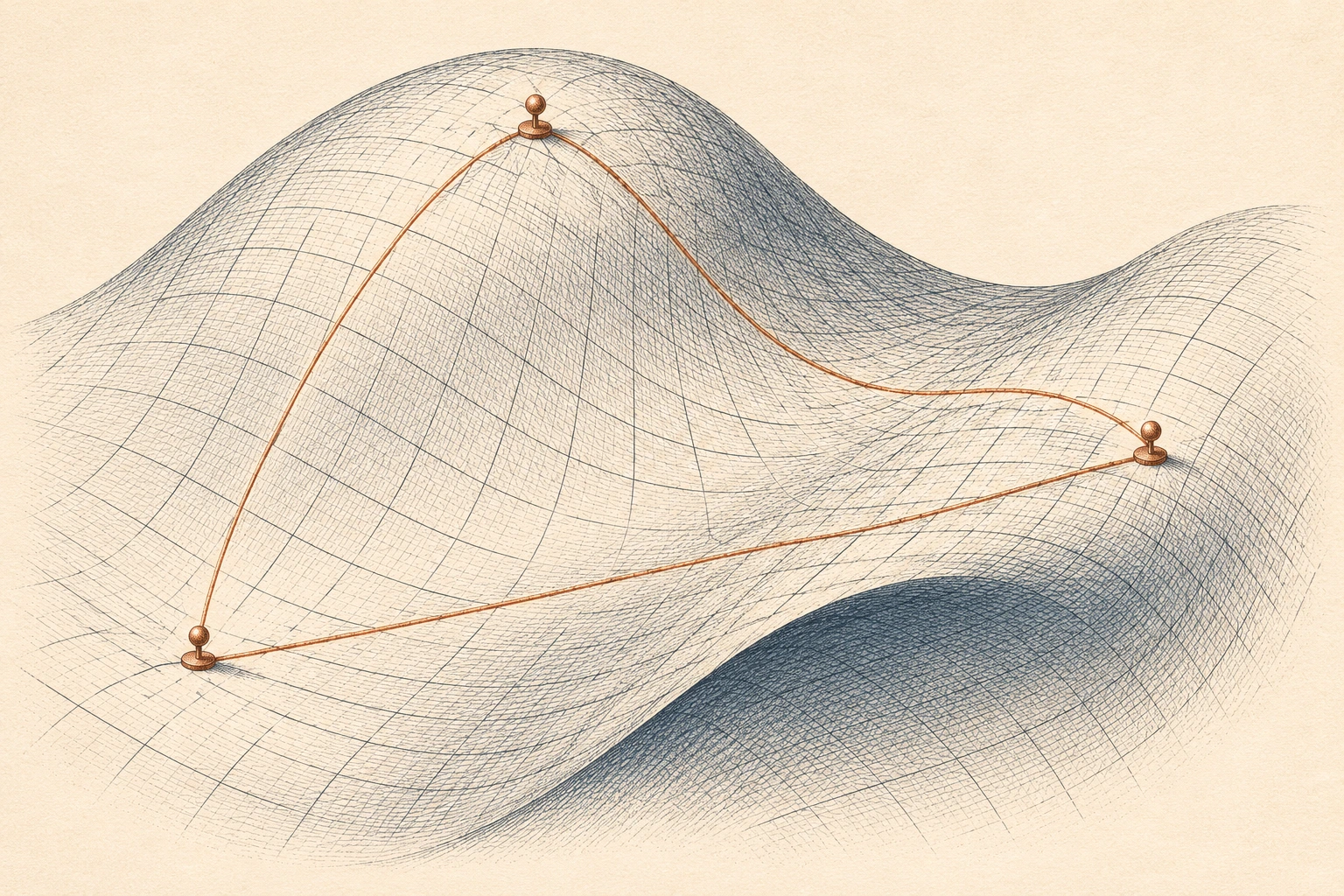
Engraving 1. Geometry can be measured from the inside. Measurements of distances and directions can be made within the space itself. The curved surface serves as a two-dimensional analogy here: the researcher learns about curvature from the routes and their relative positions. External perspective is necessary for the drawing, but is not a necessary part of the physical description; The exact metric is not given by this engraving.
This is where the useful part of the familiar balloon analogy ends. It shows how distances between points can increase without a designated center on the surface. But the rubber, the air inside and the room around the ball relate to the arrangement of the model on the table. It is impossible to transfer them to cosmology without an additional physical basis. To describe three-dimensional space, an external room is not necessary.
In the general theory of relativity, the geometry of space-time is included in the physical description. It determines how gaps are measured and what events can exchange signals. Matter and geometry are related by equations. Coordinates help indicate events, but they are not physical rods and clocks in themselves. They can be changed while maintaining the observed distances and times.
It does not follow from this that a more comprehensive structure is impossible. Theories with extra dimensions offer just such constructions. But this is an additional hypothesis that requires its own equations and tests. We do not yet have a logical requirement to place any physical world into another physical world. The endless chain of outer boxes comes from our original habit, not from a dimension.
Three meanings of the word Universe
In conversation, the word “Universe” often serves several purposes at once. Sometimes it refers to all of physical reality. Sometimes - the space-time of a specific cosmological model. Sometimes - the area from which signals managed to arrive to us. These meanings overlap, but give different answers to the question of boundaries.
The observed area is limited by the history of signal propagation. Light has a finite local speed, but cosmic geometry changes. Therefore, information has reached us only about part of the events. The boundary of such access does not have to coincide with a physical wall, the end of a substance, or a break in space. A person far enough away would have a different observable area. Our position at its center expresses the way the map is constructed around the observer.
Standard cosmological geometry distinguishes between the particle horizon, the future event horizon, and the Hubble sphere. The first is related to the accessible past. The second limits the area from which a signal emitted at a selected moment can ever reach the observer; it depends on the entire subsequent expansion history and does not exist in every model. The third is determined by the current rate of expansion. Their radii generally differ. The Hubble sphere itself is not the absolute limit of visibility. [1]
To get a sense of the scale of the difference, consider a tutorial flat model with nonrelativistic matter, radiation, and a positive cosmological constant. The matter here includes ordinary and dark components; We will talk about the second in detail in chapter 6. With the chosen parameters close to standard cosmological values, the age is about 13.8 billion years, and the current particle horizon radius is about 46.1 billion light years. This is our calculation for the declared model; formulas and parameters are given in the appendix. The radius is not equal to age times the speed of light because distances changed as light traveled.
The number 46.1 billion already contains a method of comparison: the distances are recalculated for one current slice of cosmic time. The telescope itself does not see such a slice. The further we look, the earlier the state of the source we observe. The border of the accessible past and the map of distances today are connected by calculation, and do not coincide in the finished photograph.
By extending the model beyond the observational limit, we assume that its rules apply there as well. Such extrapolation may be well motivated, but it is different in meaning from measurement. The phrase “there is a similar Universe beyond” expresses a simple continuation of the model. The phrase “we see what lies next” requires a signal that we do not have.
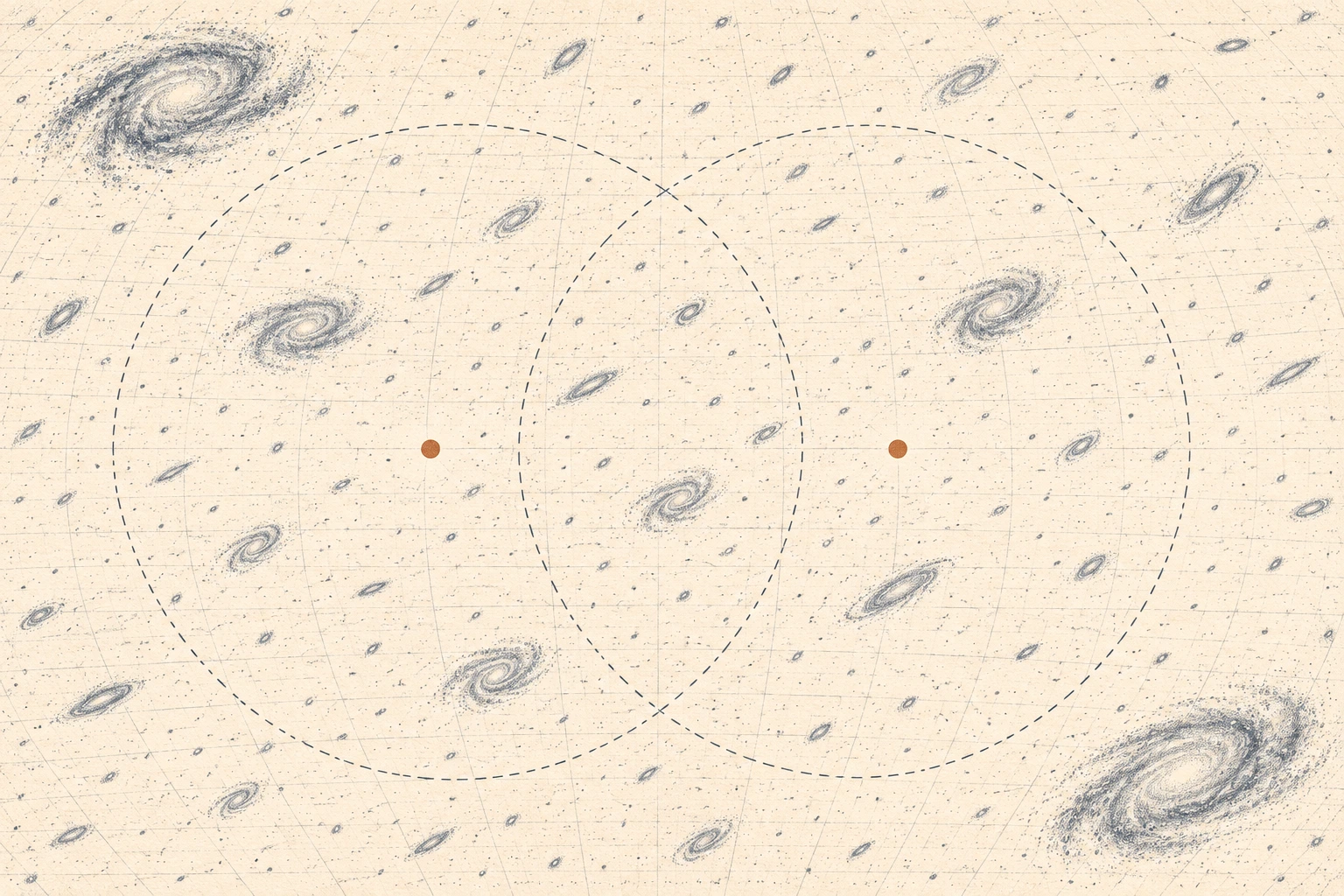
Engraving 2. The observed area depends on the observer. Two conditional observation areas are built around different observers. They partially overlap, and the depicted environment continues beyond them. The outline denotes a restriction of access to signals, rather than a wall or the end of a substance. This is a clear analogy; the dimensions of the horizons and today's distances are determined by a separate cosmological calculation.
Finiteness without a wall
The finitude of space is also not identical to the presence of an edge. You can define a geometry in which a traveler, moving long enough in a certain direction, returns to the starting point. In another space such a return is impossible. In small neighborhoods, these worlds may have the same geometric properties, but differ in the way they connect distant regions.
This connection method is studied by topology. Geometry is responsible, in particular, for distances and curvature; topology - for more general properties of connectivity. Therefore, the proximity of the observed spatial curvature to zero does not establish the infinite size of all space. There are flat compact models in which the volume is finite. The possibility of such a construction is a mathematical fact; The belonging of our Universe to this class must be decided by observations. [2]
But what if we assume a real physical border? Then you will need to describe the behavior of the substance and signals near it. Can light reach the border? What determines the state of the fields on it? Does it change the available vibrations and energy distribution? The word “edge” becomes a physical hypothesis only after such conditions appear. Drawing a wall in emptiness does not automatically define them.
One can also consider a region whose boundary simply lies outside causal accessibility. Its very remote existence then does not guarantee any measurable effect here. Verification will require additional connections - for example, the predicted impact on the overall history or on the state of the observed fields. If two models in the entire accessible region give the same probabilities of all outcomes, the name of the outer region will not allow one to experimentally choose between them. This is the limit of formulated comparison, and not a prohibition on looking for more meaningful models.
For now, it is useful to hold on to one thought. The question “where is the edge” has an answer only after we have determined what object we are discussing and what we consider to be the edge. Sometimes the answer is a measurable horizon. Sometimes - a property of the selected topology. Sometimes a question requires new physics, because the very familiar description of space approaches the limit of applicability.
From an imaginary world to a physical model
Cosmology allows for bold constructions, but the meaning of the word “allows” is limited here. We can write down a mathematically consistent geometry and still not know whether there is a process that can create it. We can obtain a solution to the equations and then find that small disturbances destroy it. We can find a stable model that predicts observed effects that have already been excluded by experiment. Each subsequent step introduces an additional requirement.
Therefore, the book will contain statements of varying strength. The spectrum recorded by the instrument refers to the data after calibration. The age obtained from a cosmological model depends on its assumptions. The possible additional dimension remains a hypothesis. A numerical example that shows the ambiguity of the derivation can be rigorous even if the parameters chosen for it do not describe real space.
We will distinguish between these cases in the argument itself. Sometimes the words “in this model” are more important than the number that follows them. Sometimes the absence of a signal narrows the parameters, but does not eliminate the entire class of explanations. Sometimes an idea doesn't yet have a calculated prediction, and the first necessary step is working with equations rather than building a more powerful telescope.
This discipline has practical meaning. If the question is posed too broadly, any observation can easily be declared compatible with the hypothesis. For example, beyond the horizon one can imagine almost any structure in the world. As long as the device does not affect the available data and is not related to the theory being tested, the observer has nothing to compare with its predictions. To advance, you need to find a specific consequence that might turn out to be false.
The possibility of verification also has several levels. The installation may lack precision. The desired epoch may be hidden by the opacity of early material. Several different mechanisms can produce the same signal. Finally, two descriptions may be physically equivalent over the entire accessible region. Solutions to these problems vary. Magnifying the telescope mirror does not help in all cases.
How to check it
Let's start with the assumption on which the simple cosmological picture rests: on sufficiently large scales, space is described by a single homogeneous and isotropic geometry. Galaxies and voids make the real Universe inhomogeneous, so we are talking about a large-scale approximation and its accuracy. This approximation itself can be checked through the consistency of different distances and expansion rates.
Physically, two types of measurements are needed. The angular sizes of statistical structures in the distribution of galaxies provide transverse scales. The redshift distribution of the same structures carries information about the radial expansion. Additional estimates of time can be obtained from differences in the ages of stellar populations, although here one must take into account their evolutionary models. No channel is free from assumptions, so it is useful to make them explicit and compare independent calibration methods.
In Friedmann-Lemaître-Robertson-Walker geometry, distances and expansion rates are related so that data from different eras should restore the same value of today's curvature parameter. The physical curvature of spatial slices may change during expansion; the parameter reduced to the general normalization is compared. This is what the Clarkson, Bassett and Lu test is based on. Its violation after error control would call into question the accepted set of geometric assumptions. The fulfillment of the condition in itself does not prove complete homogeneity. [3]
Real analysis will require galaxy selection models, precise spectroscopic calibration, control of the influence of intrinsic velocities, consistent handling of covariances, and checking whether the desired result has not already been built into the way the distances are reconstructed. You cannot first calculate all the distances for a fixed geometry and then declare their agreement to be an independent proof of the same geometry.
The next research product here is quite specific: analyzing artificial catalogs with known geometries in advance, including controlled deviations from homogeneity, and then applying the same method to the observations. This establishes which deviations the procedure is actually capable of recognizing. The agreement obtained will limit the available violations of the model; a disagreement will indicate which part of the overall chain needs to be re-examined.
The properties of space can be explored from the inside. Let's see how information about a distant event turns into instrument readings.
Chapter 2