Thermal history
If you trace the expansion backwards, the matter on average becomes denser and the radiation gets hotter. But simply moving the equations in the opposite direction is not enough to restore the past. We need preserved traces. In the case of the early hot Universe, such traces are found in the composition of matter, in the spectrum of the cosmic microwave background radiation and in the structure of its inhomogeneities.
The strength of this painting lies in the connection between different eras through verifiable physics. Nuclear reactions, atomic transitions, and the propagation of light have left various observable effects. They can be compared. Extrapolation increases as we delve deeper into the past, so it's helpful to separate a well-tested hot history early on from hypotheses about what made it possible.
Radiation remembers temperature
Thermal radiation in equilibrium has a certain spectrum. Its shape is related to temperature and the fundamental laws of statistical physics. When such radiation propagates through the expanding Universe without significant new energy release, the wavelengths increase in a consistent manner. The spectrum retains its thermal form, and the temperature decreases in inverse proportion to the scale factor.
The early hot stage therefore predicts more than a faint background glow. It connects the spectral shape, present-day temperature, and temperatures at earlier epochs. Today's cosmic microwave background temperature is measured from its spectrum; Fixsen's analysis gave a combined estimate of 2.72548 ± 0.00057 kelvin. This is a specific temperature measurement, rather than an independent measurement of the age of the Universe. [5]
Is it possible to check whether this radiation was hotter before? This does not require sending the thermometer into the past. In distant gas clouds, molecules interact with surrounding radiation. The populations of their energy levels affect the absorption lines in the light of the more distant quasar. If collisions and local radiation are taken into account, such levels can serve as a cosmic thermometer.
It is this principle that was used in observations of the excitation of carbon monoxide molecules in distant absorption systems. The results are consistent with the standard temperature increase with redshift. The method has its own astrophysical uncertainties, but it tests temperature history through different physics than today's whole-sky microwave measurements. [15]
How did the first light nuclei appear?
In early plasma, reactions were fast enough that particles could interact repeatedly during a noticeable change in conditions. As it expanded, density and temperature decreased. There came moments when a certain reaction no longer had time to maintain the previous equilibrium. Its trace was preserved in the form of the composition of matter or the distribution of particles.
Here two physical times are compared. One is the average time between the required reactions for a particle, the other is the time of noticeable expansion of the medium, on the order of 1/H. While the first is much shorter than the second, the collisions have time to adapt the composition to the changing temperature. When they become too rare, the previous balance is disrupted. The so-called freezing of a reaction does not mean that the particles stop moving or that all reactions are turned off at the same time. Each process has its own speed and leaves its own mark. [16]
In the first seconds of the hot history, the ratio of neutrons and protons was of particular importance. Weak interactions transferred some particles into others, then began to lag behind the expansion. Free neutrons continued to decay. The steady accumulation of deuterium and the main synthesis of light nuclei date back to the first minutes of the hot history. Modern calculations of this sequence use a network of reactions, measured cross sections and neutron lifetimes. [16]
Why did nuclei not appear immediately as soon as the average energy of particles became less than their binding energy? The thermal distribution has a high-energy tail. In addition, there are many more photons than baryons. Therefore, even a small fraction of sufficiently energetic photons could destroy the newly formed deuterium. Only after further cooling was the synthesis chain able to continue effectively.
Almost all the neutrons preserved by this time ended up in helium nuclei-4. A simple assessment reveals the reason for the large amount of primordial helium. If there are approximately seven protons per neutron, then two neutrons together with two protons form one helium nucleus from the original sixteen nucleons. Helium accounts for about a quarter of their mass. A more accurate result depends on the actual reaction rates and neutron decay time.
The Universe did not turn all matter into heavy elements. Expansion quickly reduced density, and the properties of light nuclei limited the paths for further synthesis. The formation of many heavy elements is associated with the subsequent evolution of stars and other astrophysical processes. Particularly valuable for cosmology are residual quantities of light nuclei that are sensitive to early conditions.
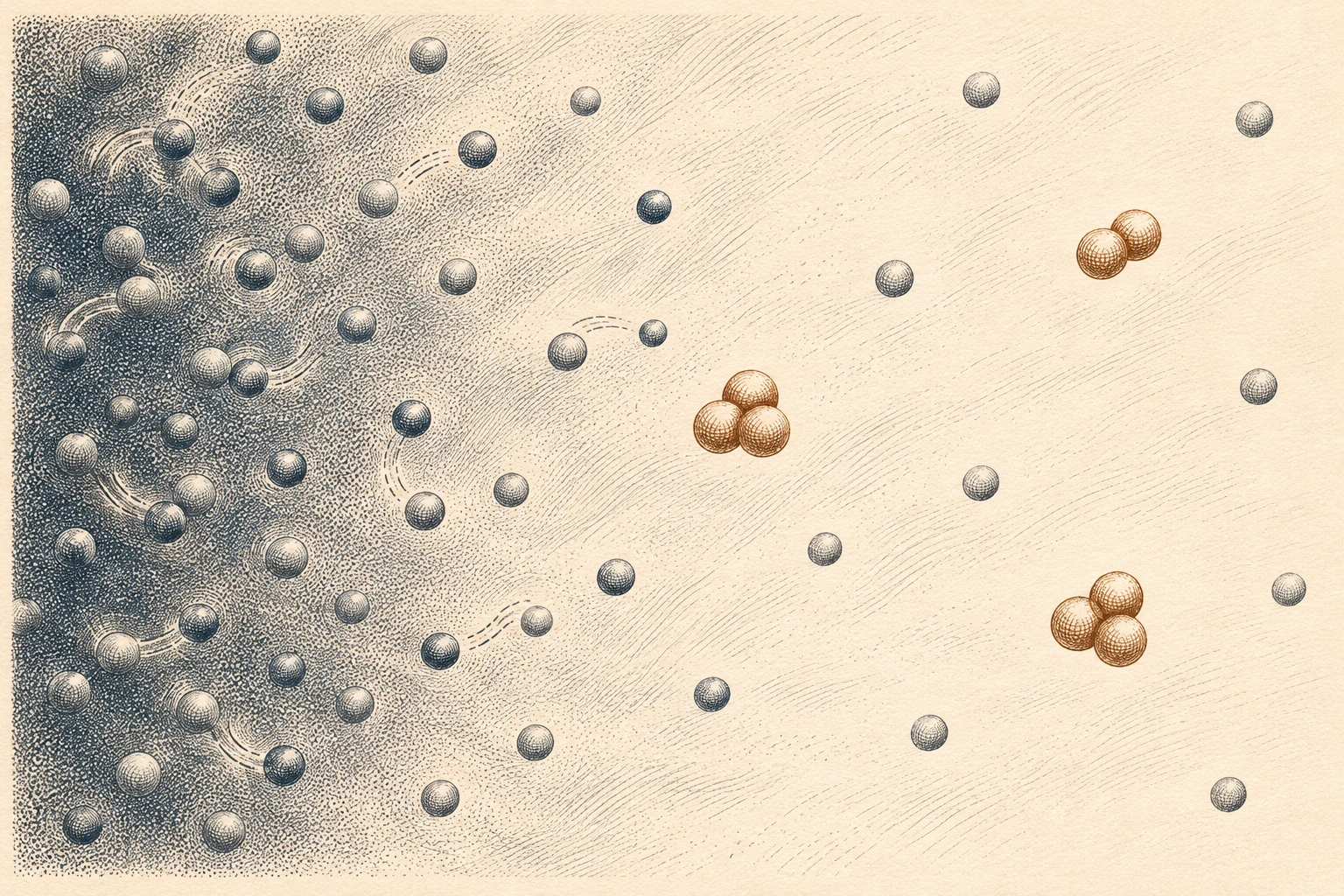
Engraving 5. When early plasma leaves light nuclei. As expansion progressed, the density, temperature, and the ratio of reaction time to the time of evolution of the medium changed. After overcoming the deuterium obstacle, the effective formation of light nuclei became possible. Only a qualitative transition from particles to small connected groups is shown here; the composition, reaction rates and yield of elements are calculated using the nuclear network.
Two ways to measure the same contents
The deuterium content depends on the density of ordinary matter in the early Universe. The more often the corresponding nuclear reactions occur, the differently its residual fraction changes. But primary deuterium has to be measured much later. The gas could have passed through stars, mixed with other matter, or ended up in a complex absorption system.
Therefore, observers look for relatively little processed gas clouds and examine several lines of the same absorber. The isotopic shift allows one to distinguish between hydrogen and deuterium. It is necessary to check whether the weak deuterium line does not imitate hydrogen from another component at a different speed. Accurate spectroscopy and a unified cloud model here determine the quality of the cosmological inference. The one percent estimate obtained by Cook, Pettini, and Steidel in 2018 provides an example of how a small, carefully studied sample can be powerfully limiting. [17]
Another physical channel for determining the density of ordinary matter is provided by cosmic microwave background radiation. Before the last scattering, photons and charged matter formed a bound medium in which vibrations propagated. The number of baryons influenced their dynamics. Therefore, the characteristic structure of temperature and polarization spectra carries information about the same physical quantity that participated in nuclear reactions much earlier. When rigorously testing nucleosynthesis itself, it is also necessary to take into account whether the fraction of helium predicted by it was previously used in the analysis of the cosmic microwave background radiation. Independent verification is carried out by allowing this proportion to vary and maintaining the overall uncertainties. [6]
Comparing the two eras requires a coordinated transition from the densities then to today's parameters. If there had been a significant addition of energy between them, a change in composition, or an unusual violation of the accepted law of evolution, this could spoil the agreement. This test connects nuclear physics with cosmological geometry and makes it possible to search for new components that are almost inaccessible to direct observation.
Imagine an additional light particle that barely interacts with ordinary matter. If many such particles existed in the early Universe and moved relativistically, their energy would help determine the expansion rate. Nuclear reactions would have a different amount of time to proceed at each temperature. Other conditions held fixed, faster expansion could, for example, change when effective neutron-proton interconversion ceases and alter the subsequent helium yield.
Thus, a particle can leave a trace without even hitting our detector. But the size of the trace depends on its early population. The mere existence of a particle species does not tell us how much energy it carried. For a cosmological constraint, it is necessary to specify the birth mechanism, the temperature of the corresponding sector, and possible decays. This explains why the laboratory constraint on the interaction and the cosmological constraint on density are different parts of the same test.
Comparison with the CMB adds a temporal distinction. The component could exist during nucleosynthesis and decay before the last scattering or transition to another mode of motion. For this version to become an explanation, it is necessary to calculate both eras with the same particle history. The freedom to choose independent densities for them would destroy the predictive relationship.
Where the established history ends
There remain real difficulties in this picture. A known problem with lithium is the discrepancy between the standard prediction and the lithium abundance inferred from observations of some old, heavy element-poor stars. Interpretation requires taking into account changes in stellar composition, material transfer, and uncertainties in spectral analysis. The possibility of a new physics is discussed, but the mere fact of disagreement does not automatically select it. [16]
The accuracy of deuterium predictions also depends on nuclear data. Improvement in one response does not guarantee the disappearance of other uncertainties. As an astronomical measurement becomes more precise, a previously subtle error in the speed of another reaction can begin to determine the outcome. The early space verification program therefore involves conventional laboratory nuclear physics in which the experimenter controls the particle beam and target composition.
The earlier the era under consideration, the more important the limits of applicability of the theory. The accelerator can confirm the interaction properties at high energy. But the cosmological use of this result additionally assumes a certain density, composition of the medium and expansion history. A specific process is reproduced in the laboratory. The entire cosmological situation is restored through the model and the preserved observational traces.
If we continue the classical solution far back, we can arrive at a regime of extremely high density and curvature. This indicates a limit where it is necessary to check the applicability of the equations used. The very existence of such a limit is not an observation of the absolute birth of time. The earlier stage, quantum transition or other description remains a subject of independent research.
The term “Big Bang” is therefore convenient to use with clarification. The hot history implies expansion and cooling of the early plasma, supported by several observational tests. The assumption of an absolute beginning is a stronger statement. Data on light elements retain their value under different hypotheses about how the hot stage arose, if these hypotheses reproduce the necessary conditions at the time of nucleosynthesis.
First second trace
The hot history must have one more witness - the cosmic neutrino background. Neutrinos are also born in the Sun, supernovae and terrestrial installations, but here we are talking about particles that inhabited the early hot environment. Their cosmological meaning is determined precisely by the origin and subsequent evolution of distribution. The detection of any neutrino is not the detection of this background, just as the registration of an ordinary radio photon does not mean the measurement of cosmic microwave background radiation.
In early plasma, weak interactions supported the exchange of energy between neutrinos and other particles. As it cooled, this exchange could no longer keep up with the expansion. The characteristic epoch refers to the first seconds of the standard hot history, at temperatures on the order of megaelectronvolts. This is not an instantaneous shutdown of one reaction, nor is it a measurement of the absolute age of space. The background stores information about release conditions and subsequent influences that may have changed particle numbers, momentum, or motion.
The simplest estimate of temperature comes from the conservation of entropy. After an idealized instantaneous decoupling, the annihilation of electrons and positrons predominantly heats the photons relative to the already separated neutrinos. In a photonic-electronic medium, the effective number of degrees of freedom involved in entropy changes from 11/2 to 2. Temperature scales as the inverse cube root of this number, in addition to cosmological cooling. We get the well-known relation:
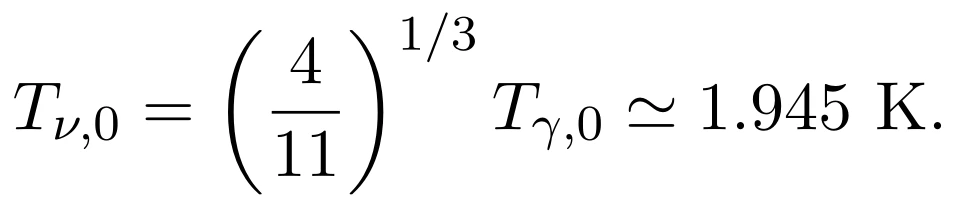
For the numerical example, Tγ,0 = 2.72548 kelvins from the above measurement are used; the calculated coefficient is approximately 0.71377. This is an idealized estimate and not a direct measurement of modern neutrino temperature. For massive particles that have become nonrelativistic, the value Tν,0 denotes the scale of the retained momentum distribution. Without additional recalculation, it cannot be understood as the usual kinetic temperature of a gas, determined by the average energy of motion.
Accurate calculation of decoupling requires kinetic equations, taking into account collisions, oscillations between flavors and plasma properties. Photons and neutrinos do not separate completely instantly, so the simple temperature law has corrections. In the calculation of Froustey, Pitru and Volpe 2020, the effective number of relativistic neutrino degrees of freedom Neff = 3.0440 was obtained. The difference from three describes a correction to the energy density, not the discovery of a fractional number of particles. [18]
The parameter Neff is generally convenient as a single measure of the energy of the relativistic sector relative to photons. Different sets of particles and temperatures can give the same value. Therefore, measuring only this quantity will not determine the interaction of neutrinos. To learn more, we need to use not only the average density, but also the behavior of the perturbations: how matter transferred energy between regions and changed the surrounding gravitational field.
Freely propagating relativistic neutrinos move differently than bound photon-baryon plasma. Their disturbances change gravitational potentials, which affect the acoustic vibrations of this plasma. A characteristic phase shift of oscillations occurs. This is different from simply changing the angular size of the entire painting due to geometry. Bashinsky and Seljak derived the corresponding physical mechanism and showed its diagnostic value under given adiabatic initial conditions. [19]
In 2015, Fallin, Knox, Millea and Pan reported the discovery of the expected phase signature in the temperature spectrum of the CMB. This is an example of indirect evidence of the behavior of cosmic neutrinos: the detector measures photons, and the neutrino is inferred through gravitational influence. This result should be distinguished from both the measurement of neutrino mass and the direct capture of a relic neutrino in the laboratory. [20]
For the next study, two specific stories can be compared. In the first, neutrinos propagate freely after standard weak decoupling. In the second, the additional elastic interaction between them maintains collisions longer, maintaining a similar average energy density. Such options have been studied for a long time. For example, Cyr-Racine and Sigurdson considered the effective neutrino self-interaction strength Geff and its reflection in cosmological perturbations. [21]
In the regime of contact interaction with a heavy mediator for relativistic neutrinos, the characteristic collision rate has a temperature dependence Γν ∝ Geff2Tν5 in units where c, ħ and kB are equal to unity. The coefficient and angular response depend on the adopted microscopic model. To calculate it, it is not enough to arbitrarily move the decoupling time: you need to set the collision term, check the applicability mode of the approximation, and trace the hierarchy of angular disturbances of the distribution. [21]
This formulation does not assume that strong self-interaction is now required by the data. In work published in 2025 by Camarena and Cyr-Racine, a joint consideration of selected CMB data and galaxy distributions significantly constrained a simple version of such a cosmology. The result refers to the studied model and datasets. It shows why the new version should be tested by several observables at once, rather than presenting a successful fit to a separate spectrum. [22]
It is especially useful to select stories in advance with a similar average energy of the relativistic sector. The difference in phase and polarization then tests the nature of the motion, not just the addition of new energy. At the same time, changes in standard cosmological parameters and the helium fraction should be allowed. Otherwise, a rigidly fixed auxiliary value can artificially increase the visibility of the difference. The final task is to find collision parameters that remain distinguishable after such joint comparison.
Direct examination of the background requires a different instrument. One of the ways being studied is the capture of neutrinos by tritium with the formation of helium-3 and an electron:

Capture is capable of producing an electron with an energy above the end of the normal beta spectrum. For almost identical nonrelativistic masses, the characteristic distance between the signal and the beta end is approximately 2mνc2. For different masses, it is necessary to calculate several contributions with mixing weights. The frequency of events also depends on the local density, helicity and nature of the neutrino; these dependencies are analyzed in detail by Long, Lunardini and Sabancilar. [23]
The PTOLEMY research program is considering the development of a setup for such capture. Published estimates relate its capabilities to target mass, energy resolution, and background. Between a physically resolved reaction and a reliable cosmological measurement lies a test of the actual response: how tritium binds to the material, what broadens the electron line, how electrons lose energy, and how stable its scale is determined. Project estimates do not constitute a report of the detection of relic neutrinos. [24]
The PTOLEMY white paper used shows the construction of a prototype magnetic system and electromagnetic filter. The immediate engineering goal is to verify the selection and measurement of electrons with the desired properties. This phase should be taken into account separately in the study plan and not replaced by a design assessment of the feasibility of the full installation. [25]
Even a successful capture will not provide an unconditional photograph of the first second. A modern gravitational accumulation of neutrinos can change the density near the Earth, and the properties of the masses can transform this density into the capture rate. Therefore, the laboratory and cosmological channels are valuable together: the first tests particles directly, the second limits early energy and propagation. Their disagreement will become interesting only after calculating the entire chain connecting both measurements.
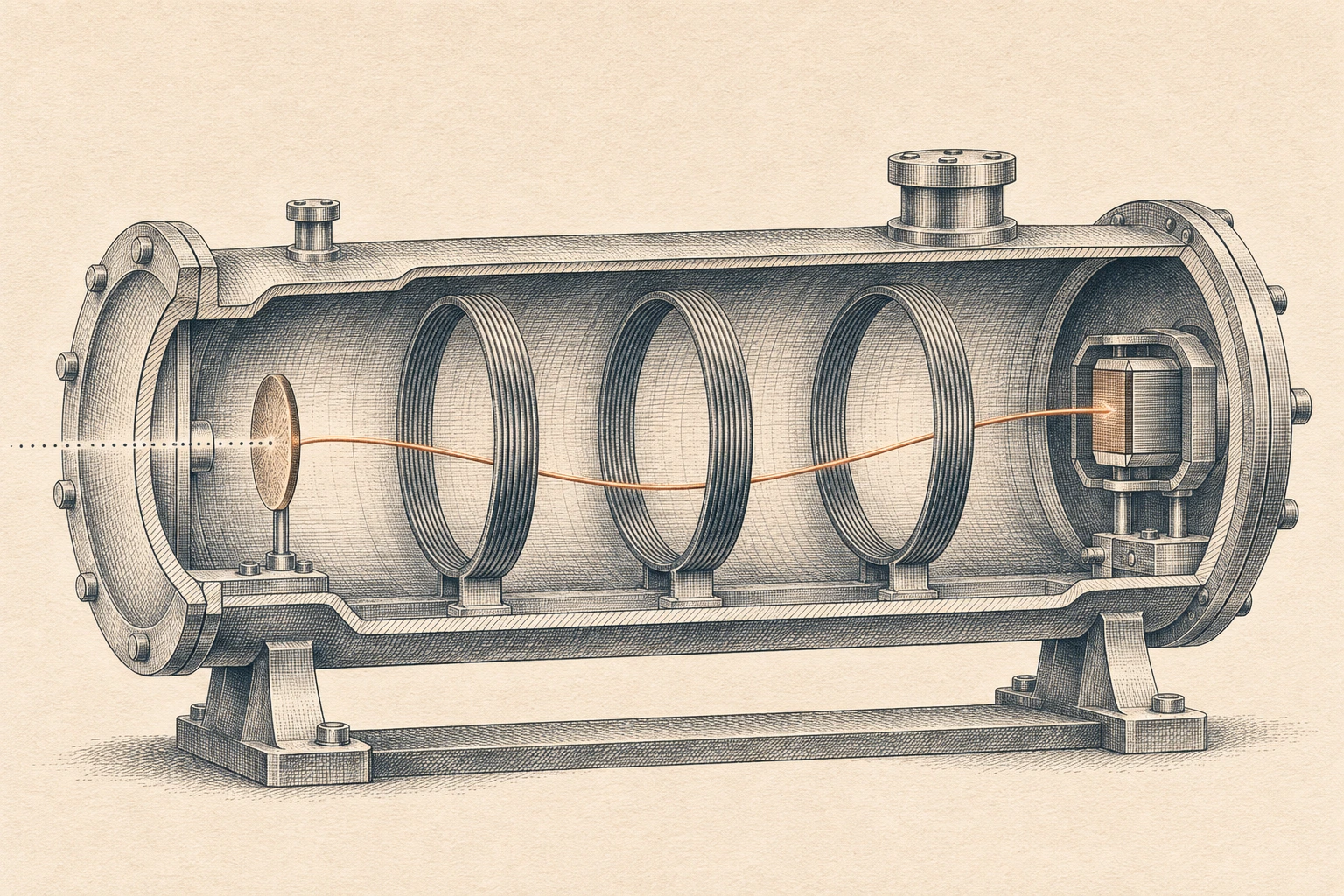
Engraving 6. From a neutrino target to an electronic signal. In the direct search method being studied, a neutrino is captured by tritium, and the energy of the resulting electron is measured. The conventional arrangement connects the target, electron transfer and detector. It does not reproduce the design of a specific project: the ability to isolate the relic-neutrino signal is determined by the energy resolution, background, target properties and calibration stability.
How to check it
The first path goes through the laboratory. In the reaction of proton capture by deuterium, helium-3 is formed and a gamma quantum is emitted. By measuring the probability of a reaction at the desired energies, it is possible to reduce the uncertainty in the calculation of primordial deuterium. The LUNA experiment used a proton beam, a gas target, and gamma ray recording in an underground laboratory where the cosmic background is significantly attenuated. This is a concrete example of how a measurement on Earth refines the conclusion about the first minutes of cosmic history. [26]
Further challenges include concerted improvement of the entire critical reaction network, control of target properties, detector efficiency and energy scale. The updated network must then be compared with independent observations of deuterium and helium, without fitting each reaction to the desired cosmological density. It is especially useful to publish error correlations: a few well-measured quantities may retain a common systematic uncertainty.
The second way examines the deviations of the spectrum of the cosmic microwave background radiation from the thermal form. Additional energy release in the early environment can leave a spectral trace if the processes of restoring equilibrium are no longer effective enough to completely erase it. Based on the shape and magnitude of the distortion, the time and mechanism of energy release can be limited. However, one spectral component can have several sources, including ordinary astrophysical processes.
Physically, you need an absolute spectrometer with an accurate internal reference source, wide frequency coverage and control of the device’s own radiation. Multi-frequency observations allow separation of galactic dust and other foregrounds. The PIXIE instrumental concept shows how spectroscopy and polarimetry can be combined in such a task; published design capabilities should be distinguished from already obtained operational mission sensitivities. [27]
A specific research work begins with the choice of a process: for example, the decay of a particle with a given lifetime and energy fraction. Next, changes in the composition of the plasma, primary elements and radiation spectrum are calculated. The model must pass these tests with the same parameters. A signal in one channel with a prohibited effect in another does not provide a consistent explanation.
A positive result will require checking the spectral shape, frequency calibration and alternative sources. The absence of distortion will limit the energy release only in those epochs and channels to which the experiment is sensitive. A very early process could have been thermalized; too weak will remain beyond the threshold of the device. It is the calculation of these boundaries that turns the promise of “seeing the beginning” into a definite task.
The neutrino part of the program begins by reproducing the standard calculation and one published collision model. Then, on a common grid of parameters, the temperature, polarization and cross spectra of the CMB are calculated, maintaining the connection with nucleosynthesis. If a hypothesis with a fixed non-zero interaction requires a phase and polarization pattern that does not fit into the data after changing the allowed parameters, this version is rejected. A null result limits the range of interaction; it does not prohibit any hidden neutrino interaction.
For direct capture, the first result must be a measured distribution of the response to electrons of known energy, together with background and scale stability. It is convolved with the predicted lines and beta spectrum for specific masses and local densities. This is how verifiable requirements for the next device are obtained. Without sufficient resolution, the absence of a separate line does not refute the cosmic neutrino background. Both branches of work can produce a meaningful result before detection: an acceptable history of free streaming and a reasonable bound on the achievability of direct registration.
The hot history links nuclear reactions, radiation and the movement of weakly interacting particles. After the formation of neutral atoms, another possible source of information appears - cosmic hydrogen itself before the birth of the first stars. His radio signal is able to continue this story to the era when the future structure of the world begins to take shape from early heterogeneities.
Chapter 5