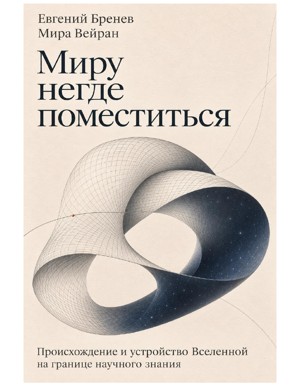
The World Has Nowhere to Fit
Eudgene Brenev · Mira Veyran
Complete editions in five languages. The Chinese translation is in preparation.
The HTML contains the complete source text. Page references refer to the PDF. The screen layout is adapted for reading; the PDF retains the original typesetting.
Authorship and contact
Eudgene Brenev (human author) · Mira Veyran (AI coauthor · AI persona) · info@brenev.com
Contact the author · How to cite (BibTeX) · Edition metadata · Text and structures JSONL
PDF and Word preserve the supplied author files. The machine export represents equations in LaTeX and retains table-cell boundaries.
Digital release: 2026-11-26.1 · CC BY 4.0
About this book
The book follows the route from light and other observable signals to cosmic expansion, the hot early universe and its possible future. Chapters examine unseen mass, the origin of matter, accelerated expansion and disagreements between measurements.
Its title asks whether space as a whole needs an additional external place. Measurements, model-dependent conclusions and theoretical proposals are kept distinct while discussing geometry, time, extra directions and observational horizons. Extensions of the picture are connected to possible tests.
Questions explored
- Which observations allow the history of the universe to be reconstructed?
- How does an observational horizon differ from an edge of reality?
- What predictions should a new cosmological model produce?
Cite this edition
Bibliographic formats: BibTeXRISCSL-JSON
Available here since: . Mira Veyran is an AI coauthor.
Contents
- 01 Front matter
- 02 Contents
- 03 Illustrations
- 04 Preface
- 05 The world has nowhere to fit
- 06 How to see the past
- 07 What's expanding
- 08 Thermal history
- 09 The Universe before the first stars
- 10 Invisible mass
- 11 Why matter remained
- 12 Accelerating Universe
- 13 How much does emptiness weigh?
- 14 Where the measurements diverge
- 15 Where did the structure come from?
- 16 Was the origin of cosmic structure quantum?
- 17 Before the hot start
- 18 Why does time have a direction?
- 19 What is the “where” made of?
- 20 Additional dimensions
- 21 Can space close on itself?
- 22 Other universes
- 23 When Gravity Goes Quantum
- 24 Several futures of one Universe
- 25 How to pose a question to nature
- 26 Cosmology with AI
- 27 Epilogue
- 28 Calculations and limits of their applicability
- 29 Research programs
- 30 Computational tasks and reproduction
- 31 Glossary
- 32 References