Invisible mass
Through a telescope, the galaxy looks like a cluster of luminous objects. If you take the photo deeper, fainter stars and clouds will appear. A natural expectation arises: it is enough to collect all the light, add a mass of invisible gas, and we will find out how much matter is in front of us. But the movement of the galaxy tells a different story. The mass needed to explain the observed velocities is often noticeably greater than the mass of ordinary matter found.
This discrepancy relates to a specific connection between observations and the law of gravity. We measure the spectra, positions and distortions of the images, then reconstruct the mass distribution. Therefore, from the very beginning, the problem has two solutions: an additional source of gravity and a change in its description. One has to choose between them based on the totality of phenomena. The explanation for one rotation curve still has to stand the test of light, hot gas, and the history of the structure's formation.
Dark matter is a component whose presence is judged primarily by its gravitational effect. The name does not identify the particle, mass, or mechanism of creation. It denotes a place in the physical description that is already limited by observations, but has not yet been filled by established microphysics. The gravitationally bound extended structure of such a substance is called a halo. In the standard picture, the visible galaxy occupies only part of this structure.
Mass by motion and light
Let's imagine a star in an almost circular orbit around a spherically symmetric distribution of matter. In the Newtonian approximation, its speed is related to the mass inside the orbit by a simple relation:
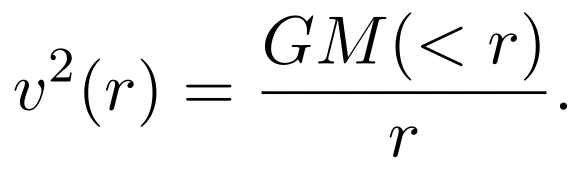
Here r is the distance to the center, G is the gravitational constant. When almost all the mass has already remained inside the orbit, the speed should decrease with distance. If the speed remains approximately constant, the required enclosed mass continues to increase. A real disk galaxy is not spherical, so an accurate reconstruction requires a different geometry, corrections for gas motion and the contribution of the stellar disk. A simple formula only explains why distant orbits are sensitive to the invisible distribution of matter.
Even the speed of a star is not included in the calculation as a ready-made number. The spectrum shows the component of motion along the line of sight. To obtain the rotation speed, you need to know the inclination of the disk. For a galaxy visible almost from the face, a high velocity in the plane of the disk may produce a small spectral shift; the tilt error will significantly change the reconstructed mass. Therefore, a good check uses a spatial motion map and independent geometry constraints. This way we can distinguish the halo property from the error that our position relative to the object created.
Distortions of distant images provide another route. Light travels through curved spacetime, and nearer mass acts as a gravitational lens. Its distribution can be estimated even when it emits very little light. Comparing such maps with X-ray emission is particularly revealing in colliding clusters. In the Bullet Cluster, hot gas containing most of the visible ordinary matter is spatially separated from the mass peaks reconstructed by lensing. This is strong evidence for an additional gravitating component. The image itself, however, does not identify the particle making up that component. [37]
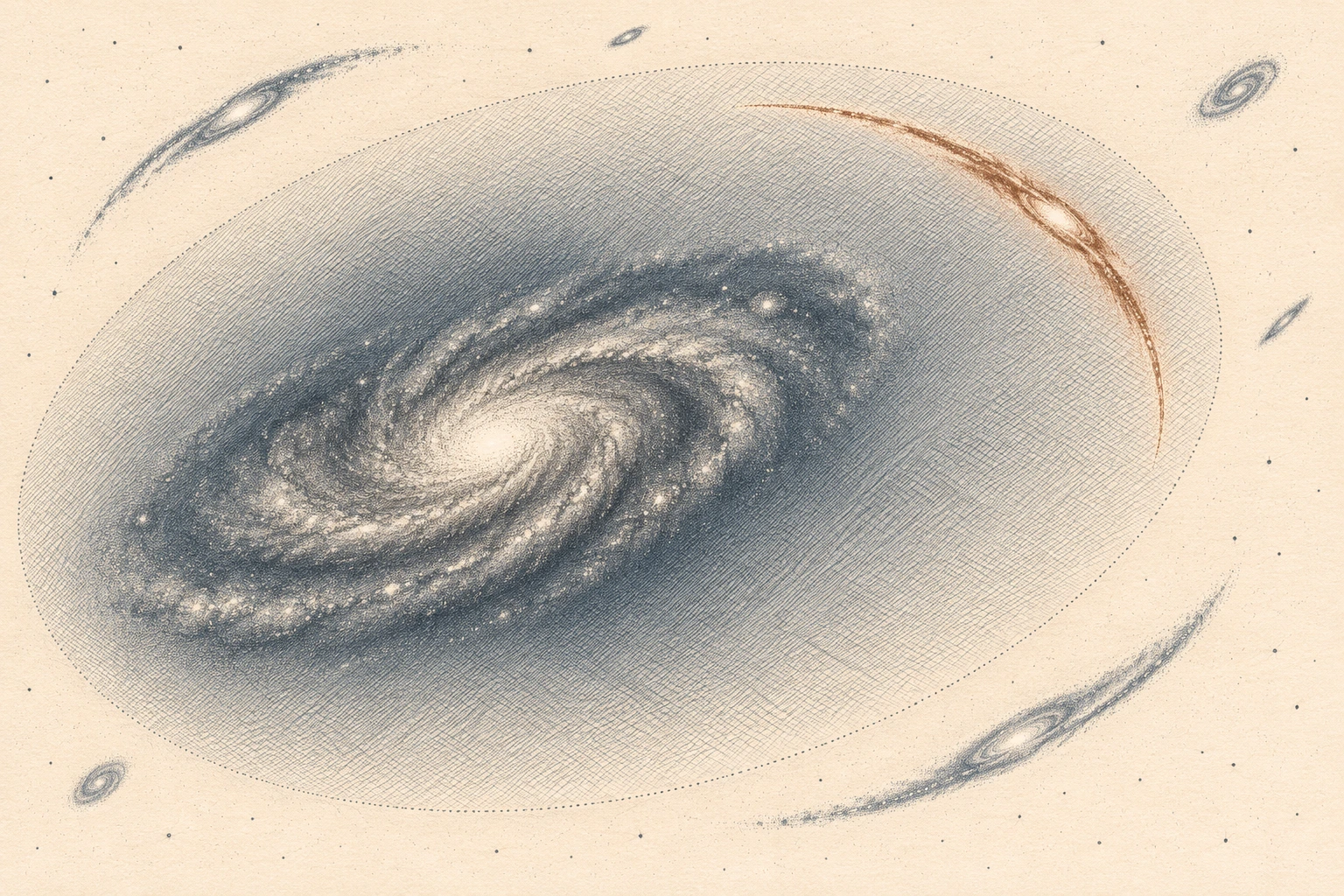
Engraving 9. Light reveals an invisible distribution of mass. Gravitational lensing changes images of distant sources and allows us to reconstruct the distribution of mass in front of them. The halo is shown in the engraving with conventional shading to make the subject of the calculation visible: such a glow is not directly observed. This method relates mass to the geometry of light, but does not itself establish a dark matter particle.
There is also an early cosmological argument. Before the formation of neutral atoms, ordinary matter participated in acoustic vibrations along with radiation. A component that interacts weakly with light had a different effect on gravitational inhomogeneities. The ratio of peak heights in the CMB spectrum therefore helps distinguish between the densities of ordinary matter and cold dark matter. In the basic flat ΛCDM model, Planck analysis gives a ratio of these densities of about five. Here, the weight of the invisible component is determined by its influence on early oscillations, taking into account other parameters of the model. [6]
It is the diversity of evidence that gives stability to the task. An attempt to replace dark matter with a modified law of gravity should predict motion, lensing, and early acoustic vibrations. The model with new particles assumes the same obligations. Comparisons become meaningful when both sides calculate the same observables and honestly account for errors.
The word “cold” in the name of the standard component characterizes its movement during the stages of structure formation. It means that the random velocities are small enough and do not erase inhomogeneities on the scales of interest. This name has nothing to do with the temperature of the surface of a dark cloud. Different particles may behave similarly in large structures, but differences will only appear on smaller scales or in laboratory interactions.
How to Hear a Rare Collision
One experimental approach is to wait for a putative dark matter particle to collide with ordinary matter. The detector is hidden from cosmic rays, surrounded by protection, and the radioactive background is carefully measured. If a galactic stream of new particles passes through the facility, it can sometimes transfer energy to a nucleus or electron. We need properties of the signal that allow us to distinguish it from already known processes.
In the LZ biphasic xenon detector, the interaction creates a flash of light and releases electrons. The electric field transports electrons to the liquid-gas interface, where an additional light signal appears. The combination of the two signals helps to reconstruct the energy and position of the event and distinguish between types of interactions. For the selected standard spin-independent scattering of weakly interacting massive particles, or WIMP, scenario, the 4.2 ton-year analysis published in 2025 found no excess above background. With a particle mass of 40 GeV/c2, the upper limit of the cross section was 2.2 × 10−48 cm2 at a confidence level of 90 percent. This is a conditional limit for this interaction and the galactic flow model. [38]
The cross section relates the flow of particles to the expected frequency of their collisions in the target. A zero result cuts off those combinations of mass, cross-section and density that should have produced a detectable excess of events. For a particle of a different mass, interacting primarily with electrons, or another type of communication, the calculation of the signal changes. It also changes when the desired particles make up only a small fraction of dark matter. Therefore, the boundary in such a graph tests a specific mode of interaction, rather than exhausting all candidates.
Axion searches have a different logic. In a magnetic field, the putative axion can be converted into an electromagnetic excitation; The resonator amplifies the response in a certain frequency band. Such a setup is sensitive both to the particle’s coupling with photons and to its local density. A laboratory experiment involving passage through an opaque wall tests the production and subsequent conversion of a new particle back into light without requiring its presence in the galactic halo. Therefore, the discovery of a light particle in the laboratory in itself would not determine its cosmological fraction. [39] [40]
The lower the background becomes, the more noticeable are processes that could previously be ignored. A separate LZ analysis found evidence of coherent scattering of solar neutrinos. The significance of the 4.5 standard deviation given there applies precisely to neutrinos under the accepted hypothesis of the absence of a dark matter signal. It is not the significance of the discovery of a new substance. The spectral similarity of neutrino events to some putative signals adds complexity, but leaves room for other nuclear targets, energy ranges, and additional event characteristics. [41]
The theory also needs to explain the number of new particles. In the early hot environment they could be born and destroyed in reactions. As the reaction cooled, the rate of reactions became insufficient to maintain the previous equilibrium, and a residue remained. Mechanisms are also possible in which equilibrium was not established at all, or the field arose as a general initial state. These options relate modern density to different parameters. Therefore, even the accurately measured mass of a new particle does not yet allow us to calculate its share in the Universe without knowledge of interactions and early history.
What changes do collisions inside dark matter make?
Scattering by an ordinary nucleus and the collision of two dark matter particles are different interactions. A weak connection with the detector does not exclude noticeable communication between particles. This allows us to consider dark halos as systems with their own internal evolution, which can be studied by mass distribution.
In self-interacting dark matter, collisions transfer energy between particles. If heat flows from the outer regions to the center, the central region expands and becomes less dense. At a later stage the flow may reverse. Losing energy, the self-gravitating center contracts; At the same time, the characteristic velocities of particles increase, and the heat outflow can increase. This sequence allows one law of interaction to create both sparse and very dense centers: different halos can be at different stages of evolution. This relationship has already been studied for small galaxies and dense objects detected by lensing. [42]
The dependence of interaction on speed is important. Small galaxies and large clusters have different characteristic velocities, and one constant number may not be a good description. In the illustrative calculation of this book, a law is chosen in which the transport cross section per unit mass decreases from approximately 8.9 to 0.0073 cm2/g when the relative speed changes from 30 to 1000 km/s. These parameters are chosen to demonstrate the effect and are not declared as permitted observations. Moreover, the transport section with a certain angular weight still needs to be correctly related to the heat transfer in the real velocity distribution.
There is a verifiable risk to such an idea. Some parameters must be suitable for the entire population under consideration. An analysis of the SPARC catalog galaxies, updated in 2026, shows how difficult it is to fulfill this condition: in the family considered, the authors did not find a single cross-section model that satisfactorily describes all galaxies. The reconstructed parameters also degenerate with the age and stage of halo evolution. Good individual descriptions therefore do not yet establish general microphysics. [43]
The same work identifies a general L-shaped region of preferable parameters: both an almost constant small cross-section and a strong dependence on speed are acceptable. This does not contradict the previous conclusion. In section 4.2, the authors separately warn: the best joint compromise does not yet provide a satisfactory description of each galaxy, and the narrow range of parameters cannot be overestimated. The next check should compare not only the position of the general minimum, but also the distribution of residuals across objects, while maintaining uncertainties in age, baryonic history and evolutionary stage. [43]
The main astrophysical competitor is nearby. Star formation bursts, gas emissions and changes in the central gravitational potential can rearrange the distribution of ordinary cold dark matter. Such effects are reproduced in numerical models with baryon feedback. Two models with comparable freedom of description of ordinary matter should be compared; otherwise, the advantage will be given to the one that was simply allowed more adjustments. [44]
Wave the size of a star system
The quantum properties of a particle become noticeable at the scale of its de Broglie wavelength. For a sufficiently light field, this scale can be astronomical. Then it is more convenient to talk about a distributed field with a changing phase and interference, and not about independent point objects moving along trajectories. For nonrelativistic motion, the characteristic length has the form:
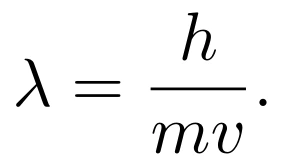
In this notation, h is Planck's constant, m is mass, v is characteristic velocity. At rest energy 2×10⁻²⁰ eV and speed 20 km/s, the own dimensional calculation gives about 30 parsec. If we use the reduced Planck constant, the corresponding scale will be 2π times smaller. Both quantities may appear in the literature, so the definition of length must be checked before comparing numbers.
Wave properties can suppress the formation of small structures. The trace is sought in the spectra of quasars: light passes through intergalactic hydrogen, which leaves many absorption lines. They measure how transmittance changes along the spectrum at different scales and compare it with artificial spectra from models of gas and dark matter. The thermal motion of the gas also smooths out small details, so its history must be determined together with the field properties. The published lower mass bound 2×10⁻²⁰ eV/c2 with 95 percent Bayesian confidence refers to a specific model where the field constitutes all dark matter. A separate calculation is required for a mixture of components. [45]
The same field creates the changing gravitational environment of stars. A system with a small internal velocity spread is called cold here. The almost identical acceleration of all stars changes the motion of the system as a whole and may have almost no effect on this scatter. Differences in acceleration between stars are important for its internal heating. The system's own gravity, the structure of the central region of the field, and the tidal action of neighboring objects determine whether it will expand and survive to this day. Modern calculations show the need to take all these effects into account. [46]
How to check it
For a self-interacting model, two samples can be defined in advance. The first contains small galaxies in which the velocities of gas and stars are measured at different points. Radio observations of neutral hydrogen and optical spectroscopy provide a motion map; imaging and star formation history constrain the contribution of ordinary matter. In the second, there are strong gravitational lenses, in the images of which they look for disturbances from small dark concentrations. To isolate their contributions, the main lens, the background source, and the material along the line of sight are simultaneously modeled.
From the first sample, acceptable parameters of the general scattering law are obtained, and then the number and profiles of detectable disturbances in the second are predicted. The probability of their detection is measured by adding artificial condensations to the image model and repeating the entire search procedure. The age and orbit of an individual halo may be unknown, but the distributions of these quantities must have a general physical basis. The version being tested is rejected if no valid set of parameters reproduces the second sample, taking into account selection and errors. Competing cold matter with the influence of ordinary matter is tested in the same way.
For a wave field, the general parameters are mass and cosmological fraction. The feasible region is first obtained from the quasar spectra along with uncertainties in temperature and gas ionization. Then, for the same parameters, the sizes and internal velocity dispersion of old stellar systems are calculated after evolution in a changing field. Repeated spectroscopy helps to separate the motion of binary stars; Additionally, estimates of age, former compactness, and tidal orbits are needed. The local field density in each object should follow from the same mixed model, and not become a new free means of matching.
A decisive result occurs if the parameters required by one channel are inconsistent with the other under tested uncertainties. The preservation of the old cold system can eliminate the field that was sure to destroy it; the absence of early suppression of structure is a field to which late dynamics attributes too large ripple effects. If the differences lie below the sensitivity, the result will be a map of an area that has not yet been tested. The next computational step here is quite defined: a general model of structure formation and late dynamics with a forecast for data that did not participate in the selection of parameters.
Chapter 7