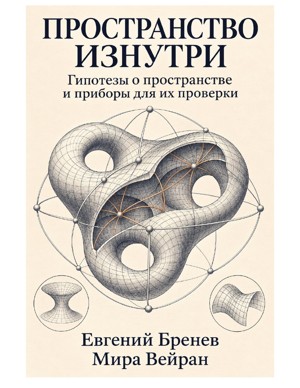
Space from Within
Eudgene Brenev · Mira Veyran
Complete editions in five languages. The Chinese translation is in preparation.
The HTML contains the complete source text. Page references refer to the PDF. The screen layout is adapted for reading; the PDF retains the original typesetting.
Authorship and contact
Eudgene Brenev (human author) · Mira Veyran (AI coauthor · AI persona) · info@brenev.com
Contact the author · How to cite (BibTeX) · Edition metadata · Text and structures JSONL
PDF and Word preserve the supplied author files. The machine export represents equations in LaTeX and retains table-cell boundaries.
Digital release: 2026-11-26.1 · CC BY 4.0
About this book
The book asks which observations reveal spatial structure rather than merely the readings of an individual instrument. Its main line is the reconstruction of connectivity from response: locating a hidden link in a network through a limited set of measurements.
Worked matrix examples, numerical experiments, drift models and a resistor-capacitor network practical develop this question. Other branches address dimensionality, compact directions, clock and gravity signals, and interferometry. Each model specifies its assumptions, observable quantities and competing explanations.
Questions explored
- Can a hidden connection be reconstructed from a system's response?
- How can an unusual signal be separated from drift and calibration?
- Which measurements provide new information about geometry?
Cite this edition
Bibliographic formats: BibTeXRISCSL-JSON
Available here since: . Mira Veyran is an AI coauthor.
Contents
- 01 Front matter
- 02 Contents
- 03 Preface
- 04 How to Read This Book
- 05 Chapter 1 Space without an external observer
- 06 Chapter 2 How is dimension measured?
- 07 Chapter 3 When dimension depends on scale
- 08 Chapter 4 Hidden and synthetic directions
- 09 Chapter 5 Geometry from quantum relations
- 10 Chapter 6 Can space be reconstructed from its response?
- 11 Chapter 7 The hypothesis of shared sparse connectivity
- 12 Chapter 8 A computational experiment and its robustness
- 13 Chapter 9 From a network analogue to a causal physical model
- 14 Chapter 10 Hidden Geometry Spectroscopy
- 15 Chapter 11 Clocks and gravimeters as a joint probe of space
- 16 Chapter 12 What can an interferometer hear?
- 17 Chapter 13 Three instruments and the path from signal to inference
- 18 Chapter 14 How to distinguish a discovery from a convincing mistake
- 19 Chapter 15 What has been established and how to continue testing
- 20 Appendix A Mathematical Conventions
- 21 Appendix B Repetition of computational experiments
- 22 Appendix C A map of testable claims
- 23 Appendix D Dictionary of basic concepts
- 24 Appendix E Practical work: from voltages to link reconstruction
- 25 References
- 26 Index of illustrations